the Creative Commons Attribution 4.0 License.
the Creative Commons Attribution 4.0 License.
 | 30 Sep 2026 | OSR10 | Chapter 3.1
Decadal variability in the Eastern and Western Mediterranean sea level trends
Federica Borile
Vladyslav Lyubartsev
Begoña Pérez Gómez
Jue Lin-Ye
Anna Mangilli
Emanuela Clementi

Paolo Oddo
The Mediterranean Sea, a semi-enclosed basin highly sensitive to climate change, exhibits complex variability in sea level trends with important environmental and societal implications. This study investigates the sea level rise decadal variability from 1993 to 2024 at sub-basin and coastal scales using satellite altimetry, ocean reanalyses, and tide gauges records. In the Western Mediterranean (WMED) sea level decadal trend has recently accelerated, partly driven by thermal expansion that exceeds halosteric contraction, with the remaining contribution likely associated with sea level mass variability. In the Eastern Mediterranean (EMED) sea level transitioned from a regime dominated by halosteric-induced drop to a recent state where steric contributions offset each other, allowing mass variability to dominate. Local trends generally confirm satellite-derived patterns, though larger differences reported in the EMED highlight the influence of regional processes, including vertical land movement. These results confirm that Mediterranean sea level change is non-linear, with decadal variability superimposed on a long-term positive trend, emphasizing the need to account for such fluctuations in regional adaptation strategies and coastal risk management.
- Article
(3039 KB) - Full-text XML
- BibTeX
- EndNote


Sea level rise is a major global concern due to its direct impact on densely populated coastal zones, posing growing challenges for adaptation and risk management (Parmesan et al., 2022). While global mean sea level trends provide an integrated picture, regional sea level change can significantly depart from the global average, especially in semi-enclosed basins, where local processes drive distinct patterns of variability (Calafat et al., 2022; Gräwe et al., 2019; Alothman et al., 2014). The Mediterranean Sea is a prominent example, recognised as a climate change hotspot where environmental and societal risks are closely linked (Tuel and Eltahir, 2020; Cramer et al., 2018; Giorgi, 2006). While regional climate-change driven sea level rise has been already documented (Adloff et al., 2015; Sannino et al., 2022), the goal of this study is to monitor and update, with recent data and products, the decadal variability of Mediterranean sea level changes, which primarily reflects internal climate variability superimposed on the anthropogenic forcing (Calafat et al., 2022).
Decadal sea-level variability in the Mediterranean is mainly controlled by regional atmospheric forcing and steric effects rather than by global mean sea-level signals (Marcos and Tsimplis, 2008): this variability arises from complex interactions between ocean dynamics and external forcing mechanisms that affect the manometric component of sea level (Pinardi et al., 2015; Calafat et al., 2012; Gomis et al., 2008). As a result, the Western and Eastern Mediterranean sub-basins, hereafter referred to as WMED and EMED, exhibit distinct sea-level evolutions (Borile et al., 2025).
The Mediterranean is a concentration basin, with meridional temperature and zonal salinity gradients (Pinardi and Masetti, 2000; Pisano et al., 2020). The interplay between temperature and salinity is thus expected to have an influence on total sea level trends in the region, in contrast to the global ocean where thermal expansion dominates (IPCC, 2023; Milne et al., 2009). Such a process has been analysed at the basin scale, with haline contraction counteracting the effect of ocean warming on sea level (Meli et al., 2023); this work further explores their decadal interplay supporting the interpretation of past sea level variability and the improvement of future projections in the Mediterranean.
Sea level variations at the basin scale also affect coastal areas, where regional ocean processes, human activities, and vertical land movements (Buzzanga et al., 2023) modulate local impacts on coastal communities (Cramer et al., 2018; MedECC, 2024). Building on previous basin-scale assessments, this study investigates Mediterranean decadal sea level trends at both regional and coastal scales, extending the analysis to the coastal domain and supporting decision-making relevant to coastal risk management on decadal timescales.
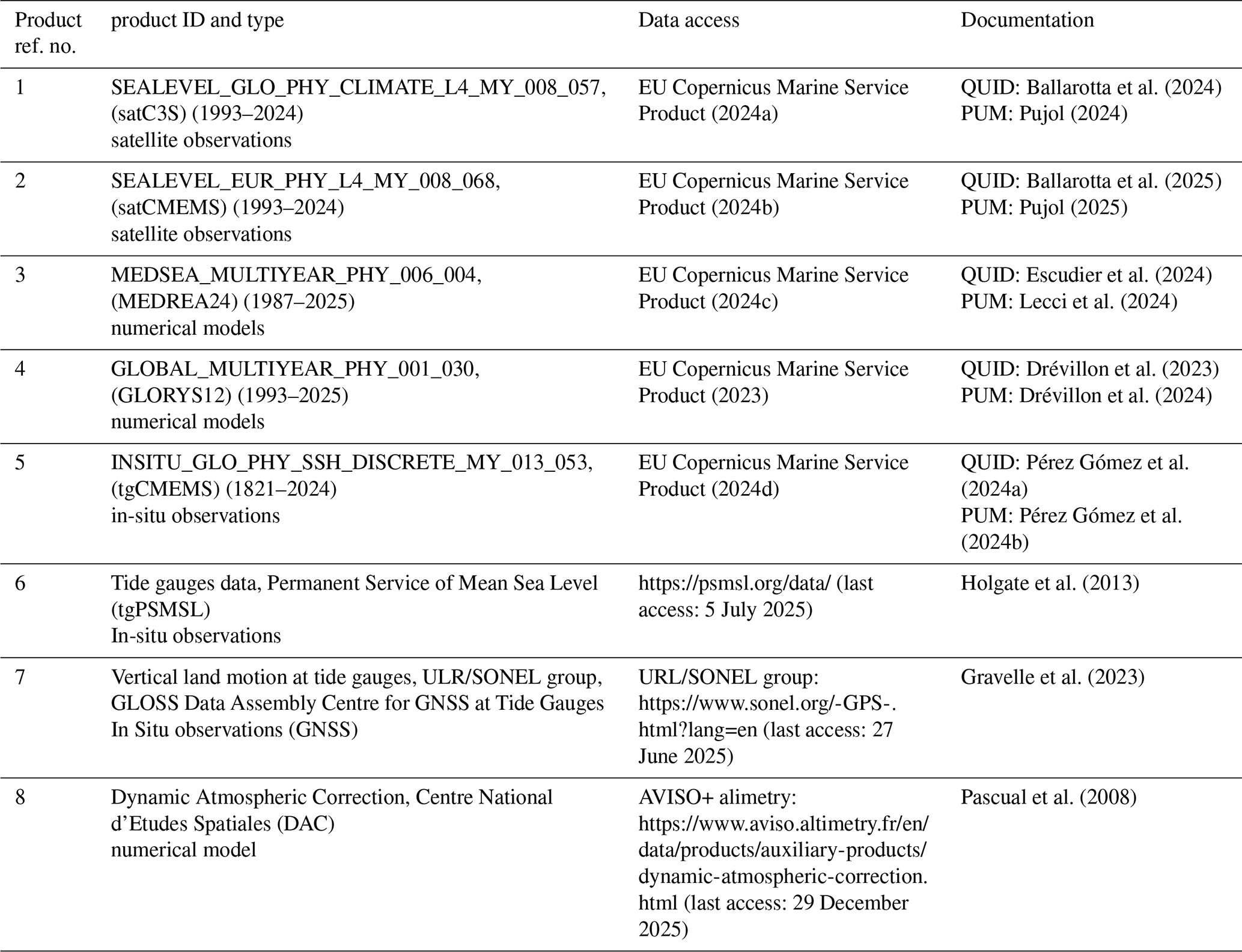
Daily sea level anomaly (SLA) data from two satellite altimetry products covering 1993–2024 are analysed to compute decadal trends in the Mediterranean Sea. The satC3S dataset (product ref. no. 1, in Table 1) is a global gridded product at ° spatial resolution designed for climate applications, ensuring long-term stability of mean sea level estimates by relying on a consistent set of two satellite missions (Dibarboure et al., 2011; Pascual et al., 2006). The satCMEMS dataset (product ref. no. 2, in Table 1) includes all available satellite missions and provides higher spatial resolution of ° over European seas. Both datasets are affected by an uncorrected instrumental drift of the TOPEX-A mission until February 1999; since this correction is not yet available in the current release of either dataset, results involving the 1993–1999 period should be interpreted with caution. Glacial isostatic adjustment (GIA) correction is not applied, as regional estimates report small and time-independent rates that do not affect interdecadal variability within the uncertainty of our decadal trend estimates (Spada and Melini, 2022).
For the sub-basin analysis, SLA data are spatially averaged over the WMED and EMED, bounded at the Sicily Strait along a zonal transect at 37° N. Time series are then analysed following the methodology of Borile et al. (2025), and here summarized: the daily seasonal cycle over the 2000–2023 period is subtracted to obtain de-seasoned SLA, and a low-pass filter is applied to isolate long-term fluctuations. Decadal trends are then computed using 10-year-long sliding windows shifted monthly and fitted with the Theil–Sen estimator (Theil, 1992; Sen, 1968), which is a non-parametric method more robust to outliers than traditional linear regression, but does not allow for the acceleration estimate. Finally, trend uncertainty is assessed using a stationary bootstrap with 1000 resamples to account for temporal autocorrelation (Patton et al., 2009; Politis and Romano, 1994).
The same approach is used to evaluate the decadal trend associated with thermosteric (ηT) and halosteric (ηH) sea level components, whose sum defines the total steric sea level (ηS):
where Tf and Sf are reference temperature and salinity values, α and β are constant linear coefficients of thermal expansion and haline contraction, and H is the spatially varying ocean depth. Both reference values and steric coefficients are taken as spatially constant basin-mean values, consistent with previous studies and suitable for a basin-averaged steric sea level analysis (Borile et al., 2025; Pinardi et al., 2014). The proposed formulation (1) is based on a simplification of the non-linear equation of state, enabling the separation of thermosteric and halosteric sea level contributions. Although this linear approximation introduces region-dependent differences, these are consistent with uncertainties in model temperature and salinity fields, supporting its use for the present analysis.
The steric sea level is estimated using daily temperature and salinity data from the regional MEDREA24 and the global GLORYS12 ocean reanalyses (products ref. no. 3 and 4, in Table 1), with horizontal resolutions of and ° respectively (Escudier et al., 2021; Lellouche et al., 2021).
To assess the reliability of satellite-derived sea level trends at the local scale, we analyse mean sea level records from tide gauges of the tgCMEMS and tgPSMSL datasets (products ref. no. 5 and 6, in Table 1). Data from tgPSMSL refer to a common Revised Local Reference (RLR) datum, as recommended for long-term analysis. Similarly, tgCMEMS data are selected based on good quality checks to detect significant datum changes. The tgPSMSL serves as the Global Sea Level Observing System (GLOSS) Data Assembly Center for monthly mean sea level records from tide gauges (Holgate et al., 2013): relying mostly on national providers for quality control, this dataset has been central to IPCC assessments of sea level rise based on in-situ observations (Oppenheimer et al., 2019). On the contrary, tgCMEMS provides centrally validated, delayed-mode sea level data derived from near-real-time observations at hourly resolution (Lin-Ye et al., 2023). Both the tgPSMSL and tgCMEMS datasets were considered, as they may include different sets of stations. In both cases, stations are selected based on record length and data completeness; short data gaps are linearly interpolated, and hourly records are averaged to daily values to match the temporal resolution of SLA data.
Where available, preference is given to stations located nearby GNSS (Global Navigation Satellite System) sensors to allow vertical land movement (VLM) correction, using trend values provided by URL/SONEL data server, ULR7 solution (product ref. no. 7, in Table 1). The ULR7 solution provides vertical velocity estimates in the ITRF2014 (International Terrestrial Reference System) frame (Gravelle et al., 2023). Accordingly, absolute sea level trends at tide gauge locations are computed by adding the VLM rate to the relative sea level trend derived from tide gauge records (Santamaría-Gómez et al., 2012).
Finally, for direct comparison between satellite and in-situ observations, satC3S SLA values are extracted at the grid point closest to each tide gauge. Differences in reference frame and high-frequency signal treatment are minimized by reintroducing the dynamic atmospheric correction (DAC) into altimetry data and applying VLM corrections to tide gauge records. The DAC is taken from the CLS product, based on the Mog2D model and distributed by Aviso+ with support from CNES (product ref. no. 8, in Table 1; Pascual et al., 2008). Overall, these processing choices aim to reduce methodological inconsistencies while acknowledging that satellite altimetry and tide gauges sample sea level variability at different spatial and temporal scales, and therefore provide complementary, rather than strictly equivalent, information.
3.1 Decadal trend at the sub-basin scale
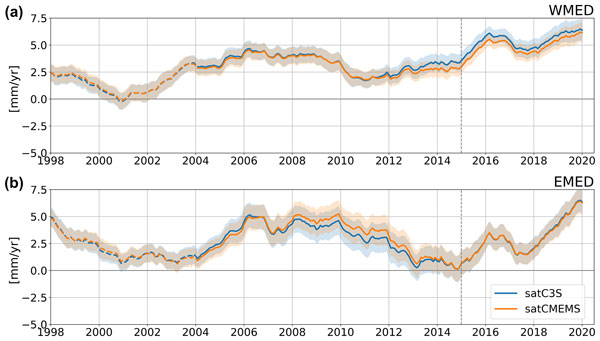
The evolution of the sea level decadal trend over the WMED and EMED regions is presented in Fig. 1, based on satC3S and satCMEMS. Each point represents the trend over the decade centered on that date (e.g., the value reported for January 2005 corresponds to the period January 2000–December 2009). Both sub-basins exhibit a decadal variability, with positive sea level trends ranging from negligible values up to 6.4 ± 1.0 mm yr−1, and two periods of relative slowdown (around 2001 and 2011 in WMED, and 2002 and 2014 in EMED). It is worth noting that satCMEMS generally agrees with satC3S within the associated uncertainty, though the latter is preferred for long-term consistency (Dibarboure et al., 2011). At basin scale, variability is strongly influenced by the sea level mass component, which reflects the large-scale balance between surface freshwater fluxes and boundary volume transports. Recent studies quantify this contribution over the Mediterranean basin as the residual of large but compensating terms, resulting in a basin-mean sea level contribution of about +8 mm yr−1 over 1993–2022, similar to the observed sea level trend from altimetry data (Borile et al., 2025; García-García et al., 2022). Because mass contribution may be highly localized in time and space, its effect on sea level emerges primarily through integration over large domains, shaping the basin-averaged signal rather than local sea level variations.
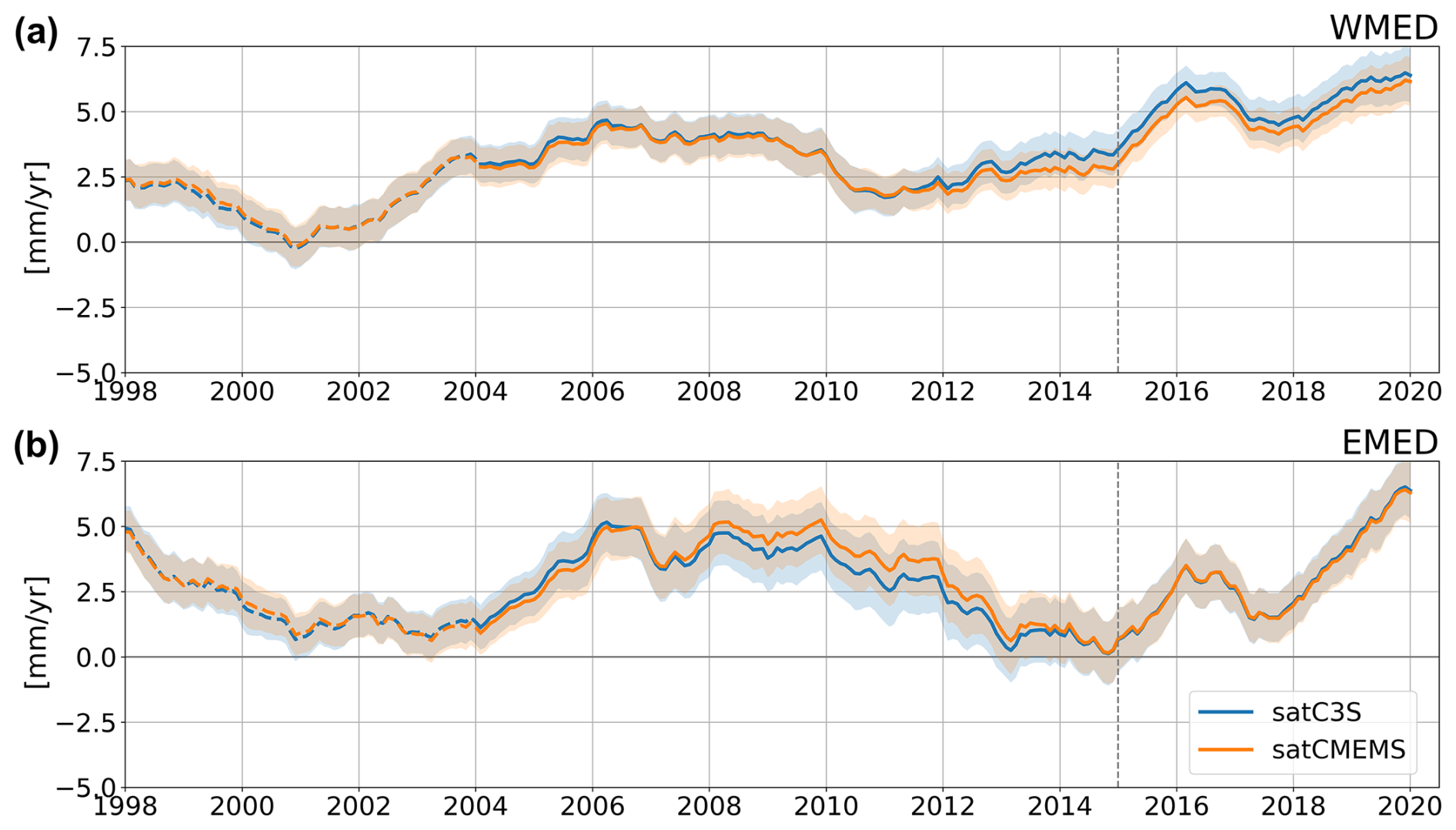
Figure 1Time series of de-seasoned SLA decadal trend values computed over sliding windows shifted by one month across the period 1993–2024 in the WMED (a) and EMED (b). Dashed lines indicate trends computed over windows that partially include the period affected by the uncorrected TOPEX-A drift, when data should be interpreted with caution. Shaded areas represent the trend uncertainty, defined as the standard deviation of the residuals from the bootstrap procedure. The vertical dashed line at January 2015 marks the starting point of tide gauges analysis shown in Fig. 4.
Focusing on the steric contribution to sea level change, Fig. 2 shows the thermosteric and halosteric components of the mean sea level decadal trend. The concept of steric compensation in the Mediterranean Sea arises from the opposing behaviour of these two components: the thermosteric trend is positive and driven by seawater thermal expansion, while the halosteric contribution is negative and associated with the observed salinity increase. Observational evidence of these processes has been reported at local and basin scales, affecting coastal and deep regions. Recent studies document a general warming and salinification of the Mediterranean (Aydogdu et al., 2023; Kubin et al., 2023; Borghini et al., 2014), alongside regional contrasts in the EMED, such as Ionian freshening and Levantine salinification (Grodsky et al., 2019). Together, these observations highlight the direct link between steric sea level components and changes in underlying thermohaline properties.
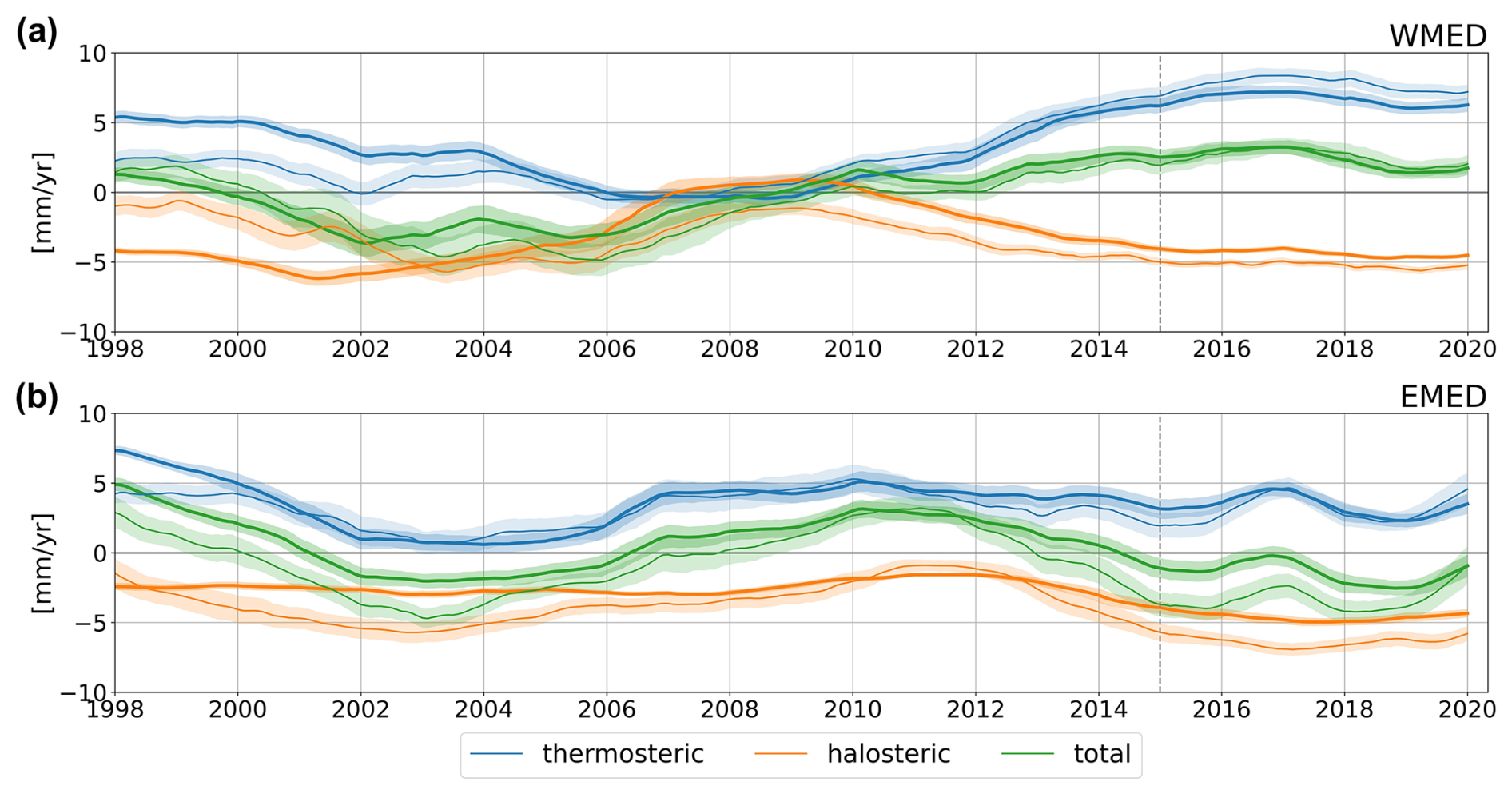
Figure 2Time series of decadal trend associated to the de-seasoned total steric sea level (ηS), and its thermosteric (ηT) and halosteric (ηH) components, computed over sliding windows shifted by one month across the period 1993–2024 in the WMED (a) and EMED (b). Different datasets are shown: MEDREA24 (thick lines) and GLORYS12 (thin lines). Shaded areas represent the trend uncertainty, defined as the standard deviation of the residuals from the bootstrap procedure. The vertical dashed line at January 2015 marks the starting point of tide gauges analysis shown in Fig. 4.
Although the steric components play a relatively minor role in the long-term mean sea level budget of the Mediterranean compared to mass-driven contributions (Pinardi et al., 2014), their decadal variability can reach amplitudes comparable to the observed sea level trends. This highlights the importance of accounting for steric processes, together with surface fluxes and boundary transports, to better understand the mechanisms governing the mean sea level change (Borile et al., 2025; Cazenave et al., 2014).
In the WMED (Fig. 1a), neglecting the 1993-1999 period due to the uncorrected TOPEX-A drift, the measured decadal trend increased from 3.0 ± 0.7 to 6.4 ± 1.0 mm yr−1. A temporary slowdown is observed in the decades around 2011, coinciding with a phase during which the combined effect of thermosteric and halosteric components shifts from significantly contributing to sea level trend to becoming nearly neutral (Fig. 2a). Indeed, in both MEDREA24 and GLORYS12, this period marks a transition between two different regimes: before the decade centered in 2009, the steric contribution dampens the total sea level rise, afterward it contributes positively. Accordingly, the increasing decadal trend reported by satC3S is supported by thermal expansion that exceeds haline contraction, consistent with reported sea surface temperature increases and long-term warming trends in the region (Pastor et al., 2018; Pisano et al., 2020).
On the other side of the Sicily Strait, the EMED trend (Fig. 1b) exhibits greater temporal variability compared to the WMED, without a clear increasing value over the entire analysed period. Two periods of negligible trends are observed around the decades centered in 2002 and 2014, separated by a rapid trend increase followed by a smoother slowdown. After the decade centered in 2015 the trend value increases again, showing an almost constant acceleration after 2018 and reaching a peak of 6.4 ± 1.1 mm yr−1 in the latest decade. Notably, while WMED and EMED currently experience similar rates of sea level rise, the EMED exhibits a much sharper acceleration.
The steric components in the EMED (Fig. 2b) help explain this behaviour: halosteric contraction persisted throughout the period, with a strengthening negative trend observed from the decade centered in 2014 onward, while thermal expansion has remained relatively stable since 2007, after a period of minimal contribution centered around 2004. The combined effect of these two components caused the total steric contribution to alternate between negative and positive trend values. In the most recent decadal windows (centered from 2015 onward), the observed EMED sea level trend increases as the total steric component's negative contribution weakens approaching negligible values, as shown in both MEDREA24 and GLORYS12. These features are consistent with documented changes in thermohaline properties of deep waters in the Adriatic–Ionian system, including recent variations in both thermosteric and halosteric contributions and associated salinization signals (Terzić et al., 2025), as well as with broader EMED variability patterns (Mohamed and Skliris, 2022).
Table 2Summary of the mean decadal sea level trend values derived from Figs. 1 and 2 and computed for decades centered between 2004 and 2020, thus excluding the period affected by the uncorrected TOPEX-A drift. All values are reported in mm yr−1.

Therefore, while WMED shows an increasing mean sea level trend over the long period, the EMED is characterized by a pronounced quasi-decadal variability that tends to mask any linear acceleration (mean trend values are reported in Table 2). The different variability is connected to large-scale circulation changes occurred in the two sub-basins, with a key contribution related to the Adriatic-Ionian Bimodal Oscillating System (BiOS, Civitarese et al., 2023; Gačić et al., 2010). Although originating in a relatively confined region, the BiOS appears sufficiently strong to influence steric sea level variability across the entire EMED (substantial correlation between decadal trend and BiOS variability, r = 0.61), consistent with previous findings (e.g. Meli et al., 2023; Civitarese et al., 2023; Meli, 2024), but not to impact the WMED behaviour (with no correlation between decadal trend and BiOS variability, r = −0.06).
3.2 Decadal trend on coastal areas
To identify the regions where sea level rise has the greatest impact on human activities, we analyse sea level data close to the coast. The accuracy of altimetry data in coastal zones is a known challenge due to land contamination on satellite measurements and small-scale dynamical processes that affect the sea level variability (Vignudelli et al., 2019; Cipollini et al., 2017). Therefore, in-situ data are crucial to validate the altimetry performance.
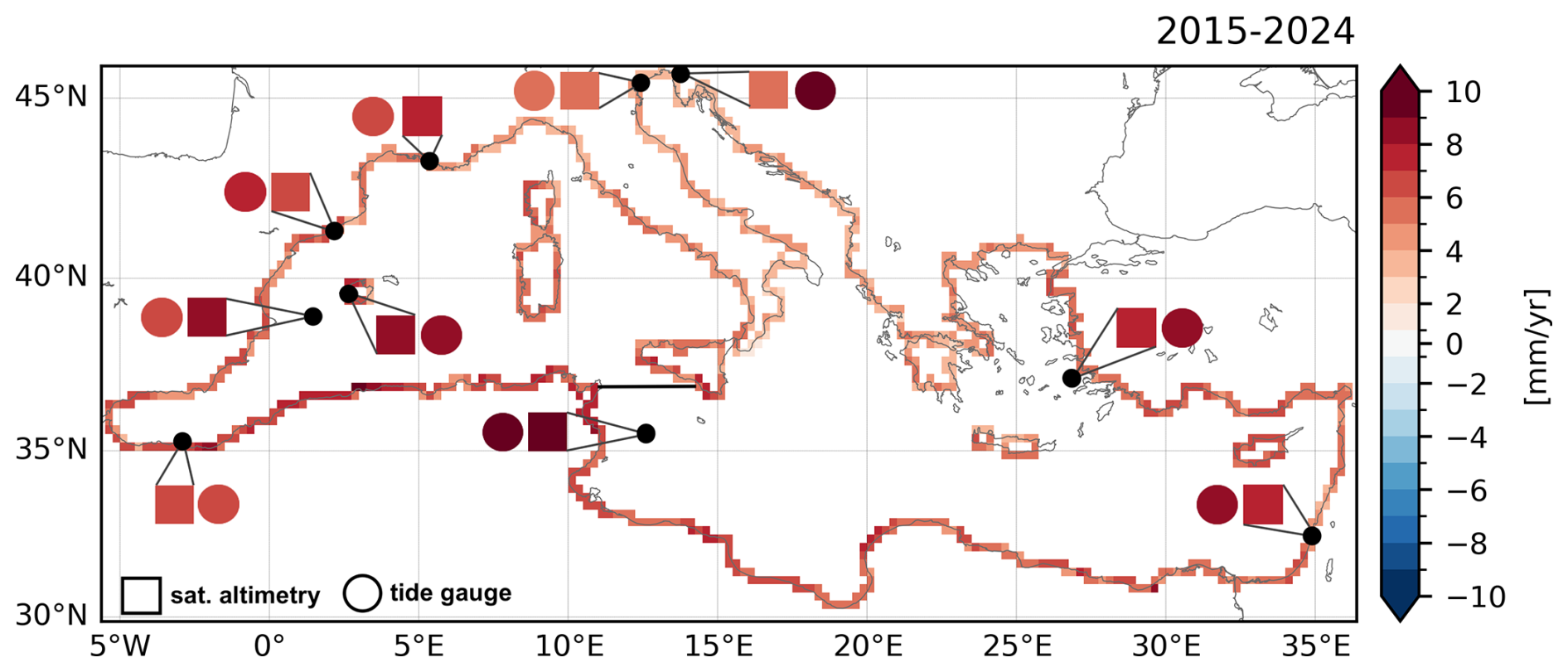
Figure 3Map of decadal sea level trends computed at coastal points from the satC3S dataset for the 2015–2024 period. This decade is the most recent available for comparing decadal trends from satC3S altimetry (where DAC has been reintroduced), with in-situ observations from tgCMEMS and tgPSMSL, adjusted for VLM. Each black dot indicates the location of a tide gauge discussed in the text. Satellite and tide gauge-derived trends at the same sites are shown as squares and circles, respectively, and are coloured according to the colorbar (values reported in Table 3). The thin black line corresponds to the zonal transect used to define the boundary between WMED and EMED at 37° N.
Table 3Sea level trends near selected coastal cities for the most recent available decade (2015–2024) derived from different datasets: satC3S (with DAC reintroduced), tgCMEMS and tgPSMSL. The VLM trend, with the distance between each tide gauge and its associated GNSS station indicated in brackets, should be added to the in-situ relative sea level trend to allow comparison with the satC3S absolute sea level trend (see Fig. 3). The resulting trend difference is reported in the last column. When both tide gauge datasets are available, tgCMEMS data are used. All trend values are reported in mm yr−1.
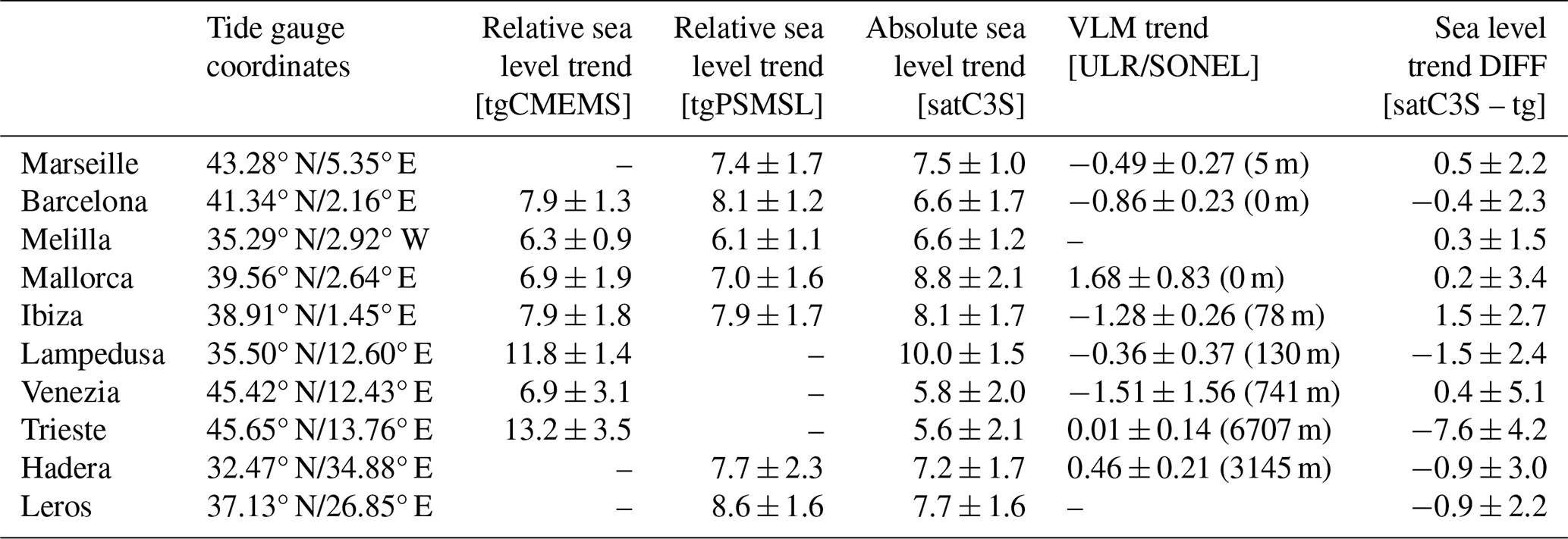
Figure 3 presents the coastal decadal trend from satC3S, computed over the period 2015–2024 to enable direct comparison with the most recent tide gauge observations from tgCMEMS and tgPSMSL. A general lack of in-situ measurements characterizes the EMED compared to the WMED, with most tide gauges located along the Spanish and French coasts (Pérez Gómez et al., 2022). Nevertheless, despite the coarse resolution of satC3S (grid cell area is ∼ 600 km2), a good agreement is observed between altimetry and tide gauges trends within the estimated uncertainties (Table 3). Larger discrepancies are mainly observed in Trieste, where the in-situ trend from tgCMEMS is double that of the altimetry-based estimate, highlighting the influence of local processes on sea level variability that may not be captured by satellite observations.
At the basin scale, the spatial distribution of trends from satC3S is quite homogeneous, with positive values across most of the Mediterranean coastal areas. Trends exceeding 8 mm yr−1 are reported in the WMED, particularly along the Algerian coast, the Balearic Islands, and the western coasts of Sardinia and Corsica. Weaker trends are observed in the Adriatic and Aegean Seas, with the Adriatic showing values below 3 mm yr−1. Notably, marginal seas display a rapid shift of regime compared to the trend computed for the period 2013–2022 in Borile et al. (2025), where negative values were previously reported. This behaviour aligns with the sharp trend increase recently observed at the EMED basin scale.
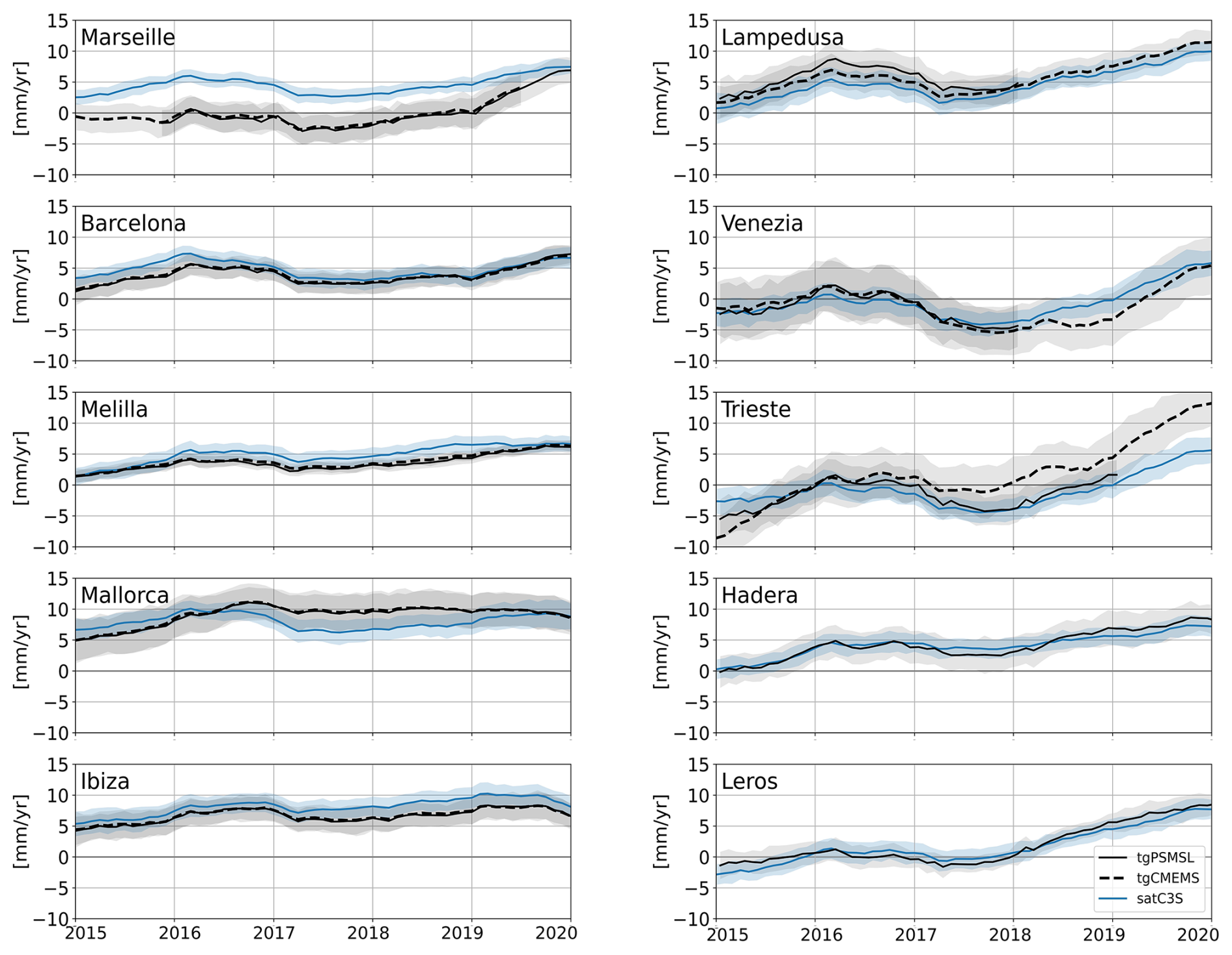
Figure 4Time series of decadal sea level trends computed nearby coastal cities, using tide gauges data from tgCMEMS, tgPSMSL, and satellite data from satC3S. For a direct comparison between satellite and in-situ data, the VLM trend is added to the relative sea level trend derived from tide gauge records, while DAC is reintroduced to satC3S altimetry. Trends are computed over sliding windows shifted monthly across the period 2010–2024; where tgCMEMS data are not available (Hadera and Leros), only tgPSMSL data are analysed. Shaded areas represent the associated uncertainty, defined as the standard deviation of the residuals from the bootstrap procedure.
Figure 4 compares decadal trend time series of absolute sea level from altimetry and tide gauges, focusing on the period from 2010 onward to reduce data gaps and ensure overlap with GNSS-based VLM correction. It is worth noting that the correspondence between coastal sea level trends and steric sea level changes is not persistent everywhere and over time, and may become significant only during specific periods, depending on the dominant local forcing mechanisms (Tsimplis and Rixen, 2002).
In the WMED, data from Melilla, Barcelona, Ibiza, Palma de Mallorca and Marseille all show a gradually increasing decadal trend consistent with the basin-scale evolution. Notably, the time series derived from tgCMEMS and tgPSMSL largely overlap, with only minor differences likely attributed to the distinct preprocessing filters applied in each dataset.
In Barcelona and Melilla, the trend increased steadily from ∼ 1 to over 5 mm yr−1. In contrast, Marseille experienced a slightly negative trend until the decade centered in 2019, after which it became positive and aligned with the altimetry trend.
Ibiza and Palma de Mallorca show trends persistently above 5 mm yr−1, though with less pronounced increase over time.
Particularly in Palma de Mallorca, a shift of only two years in the decadal analysis window leads to a doubling of the estimated trend and remained nearly stable afterward. In this case, it is worth noting that the perceived sea level rise is partially dampened by local positive VLM (Table 3).
All WMED stations show a relative maximum trend around the decades centered between 2016 and 2017, consistent with the basin-scale signal. This feature is even more pronounced at tide gauges stations located in the EMED, such as Lampedusa, Leros, Hadera, Venezia and Trieste, where a marked slowdown follows the observed peak. However, the limited availability of data in this region often limits the possibility of a comparison between tgCMEMS and tgPSMSL.
Trieste is the only station where satC3S and tgCMEMS provide decadal trend estimates that differ beyond the uncertainty bounds, likely due to local effects not captured by altimetry. Nevertheless, both datasets capture a transition from negative to positive trends in the most recent period. The case of Venezia is similar, though more complex due to the city's geographical setting and the socio-economic implications of sea level changes (Zanchettin et al., 2021). Here, a minimum trend of −5.3 ± 3.7 mm yr−1 is reported for the decade centered around 2018, which has recently turned positive according to tgCMEMS. A similar pattern is also observed in Leros, in the Aegean Sea, where the trend remains negligible until the decade centered in 2018, followed by a sharp acceleration in the most recent period.
By contrast, tide gauges outside the marginal seas show consistently positive trends exceeding the uncertainty bounds. At Lampedusa, in the Sicily Strait, the local trend increased sharply after the slowdown, rising from 2.6 ± 2.3 to nearly 10 mm yr−1. In Hadera, along the Israeli coast, the trend shows a more gradual acceleration persisting throughout the entire analysed period.
This study provides an assessment of decadal sea level trends in the Mediterranean Sea, emphasizing both regional-scale and coastal-scale variability. The results confirm that sea level rise in the basin is not a linear process but exhibits significant decadal fluctuations due to a complex interplay between mass and steric sea level components (Pinardi et al., 2015; García-García et al., 2022; Meli et al., 2023) connected to large-scale circulation changes (Gačić et al., 2010), which reflect internal climate variability.
In the Western Mediterranean (WMED), a sea level acceleration has been observed since the early 2000s, partially sustained by thermal expansion that exceeds haline contraction (Pisano et al., 2020). In contrast, the Eastern Mediterranean (EMED) displays stronger temporal variability, with halosteric contraction playing a major counterbalancing role (Meli et al., 2023; Borghini et al., 2014) correlated to the Adriatic-Ionian Bimodal Oscillating System mechanism (Civitarese et al., 2023). This regional modulation is conceptually analogous to the influence of the El Niño-Southern Oscillation (ENSO) on global mean sea level variability (Nerem et al., 2010), though ENSO is more strongly linked to mass-driven fluctuations (Cazenave et al., 2012).
Only in recent years the EMED reached a comparable rate of sea level rise to the WMED, largely due to a weakening of the overall steric contribution. While this study has focused on the steric component, also the mass component, associated with surface water budget variations and exchanges through the Straits, remains a key factor influencing Mediterranean sea level changes on decadal timescales (Borile et al., 2025). A full interpretation of decadal variability requires a comprehensive perspective that accounts for both contributions, therefore future efforts integrating these components will be essential to achieve a complete understanding of basin sea level evolution.
At the coastal level, altimetry trends are generally consistent with tide gauge observations in the WMED, while larger uncertainties persist in the EMED, underscoring the need for improved in-situ monitoring networks and data sharing, including vertical land movement estimations as a relevant contribution to local effects (Buzzanga et al., 2023; Cramer et al., 2018). The observed reversal of trends in marginal seas such as the Adriatic and Aegean suggests that localized processes, including vertical land motion and regional circulation anomalies, can rapidly alter coastal sea level evolution.
Our findings highlight the decadal variability range of coastal sea level trends in the Mediterranean, indicating that local sea level evolution may temporarily depart from long-term mean trajectories due to regional processes. Such variability, however, should be interpreted as a component of Mediterranean sea level dynamics, superimposed on the long-term mean sea level rise that ultimately drives adaptation needs.
The publicly available datasets analyzed in this study are referenced in Table 1. Codes used to perform the analysis are available on the Zenodo Repository at: https://doi.org/10.5281/zenodo.20284500 (Borile, 2026).
FB, EC, and PO contributed to the conceptualization, methodology, and analysis. FB, VL, BGP, and JLY were responsible for data curation and organization, with AM contributing to data resources. FB and VL performed software development, formal analysis, investigation, and visualization, while AM, BGP and JLY contributed to data investigation. EC was responsible for funding acquisition, and PO supervised the study. FB prepared the original draft of the manuscript, with contributions from all co-authors in the editing and reviewing.
The contact author has declared that none of the authors has any competing interests.
The Copernicus Marine Service offering is regularly updated to ensure it remains at the forefront of user requirements. In this process, some products may undergo replacement or renaming, leading to the removal of certain product IDs from the catalogue. If readers have any questions or require assistance regarding these modifications, please feel free to reach out to the Copernicus Marine Service user support team for further guidance. They will be able to provide the necessary information to address concerns and find suitable alternatives.
Publisher's note: Copernicus Publications remains neutral with regard to jurisdictional claims made in the text, published maps, institutional affiliations, or any other geographical representation in this paper. The authors bear the ultimate responsibility for providing appropriate place names. Views expressed in the text are those of the authors and do not necessarily reflect the views of the publisher.
The authors gratefully acknowledge Nadia Pinardi for her insightful interpretation of the various factors driving decadal variability in the Mediterranean Sea. They thank the Copernicus Sea Level TAC and In Situ TAC teams for the valuable discussions that supported the interpretation of data during the preparation of this manuscript. They also acknowledge the constructive comments and suggestions provided by reviewers, which significantly helped to improve the clarity and quality of the manuscript.
This research was funded by the Copernicus Marine Service for the Mediterranean Sea Monitoring and Forecasting Centre (contract no. 2425L05-COP-MFC MED-5500). The study was also carried out within the RETURN Extended Partnership and received funding from the European Union Next-Generation EU (National Recovery and Resilience Plan – NRRP, Mission 4, Component 2, Investment 1.3 – D.D. 1243 2/8/2022, PE0000005).
This paper was edited by Pierre-Marie Poulain and reviewed by Francisco Mir Calafat and two anonymous referees.
Adloff, F., Somot, S., Sevault, F., Jordà, G., Aznar, R., Déqué, M., Herrmann, M., Marcos, M., Dubois, C., Padorno, E., Alvarez-Fanjul, E., and Gomis, D.: Mediterranean Sea response to climate change in an ensemble of twenty first century scenarios, Clim. Dyn., 45, 2775–2802, https://doi.org/10.1007/s00382-015-2507-3, 2015.
Alothman, A. O., Bos, M. S., Fernandes, R. M. S., and Ayhan, M. E.: Sea level rise in the north-western part of the Arabian Gulf, J. Geodyn., 81, 105–110, https://doi.org/10.1016/j.jog.2014.09.002, 2014.
Aydogdu, A., Miraglio, P., Escudier, R., Clementi, E., and Masina, S.: The dynamical role of upper layer salinity in the Mediterranean Sea, in: 7th edition of the Copernicus Ocean State Report (OSR7), edited by: von Schuckmann, K., Moreira, L., Le Traon, P.-Y., Grégoire, M., Marcos, M., Staneva, J., Brasseur, P., Garric, G., Lionello, P., Karstensen, J., and Neukermans, G., Copernicus Publications, State Planet, 1-osr7, 6, https://doi.org/10.5194/sp-1-osr7-6-2023, 2023.
Ballarotta, M., Pujol, M. I., and SL-TAC team: EU Copernicus Marine Service Quality Information Document for the Global Ocean Gridded L 4 Sea Surface Heights And Derived Variables Reprocessed Copernicus Climate Service, SEALEVEL_GLO_PHY_CLIMATE_L4_MY_008_057, issue 3.0, Mercator Ocean International, https://documentation.marine.copernicus.eu/QUID/CMEMS-SL-QUID-008-057.pdf (last access: 30 October 2025), 2024.
Ballarotta, M., Pujol, M. I., and SL-TAC team: EU Copernicus Marine Service Quality Information Document for the European Seas Gridded L 4 Sea Surface Heights And Derived Variables Reprocessed 1993 Ongoing, SEALEVEL_EUR_PHY_L4_MY_008_068, issue 13.0, Mercator Ocean International, https://documentation.marine.copernicus.eu/QUID/CMEMS-SL-QUID-008-032-068.pdf (last access: 30 October 2025), 2025.
Borghini, M., Bryden, H., Schroeder, K., Sparnocchia, S., and Vetrano, A.: The Mediterranean is becoming saltier, Ocean Sci., 10, 693–700, https://doi.org/10.5194/os-10-693-2014, 2014.
Borile, F.: Codes used in the Ocean State Report #10 contribution titled “Decadal variability in the Eastern and Western Mediterranean sea level trends”, in: State of the Planet (v0.0), Zenodo [code], https://doi.org/10.5281/zenodo.20284500, 2026.
Borile, F., Pinardi, N., Lyubartsev, V., Ghani, M. H., Navarra, A., Alessandri, J., Clementi, E., Coppini, G., Mentaschi, L., Verri, G., da Costa, V. S., Scoccimarro, E., Misurale, F., Novellino, A., and Oddo, P.: The Eastern Mediterranean Sea mean sea level decadal slowdown: the effects of the water budget, Front. Clim., 7, https://doi.org/10.3389/fclim.2025.1472731, 2025.
Buzzanga, B., Bekaert, D. P. S., Hamlington, B. D., Kopp, R. E., Govorcin, M., and Miller, K. G.: Localized uplift, widespread subsidence, and implications for sea level rise in the New York City metropolitan area, Sci. Adv., 9, eadi8259, https://doi.org/10.1126/sciadv.adi8259, 2023.
Calafat, F. M., Chambers, D. P., and Tsimplis, M. N.: Mechanisms of decadal sea level variability in the eastern North Atlantic and the Mediterranean Sea, J. Geophys. Res.-Oceans, 117, https://doi.org/10.1029/2012JC008285, 2012.
Calafat, F. M., Frederikse, T., and Horsburgh, K.: The Sources of Sea-Level Changes in the Mediterranean Sea Since 1960, J. Geophys. Res.-Oceans, 127, e2022JC019061, https://doi.org/10.1029/2022JC019061, 2022.
Cazenave, A., Henry, O., Munier, S., Delcroix, T., Gordon, A. L., Meyssignac, B., Llovel, H., Palanisamy, H., and Becker, M.: Estimating ENSO Influence on the Global Mean Sea Level, 1993–2010, Mar. Geod., 35, 82–97 https://doi.org/10.1080/01490419.2012.718209, 2012.
Cazenave, A., Dieng, H.-B., Meyssignac, B., von Schuckmann, K., Decharme, B., and Berthier, E.: The rate of sea-level rise, Nat. Clim. Change, 4, 358–361, https://doi.org/10.1038/nclimate2159, 2014.
Cipollini, P., Calafat, F. M., Jevrejeva, S., Melet, A., and Prandi, P.: Monitoring Sea Level in the Coastal Zone with Satellite Altimetry and Tide Gauges, in: Integrative Study of the Mean Sea Level and Its Components, edited by: Cazenave, A., Champollion, N., Paul, F., and Benveniste, J., Springer International Publishing, Cham, 35–59, https://doi.org/10.1007/978-3-319-56490-6_3, 2017.
Civitarese, G., Gačić, M., Batistić, M., Bensi, M., Cardin, V., Dulčić, J., Garić, R., and Menna, M.: The BiOS mechanism: History, theory, implications, Prog. Oceanogr., 216, 103056, https://doi.org/10.1016/j.pocean.2023.103056, 2023.
Cramer, W., Guiot, J., Fader, M., Garrabou, J., Gattuso, J.-P., Iglesias, A., Lange, M. A., Lionello, P., Llasat, M. C., Paz, S., Peñuelas, J., Snoussi, M., Toreti, A., Tsimplis, M. N., and Xoplaki, E.: Climate change and interconnected risks to sustainable development in the Mediterranean, Nat. Clim. Change, 8, 972–980, https://doi.org/10.1038/s41558-018-0299-2, 2018.
Dibarboure, G., Pujol, M.-I., Briol, F., Traon, P. Y. L., Larnicol, G., Picot, N., Mertz, F., and Ablain, M.: Jason-2 in DUACS: Updated System Description, First Tandem Results and Impact on Processing and Products, Mar. Geod., 34, 214–241, https://doi.org/10.1080/01490419.2011.584826, 2011.
Drévillon, M., Lellouche, J. M., Régnier, C., Garric, G., Bricaud, C., Hernandez, O., and Bourdallé-Badie, R.: EU Copernicus Marine Service Quality Information Document for the Global Ocean Physics Reanalysis, GLOBAL_MULTIYEAR_PHY_001_030, issue 1.6, Mercator Ocean International, https://documentation.marine.copernicus.eu/QUID/CMEMS-GLO-QUID-001-030.pdf (last access: 5 July 2025), 2023.
Drévillon, M., Fernandez, E., and Lellouche, J. M.: EU Copernicus Marine Service Product User Manual for the Global Ocean Physics Reanalysis, GLOBAL_MULTIYEAR_PHY_001_030, issue 1.6, Mercator Ocean International, https://documentation.marine.copernicus.eu/PUM/CMEMS-GLO-PUM-001-030.pdf (last access: 5 July 2025), 2024.
Escudier, R., Clementi, E., Cipollone, A., Pistoia, J., Drudi, M., Grandi, A., Lyubartsev, V., Lecci, R., Aydogdu, A., Delrosso, D., Omar, M., Masina, S., Coppini, G., and Pinardi, N.: A High Resolution Reanalysis for the Mediterranean Sea, Front. Earth Sci., 9, https://doi.org/10.3389/feart.2021.702285, 2021.
Escudier, R., Clementi, E., Nigam, T., Aydogdu, A., Fini, E., Pistoia, J., Grandi, A., and Miraglio, P.: EU Copernicus Marine Service Quality Information Document for the Mediterranean Sea Physics Reanalysis, MEDSEA_MULTIYEAR_PHY_006_004, issue 2.4, Mercator Ocean International, https://documentation.marine.copernicus.eu/QUID/CMEMS-MED-QUID-006-004.pdf (last access: 5 July 2025), 2024.
EU Copernicus Marine Service Product: Global Ocean Physics Reanalysis, Mercator Ocean International [data set], https://doi.org/10.48670/moi-00021, 2023.
EU Copernicus Marine Service Product: Global Ocean Gridded L 4 Sea Surface Heights And Derived Variables Reprocessed Copernicus Climate Service, Mercator Ocean International [data set], https://doi.org/10.48670/moi-00145, 2024a.
EU Copernicus Marine Service Product: European Seas Gridded L 4 Sea Surface Heights And Derived Variables Reprocessed 1993 Ongoing, Mercator Ocean International [data set], https://doi.org/10.48670/moi-00141, 2024b.
EU Copernicus Marine Service Product: Mediterranean Sea Physics Reanalysis, Mercator Ocean International [data set], https://doi.org/10.25423/CMCC/MEDSEA_MULTIYEAR_PHY_006_004_E3R1, 2024c.
EU Copernicus Marine Service Product: Global Ocean - Delayed Mode Sea level product, Mercator Ocean International [data set], https://doi.org/10.17882/93670, 2024d.
Gačić, M., Borzelli, G. L. E., Civitarese, G., Cardin, V., and Yari, S.: Can internal processes sustain reversals of the ocean upper circulation? The Ionian Sea example, Geophys. Res. Lett., 37, https://doi.org/10.1029/2010GL043216, 2010.
García-García, D., Vigo, M. I., Trottini, M., Vargas-Alemañy, J. A., and Sayol, J.-M.: Hydrological cycle of the Mediterranean-Black Sea system, Clim. Dyn., 59, 1919–1938, https://doi.org/10.1007/s00382-022-06188-2, 2022.
Giorgi, F.: Climate change hot-spots, Geophys. Res. Lett., 33, https://doi.org/10.1029/2006GL025734, 2006.
Gomis, D., Ruiz, S., Sotillo, M. G., Álvarez-Fanjul, E., and Terradas, J.: Low frequency Mediterranean sea level variability: The contribution of atmospheric pressure and wind, Glob. Planet. Change, 63, 215–229, https://doi.org/10.1016/j.gloplacha.2008.06.005, 2008.
Gravelle, M., Wöppelmann, G., Gobron, K., Altamimi, Z., Guichard, M., Herring, T., and Rebischung, P.: The ULR-repro3 GPS data reanalysis and its estimates of vertical land motion at tide gauges for sea level science, Earth Syst. Sci. Data, 15, 497–509, https://doi.org/10.5194/essd-15-497-2023, 2023.
Gräwe, U., Klingbeil, K., Kelln, J., and Dangendorf, S.: Decomposing Mean Sea Level Rise in a Semi-Enclosed Basin, the Baltic Sea, J. Climate, 32, 3089–3108, https://doi.org/10.1175/JCLI-D-18-0174.1, 2019.
Grodsky, S. A., Reul, N., Bentamy, A., Vandemark, D., and Guimbard, S.: Eastern Mediterranean salinification observed in satellite salinity from SMAP mission, J. Mar. Sys., 198, 103190, https://doi.org/10.1016/j.jmarsys.2019.103190, 2019.
Holgate, S. J., Matthews, A., Woodworth, P. L., Rickards, L. J., Tamisiea, M. E., Bradshaw, E., Foden, P. R., Gordon, K. M., Jevrejeva, S., and Pugh, J.: New Data Systems and Products at the Permanent Service for Mean Sea Level, J. Coast. Res., 29, 493–504, https://doi.org/10.2112/JCOASTRES-D-12-00175.1, 2013.
Intergovernmental Panel on Climate Change (IPCC): Ocean, Cryosphere and Sea Level Change, in: Climate Change 2021 – The Physical Science Basis: Working Group I Contribution to the Sixth Assessment Report of the Intergovernmental Panel on Climate Change, Cambridge University Press, Cambridge, 1211–1362, https://doi.org/10.1017/9781009157896.011, 2023.
Kubin, E., Menna, M., Mauri, E., Notarstefano, G., Mieruch, S., and Poulain, P. M.: Heat content and temperature trends in the Mediterranean Sea as derived from Argo float data, Front. Mar. Sci., 10, 1271638, https://doi.org/10.3389/fmars.2023.1271638, 2023.
Lecci, R., Drudi, M., Grandi, A., and Clementi, E.: EU Copernicus Marine Service Product User Manual for the Mediterranean Sea Physics Reanalysis, MEDSEA_MULTIYEAR_PHY_006_004, issue 2.4, Mercator Ocean International, https://documentation.marine.copernicus.eu/PUM/CMEMS-MED-PUM-006-004.pdf (last access: 5 July 2025), 2024.
Lellouche, J.-M., Greiner, E., Bourdallé-Badie, R., Gilles, G., Melet, A., Drévillon, M., Bricaud, C., Hamon, M., Le Galloudec, O., Regnier, C., Candela, T., Testut, C.-E., Gasparin, F., Ruggiero, G., Mounir, B., Yann, D., and Pierre-Yves, L. T.: The Copernicus Global ° Oceanic and Sea Ice GLORYS12 Reanalysis, Front. Earth Sci., 9, https://doi.org/10.3389/feart.2021.698876, 2021.
Lin-Ye, J., Pérez Gómez, B., Gallardo, A., Manzano, F., de Alfonso, M., Bradshaw, E., and Hibbert, A.: Delayed-mode reprocessing of in situ sea level data for the Copernicus Marine Service, Ocean Sci., 19, 1743–1751, https://doi.org/10.5194/os-19-1743-2023, 2023.
Marcos, M. and Tsimplis, M. N.: Coastal sea level trends in Southern Europe, Geophys. J. Int., 175, 70–82, https://doi.org/10.1111/j.1365-246X.2008.03892.x, 2008.
MedECC: Summary for Policymakers, in: Climate and Environmental Coastal Risks in the Mediterranean, edited by: Djoundourian, S., Lionello, P., Llasat, M. C., Guiot, J., Cramer, W., Driouech, F., Gattacceca, J. C., and Marini, K., MedECC Reports, MedECC Secretariat, Marseille, France, p. 28, ISBN 978-2-493662-03-3, 2024.
Meli, M.: The potential recording of North Ionian Gyre's reversals as a decadal signal in sea level during the instrumental period, Sci. Rep., 14, 4907, https://doi.org/10.1038/s41598-024-55579-4, 2024.
Meli, M., Camargo, C. M. L., Olivieri, M., Slangen, A. B. A., and Romagnoli, C.: Sea-level trend variability in the Mediterranean during the 1993–2019 period, Front. Mar. Sci., 10, https://doi.org/10.3389/fmars.2023.1150488, 2023.
Milne, G. A., Gehrels, W. R., Hughes, C. W., and Tamisiea, M. E.: Identifying the causes of sea-level change, Nat. Geosci., 2, 471–478, https://doi.org/10.1038/ngeo544, 2009.
Mohamed, B. and Skliris, N.: Steric and atmospheric contributions to interannual sea level variability in the eastern mediterranean sea over 1993–2019, Oceanologia, 64, 50–62, https://doi.org/10.1016/j.oceano.2021.09.001, 2022.
Nerem, R. S., Chambers, D. P., Choe, C., and Mitchum, G. T.: Estimating Mean Sea Level Change from the TOPEX and Jason Altimeter Missions, Mar. Geod., 33, 435–446, https://doi.org/10.1080/01490419.2010.491031, 2010.
Oppenheimer, M., Glavovic, B., Hinkel, J., van deWal, R., Magnan, A. K., Abd-Elgawad, A., Cai, R., Cifuentes-Jara, M., Deconto, R. M., Ghosh, T., Hay, J., Isla, F., Marzeion, B., Meyssignac, B., and Sebesvari, Z.: Sea Level Rise and Implications for Low Lying Islands, Coasts and Communities, in: IPCC Special Report on the Ocean and Cryosphere in a Changing Climate (SROCC), Cambridge University Press, Cambridge, UK and New York, NY, USA, 321–445, https://doi.org/10.1017/9781009157964.006, 2019.
Parmesan, C., Morecroft, M. D., Trisurat, Y., and Mezzi, D.: Climate Change 2022: Impacts, Adaptation and Vulnerability, GIEC, IPCC, hal-03774939, https://hal.science/hal-03774939v1 (last access: 23 April 2026), 2022.
Pascual, A., Faugère, Y., Larnicol, G., and Le Traon, P.-Y.: Improved description of the ocean mesoscale variability by combining four satellite altimeters, Geophys. Res. Lett., 33, https://doi.org/10.1029/2005GL024633, 2006.
Pascual, A., Marcos, M., and Gomis, D.: Comparing the sea level response to pressure and wind forcing of two barotropic models: Validation with tide gauge and altimetry data, J. Geophys. Res.-Oceans, 113, https://doi.org/10.1029/2007JC004459, 2008.
Pastor, F., Valiente, J. A., and Palau, J. L: Sea Surface Temperature in the Mediterranean: Trends and Spatial Patterns (1982–2016), Pure Appl. Geophys., 175, 4017–4029, https://doi.org/10.1007/s00024-017-1739-z, 2018.
Patton, A., Politis, D. N., and White, H.: Correction to “Automatic Block-Length Selection for the Dependent Bootstrap” by D. Politis and H. White, Econom. Rev., https://doi.org/10.1080/07474930802459016, 2009.
Pérez Gómez, B., Vilibić, I., Šepić, J., Međugorac, I., Ličer, M., Testut, L., Fraboul, C., Marcos, M., Abdellaoui, H., Álvarez Fanjul, E., Barbalić, D., Casas, B., Castaño-Tierno, A., Čupić, S., Drago, A., Fraile, M. A., Galliano, D. A., Gauci, A., Gloginja, B., Martín Guijarro, V., Jeromel, M., Larrad Revuelto, M., Lazar, A., Keskin, I. H., Medvedev, I., Menassri, A., Meslem, M. A., Mihanović, H., Morucci, S., Niculescu, D., Quijano de Benito, J. M., Pascual, J., Palazov, A., Picone, M., Raicich, F., Said, M., Salat, J., Sezen, E., Simav, M., Sylaios, G., Tel, E., Tintoré, J., Zaimi, K., and Zodiatis, G.: Coastal sea level monitoring in the Mediterranean and Black seas, Ocean Sci., 18, 997–1053, https://doi.org/10.5194/os-18-997-2022, 2022.
Pérez Gómez, B., Lin-Ye, J., Hibbert, A., and Bradshaw, E.: EU Copernicus Marine Service Quality Information Document for the Global Ocean – Delayed Mode Sea level product, INSITU_GLO_PHY_SSH_DISCRETE_MY_013_053, issue 1.6, Mercator Ocean International, https://documentation.marine.copernicus.eu/QUID/CMEMS-INS-QUID-013-053.pdf (last access: 30 October 2025), 2024a.
Pérez Gómez, B., Lin-Ye, J., Gallardo, A., Bradshaw, E., Hibbert, A., Manzano F., and In Situ TAC partners: EU Copernicus Marine Service Product User Manual for the Global Ocean – Delayed Mode Sea level product, INSITU_GLO_PHY_SSH_DISCRETE_MY_013_053, issue 1.6, Mercator Ocean International, https://documentation.marine.copernicus.eu/PUM/CMEMS-INS-PUM-013-053.pdf (last access: 30 October 2025), 2024b.
Pinardi, N. and Masetti, E.: Variability of the large scale general circulation of the Mediterranean Sea from observations and modelling: a review, Palaeogeogr. Palaeoclimatol. Palaeoecol., 158, 153–173, https://doi.org/10.1016/S0031-0182(00)00048-1, 2000.
Pinardi, N., Bonaduce, A., Navarra, A., Dobricic, S., and Oddo, P.: The Mean Sea Level Equation and Its Application to the Mediterranean Sea, J. Climate, 27, 442–447, https://doi.org/10.1175/JCLI-D-13-00139.1, 2014.
Pinardi, N., Zavatarelli, M., Adani, M., Coppini, G., Fratianni, C., Oddo, P., Simoncelli, S., Tonani, M., Lyubartsev, V., Dobricic, S., and Bonaduce, A.: Mediterranean Sea large-scale low-frequency ocean variability and water mass formation rates from 1987 to 2007: A retrospective analysis, Prog. Oceanogr., 132, 318–332, https://doi.org/10.1016/j.pocean.2013.11.003, 2015.
Pisano, A., Marullo, S., Artale, V., Falcini, F., Yang, C., Leonelli, F. E., Santoleri, R., and Buongiorno Nardelli, B.: New Evidence of Mediterranean Climate Change and Variability from Sea Surface Temperature Observations, Remote Sens., 12, 132, https://doi.org/10.3390/rs12010132, 2020.
Politis, D. N. and Romano, J. P.: The Stationary Bootstrap, J. Am. Stat. Assoc., 89, 1303–1313, https://doi.org/10.1080/01621459.1994.10476870, 1994.
Pujol, M. I.: EU Copernicus Marine Service Product User Manual for the Global Ocean Gridded L 4 Sea Surface Heights And Derived Variables Reprocessed Copernicus Climate Service, SEALEVEL_GLO_PHY_CLIMATE_L4_MY_008_057, issue 4.0, Mercator Ocean International, https://documentation.marine.copernicus.eu/PUM/CMEMS-SL-PUM-008-057.pdf (last access: 30 October 2025), 2024.
Pujol, M. I.: EU Copernicus Marine Service Product User Manual for the European Seas Gridded L 4 Sea Surface Heights And Derived Variables Reprocessed 1993 Ongoing, SEALEVEL_EUR_PHY_L4_MY_008_068, issue 10.0, Mercator Ocean International, https://documentation.marine.copernicus.eu/PUM/CMEMS-SL-PUM-008-032-068.pdf (last access: 30 October 2025), 2025.
Sannino, G., Carillo, A., Iacono, R., Napolitano, E., Palma, M., Pisacane, G., and Struglia, M.: Modelling present and future climate in the Mediterranean Sea: a focus on sea-level change, Clim. Dyn., 59, 357–391, https://doi.org/10.1007/s00382-021-06132-w, 2022.
Santamaría-Gómez, A., Gravelle, M., Collilieux, X., Guichard, M., Míguez, B. M., Tiphaneau, P., and Wöppelmann, G.: Mitigating the effects of vertical land motion in tide gauge records using a state-of-the-art GPS velocity field, Glob. Planet. Change, 98–99, 6–17, https://doi.org/10.1016/j.gloplacha.2012.07.007, 2012.
Sen, P. K.: Estimates of the Regression Coefficient Based on Kendall's Tau, J. Am. Stat. Assoc., 63, 1379–1389, https://doi.org/10.1080/01621459.1968.10480934, 1968.
Spada, G. and Melini, D.: New estimates of ongoing sea level change and land movements caused by Glacial Isostatic Adjustment in the Mediterranean region, Geophys. J. Int., 229, 984–998, https://doi.org/10.1093/gji/ggab508, 2022.
Terzić, E., Cardin, V., Le Meur, J., Dunić, N., Vodopivec, M., and Vilibić, I.: Unprecedented warming and salinization observed in the deep Adriatic, Limnol. Oceanogr. Lett., 10, 888–898, https://doi.org/10.1002/lol2.70051, 2025.
Theil, H.: A Rank-Invariant Method of Linear and Polynomial Regression Analysis, in: Henri Theil's Contributions to Economics and Econometrics: Econometric Theory and Methodology, edited by: Raj, B. and Koerts, J., Springer Netherlands, Dordrecht, 345–381, https://doi.org/10.1007/978-94-011-2546-8_20, 1992.
Tsimplis, M. N. and Rixen, M.: Sea level in the Mediterranean Sea: The contribution of temperature and salinity changes, Geophys. Res. Lett., 29, 51-1–51-4, https://doi.org/10.1029/2002GL015870, 2002.
Tuel, A. and Eltahir, E. A. B.: Why Is the Mediterranean a Climate Change Hot Spot?, J. Climate, 33, 5829–5843, https://doi.org/10.1175/JCLI-D-19-0910.1, 2020.
Vignudelli, S., Birol, F., Benveniste, J., Fu, L.-L., Picot, N., Raynal, M., and Roinard, H.: Satellite Altimetry Measurements of Sea Level in the Coastal Zone, Surv. Geophys., 40, 1319–1349, https://doi.org/10.1007/s10712-019-09569-1, 2019.
Zanchettin, D., Bruni, S., Raicich, F., Lionello, P., Adloff, F., Androsov, A., Antonioli, F., Artale, V., Carminati, E., Ferrarin, C., Fofonova, V., Nicholls, R. J., Rubinetti, S., Rubino, A., Sannino, G., Spada, G., Thiéblemont, R., Tsimplis, M., Umgiesser, G., Vignudelli, S., Wöppelmann, G., and Zerbini, S.: Sea-level rise in Venice: historic and future trends (review article), Nat. Hazards Earth Syst. Sci., 21, 2643–2678, https://doi.org/10.5194/nhess-21-2643-2021, 2021.