the Creative Commons Attribution 4.0 License.
the Creative Commons Attribution 4.0 License.
 | 30 Sep 2026 | OSR10 | Chapter 2.3
Freshening of the Barents Sea during the recent decade and its impact on the outflow of dense waters

Vidar S. Lien
Sourav Chatterjee
Saradhy Surendran
Antonio Bonaduce
Laurent Bertino
Dense water formed in the shallow Barents Sea feeds the deep branch of the Atlantic Meridional Overturning Circulation and is therefore an important part of the global climate system. The properties of dense waters in the Barents Sea are sensitive to the temperature and salinity of Atlantic Water (AW) advected into the region, as well as to the interaction with sea ice. Here, using a suite of satellite, reanalysis and in situ data for the time-period 1991–2024, we investigate the drivers of the interannual variability and recent changes in the hydrographic properties of the dense waters exiting the Barents Sea. Statistical analysis of the data shows that the freshening in the southern Barents Sea during the recent years, is primarily associated with decreased salinity of the inflowing AW. In contrast, freshening in the northern Barents Sea reflects the combined influence of fresher AW and enhanced import of sea ice from the central Arctic, driven by changes in atmospheric circulation, which temporarily halted the long-term Atlantification trend. The combination of reduced salinity and persistently warm conditions produced the lowest density of dense waters exiting the Barents Sea in the last three decades, with implications for downstream overturning circulation.
- Article
(2067 KB) - Full-text XML
- BibTeX
- EndNote


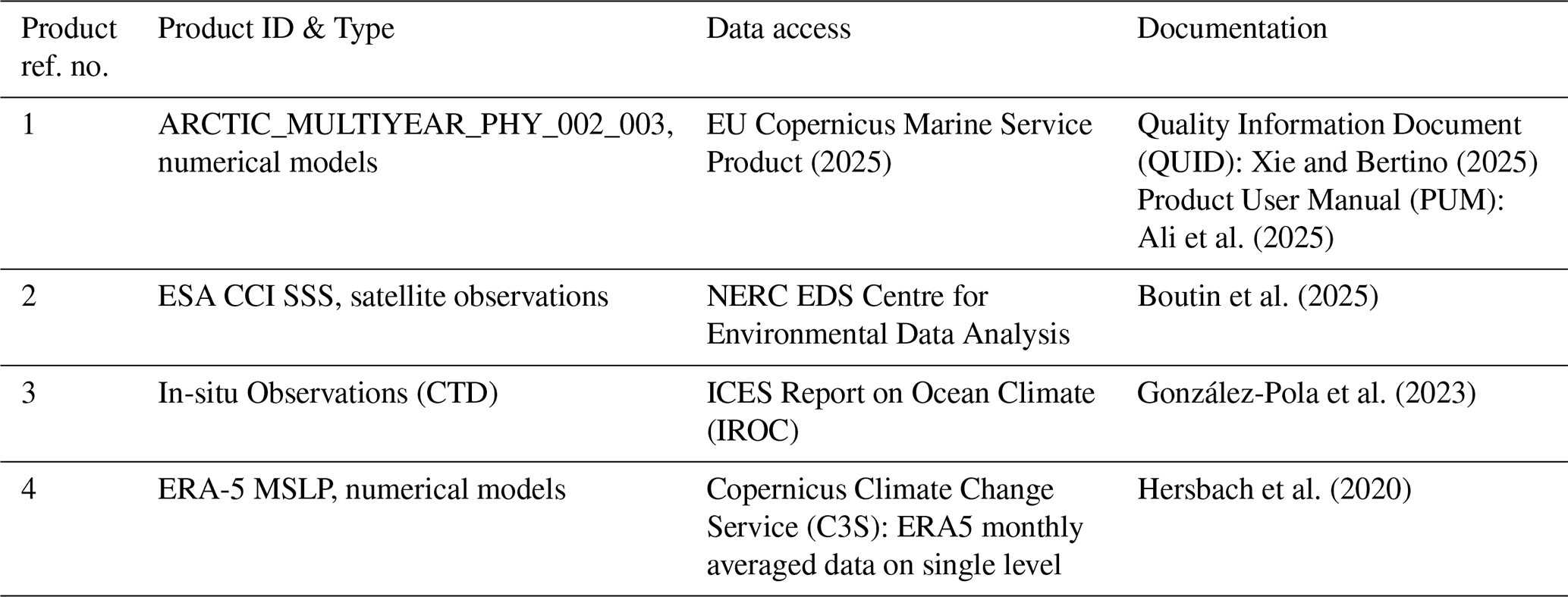
Table 1Product ID & Type, data access and documentation details of different datasets used in this study.
The advection of Atlantic Water (AW) into the Arctic Ocean and its transformation into dense water through heat and freshwater exchanges constitute a major component of the thermohaline circulation (Aagaard, 1981; Rudels et al., 2015; Raj and Halo, 2016; Bashmachnikov et al., 2023). The shallow Barents Sea shelf (mean depth of 230 m) located along the advective path of AW (Furevik, 2001; Sundby and Drinkwater, 2007; Årthun and Eldevik, 2016) accounts for a substantial part of the dense water that is formed within the Arctic (Martin and Cavalieri, 1989). The AW entering the Barents Sea from the southwest through the Barents Sea Opening (BSO) is a major source of interannual variability in the region's hydrography (Årthun et al., 2012; Lien et al., 2024). After entering the southern Barents Sea (SBS), a large amount of the heat carried by the AW is released to the atmosphere (Serreze et al., 2007; Smedsrud et al., 2010), before travelling further north and setting the southward limit of sea ice extent in the northern Barents Sea (NBS) (Barton et al., 2018). In comparison to the SBS, the hydrographic variability in the NBS is shaped not only by variations in the AW entering from the south and north (see Fig. 1; Lind and Ingvaldsen, 2012), but also by the import of sea ice and less saline Arctic Water from the polar basin (Lind et al., 2018). After undergoing considerable modifications within the Barents Sea, the poleward flowing AW enters the polar basin through the St. Anna Trough (SAT) (e.g., Schauer et al., 2002), thereby contributing to the renewal of the intermediate and deep water in the Arctic Ocean (Rudels et al., 1994; Jones et al., 1995; Rudels et al., 2000).
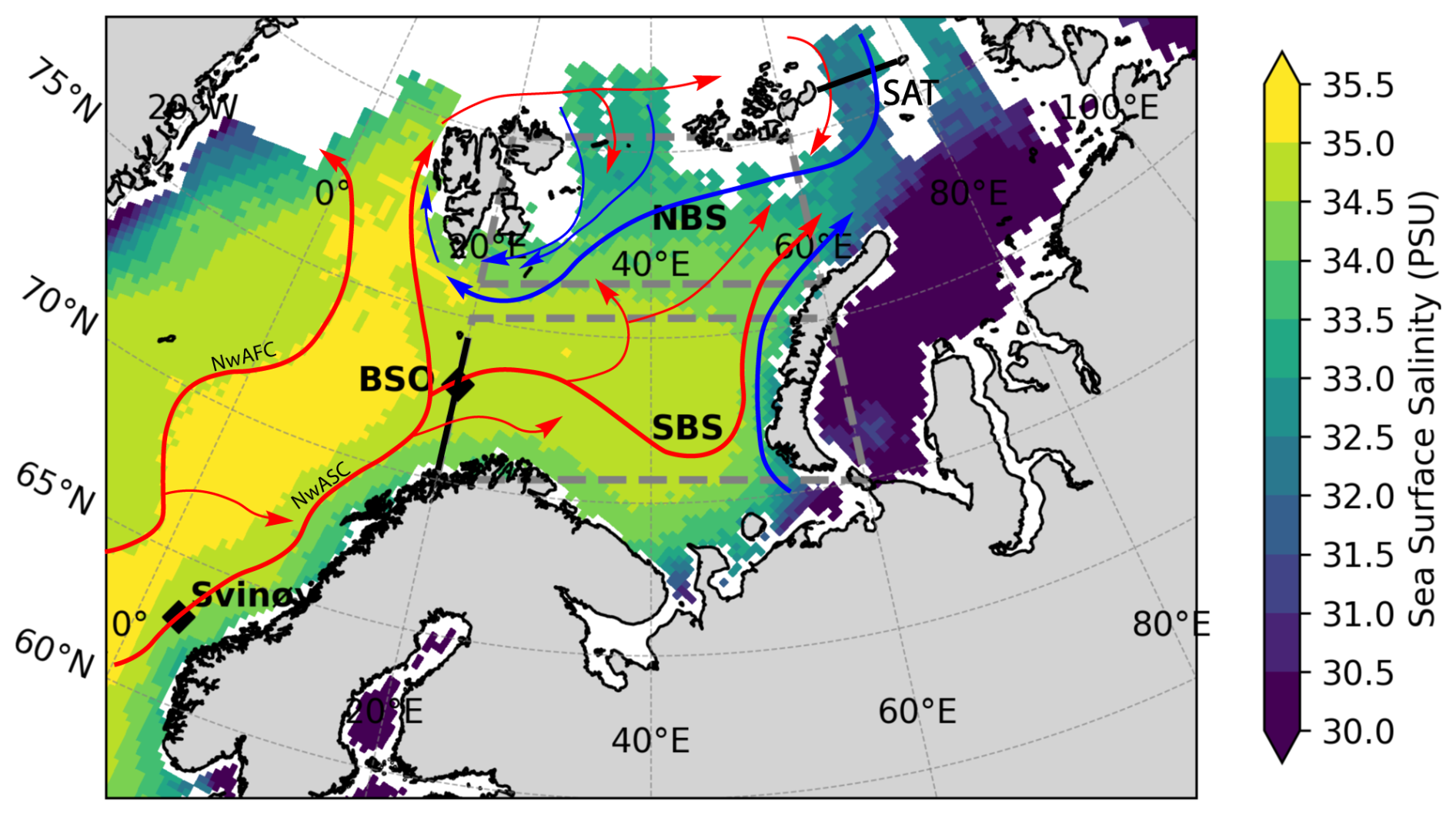
Figure 1Mean sea surface salinity (SSS) in the eastern Nordic Seas and the Barents Sea (2010–2023) from ESA CCI SSS satellite database (see Table 1 for details). Thick black lines indicate the location of sections, Barents Sea Opening (BSO) and St. Anna Trough (SAT) shown in Fig. 6. Two black square boxes represent the locations of Svinøy and BSO shown in Fig. 2. The main circulation features of the region are overlayed (Red: Atlantic Water; Blue: Arctic Water) on the mean SSS. The Norwegian Atlantic Slope Current (NwASC; Orvik et al., 2001) and Norwegian Atlantic Front Current (NwAFC; Raj et al., 2019) transporting warm AW poleward are also indicated. The location of the NBS and SBS are represented by two dashed grey boxes.
Within the Barents Sea, several processes contribute to the water mass modification (Pfirman et al., 1994; Rudels et al., 1994; Ozhigin and Ivshin, 1999; Rudels et al., 2004). These processes include freshwater input from river runoff, sea-ice melting and net precipitation (Coachman and Barnes, 1963; Steele et al., 1995), wind and tidal mixing (Sundfjord et al., 2007), atmospheric cooling and subsequent sea-ice formation (Aagaard et al., 1981; Smedsrud et al., 2013; Skagseth et al., 2020). The dense water formed within, exits the Barents Sea through the northern BSO into the Nordic Seas, and through the St. Anna Trough into the central Arctic (Fig. 1). Given its contribution to the overflow waters that feed the lower limb of the Atlantic Meridional Overturning Circulation (AMOC), variability in dense-water formation within the Barents Sea is of high importance (Smedsrud et al., 2013; Lind et al., 2018).
During recent years, the Barents Sea has experienced rapid changes driven by complex feedback mechanisms, making the region a focal point for understanding ongoing and future Arctic climate change and its implications (Lind et al., 2018; Chatterjee et al., 2024; Challet et al., 2025). An example is the reduced atmospheric heat loss in the SBS (Skagseth et al., 2020) that is found to impact the outflow of dense waters entering the Nordic Seas through the northern part of the BSO (Skagseth et al., 2020). The dense waters exiting the Barents Sea at BSO and SAT can also be affected by changes in salinity due to sea ice import from the north (Lind et al., 2018), as well as by the downstream impact of the freshwater anomalies from the northern North Atlantic. In this context, a large salinity anomaly observed during 2012–2016 stands out, representing the most anomalous event recorded during the past 120 years in the northern North Atlantic (Holliday et al., 2020; Kenigson and Timmermans, 2021). While, Holliday et al. (2020) attributed this freshening to anomalous winter wind patterns rerouting Arctic-origin water in the Labrador Current into the northern North Atlantic, Kenigson and Timmermans (2021) linked it to the wind-driven displacements of the Subpolar Front. This event also coincided with the decadal variability in the subpolar gyre circulation, which has strengthened since the mid-2000s (Chafik et al., 2019) and exerts a strong influence on the properties of AW entering the Nordic Seas (Hatun et al., 2005). Even though the subsequent northward propagation of these negative salinity anomalies has been documented (Mork et al., 2019), their downstream impacts, particularly on dense water formation in the Barents Sea, remain poorly understood. In here, we combine regional ocean reanalysis, in situ observations, and satellite remote sensing datasets to investigate recent changes in Barents Sea salinity, identify the mechanisms driving these changes, and assess their influence on the properties of dense waters exiting the Barents Sea.
Details of the model data, satellite data obtained from the Climate Change Initiative (CCI) of the European Space Agency (ESA), ECMWF Reanalysis Version5 (ERA5) atmospheric reanalysis and in situ data from International Council for the Exploration of the Sea (ICES), is given below and in Table 1. Different acronyms used are listed in the Appendix.
TOPAZ4 Reanalysis: TOPAZ4 is a regional ocean-sea ice reanalysis product and represents Arctic Ocean Physics Reanalysis in the Copernicus Marine Service (product ref. no. 1, Table 1). The TOPAZ4b version used here is a coupled ocean and sea ice data assimilation system for the Arctic based on the HYbrid Coordinate Ocean Model (HYCOM), with 50 hybrid z-isopycnal layers at a horizontal resolution of 12 to 16 km, uses the ensemble Kalman filter method (EnKF; Evensen, 2003; Ali et al., 2019; Raj et al., 2020) to assimilate consistently multiple types of observations in the ocean and sea ice (Xie et al., 2016, 2019). Forced by ERA5 reanalysis, it assimilates observations, including along-track altimetry data, sea surface temperature, sea ice concentration, and sea ice drift from satellites, along with in situ temperature and salinity profiles. The detailed setup of the TOPAZ4 reanalysis and its performance is detailed in Sakov et al. (2012) and Xie et al. (2023).
ESA CCI SSS data: The CCI+SSS project aims to generate improved calibrated global SSS fields from all available satellite L-band radiometer measurements, with regional extensions utilising C-band radiometer data. This initiative seeks to leverage the full potential of the ESA/Earth Explorer Soil Moisture and Ocean Salinity (SMOS), in conjunction with the Soil Moisture Active Passive (SMAP) and AQUARIUS satellite missions, by assembling expert teams in earth observation, satellite data validation, and the study of climate variability. Monthly sea surface salinity product (product ref. no. 2, Table 1) for the Northern Hemisphere on a 25 km EASE grid, v5.5, available for the time-period 2010 to 2023 is used here (Boutin et al., 2025).
ERA-5: Monthly mean sea level pressure (MSLP; 0.25° × 0.25° spatial grid) data (product ref. no. 4, Table 1) for the time-period (1991–2024) is used in this study to investigate the role of large-scale atmospheric forcing.
ICES data: The temperature, salinity, and density data (product ref. no. 3, Table 1) at BSO and Svinøy sections are obtained from the ICES database (https://ocean.ices.dk/core/iroc, last access: August 2025).
Lead–lag correlations were calculated from detrended monthly salinity anomalies after removing the climatological seasonal cycle. The significance of the correlations was evaluated using a two-sided Student's t-test based on the effective sample size, estimated from the lag-1 autocorrelation of the two time series to account for serial dependence.
3.1 Southern Barents Sea
Reanalysis data averaged over the full Barents Sea domain (20 to 60° E; 70 to 80° N) and from surface to bottom show a rapid decline in the overall salinity in the Barents Sea after 2016–2017, followed by a salinity minimum in 2021–2022 (trend, 2016–2022: −0.07 ± 0.01 psu per decade). The salinity decline followed a period of gradual salinity increase (1991–2015; trend: 0.01 ± 0.002 psu per decade; Fig. 2a). This salinity minimum aligns with the freshening in the North Atlantic during the period 2012–2016 (Holliday et al., 2020), and subsequently in the Norwegian Sea (Mork et al., 2019), consistent with an advection time of a few years from the North Atlantic to the BSO (Furevik, 2001; Årthun and Eldevik, 2016). To understand the regional drivers of this salinity change, we further focus our analysis on the southern (SBS; 20 to 60° E; 70 to 75° N) and northern (NBS; 20 to 60° E; 76 to 80° N) Barents Sea separately (Fig. 1). The spatial variability of mean SSS, shown in Fig. 1, is used to qualitatively separate the BS into the AW dominated SBS and the Arctic Water dominated NBS. In general, from visual analysis, the long-term variability in the salinity of the two regions shows a positive trend followed by a sudden drop in salinity since the mid 2010s (Fig. 2a).
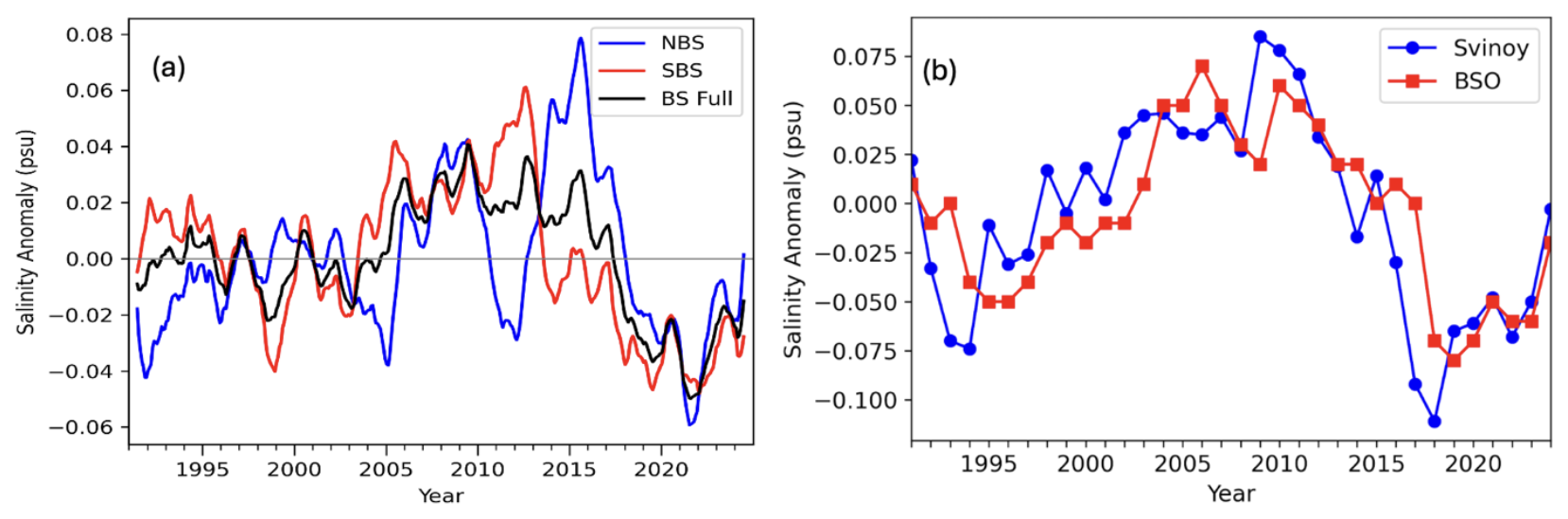
Figure 2(a) Interannual (12 month running mean) variability of depth-averaged salinity anomaly in the southern Barents Sea (SBS; red), northern Barents Sea (NBS; blue) and the full Barents Sea (BS_Full; black) obtained from TOPAZ reanalysis. (b) Time series showing annual averaged salinity anomaly in the upper 200 m depth at the Svinøy (63° N, 3° E; Fig. 1) and Barents Sea Opening (BSO; Fig. 1; 73° N, 20° E), from in situ observations (ICES data) during the TOPAZ time period (1991–2024).
The propagation of salinity anomalies from the Nordic Seas into the SBS via BSO is visible in Fig. 2b. In accordance with findings reported in the literature, the salinity variability (upper ocean, 200 m) in SBS follows that at the BSO and Svinøy, located further upstream along the advection path of AW in the Norwegian Sea (Fig. 1). The positive trend in salinity followed by an abrupt drop is also seen at BSO and Svinøy, but with a lag. The minimum in salinity at Svinøy is found during 2018, while at BSO and SBS it is at around the time-periods 2019–2020 and 2021–2022 respectively (Fig. 2a, b). To further confirm the propagation of the salinity anomalies, we performed a lagged correlation analysis using monthly mean data from the TOPAZ reanalysis. Note that the correlation between annual mean salinity from in-situ and TOPAZ salinity data is 0.9 for both Svinøy and BSO. The lagged correlation analysis (detrended and deseasoned) shows a maximum significant correlation (r=0.6) at 16-months lag between Svinøy and BSO (Svinøy leads BSO). Even though the mean speed of the Norwegian Atlantic Slope Current (NwASC; Fig. 1) is around 30 cm s−1 (Orvik et al., 2001) with a variability of ± 10 cm s−1 (Raj et al., 2018), the hydrographic anomalies propagating along with the NwASC are much slower, roughly an order of magnitude lower than its core speed (Broomé and Nilsson, 2018). This accounts for a travel time, consistent with our result, to cover a distance of around 1300 km between Svinøy (63° N, 3° E) and BSO (73° N, 20° E).
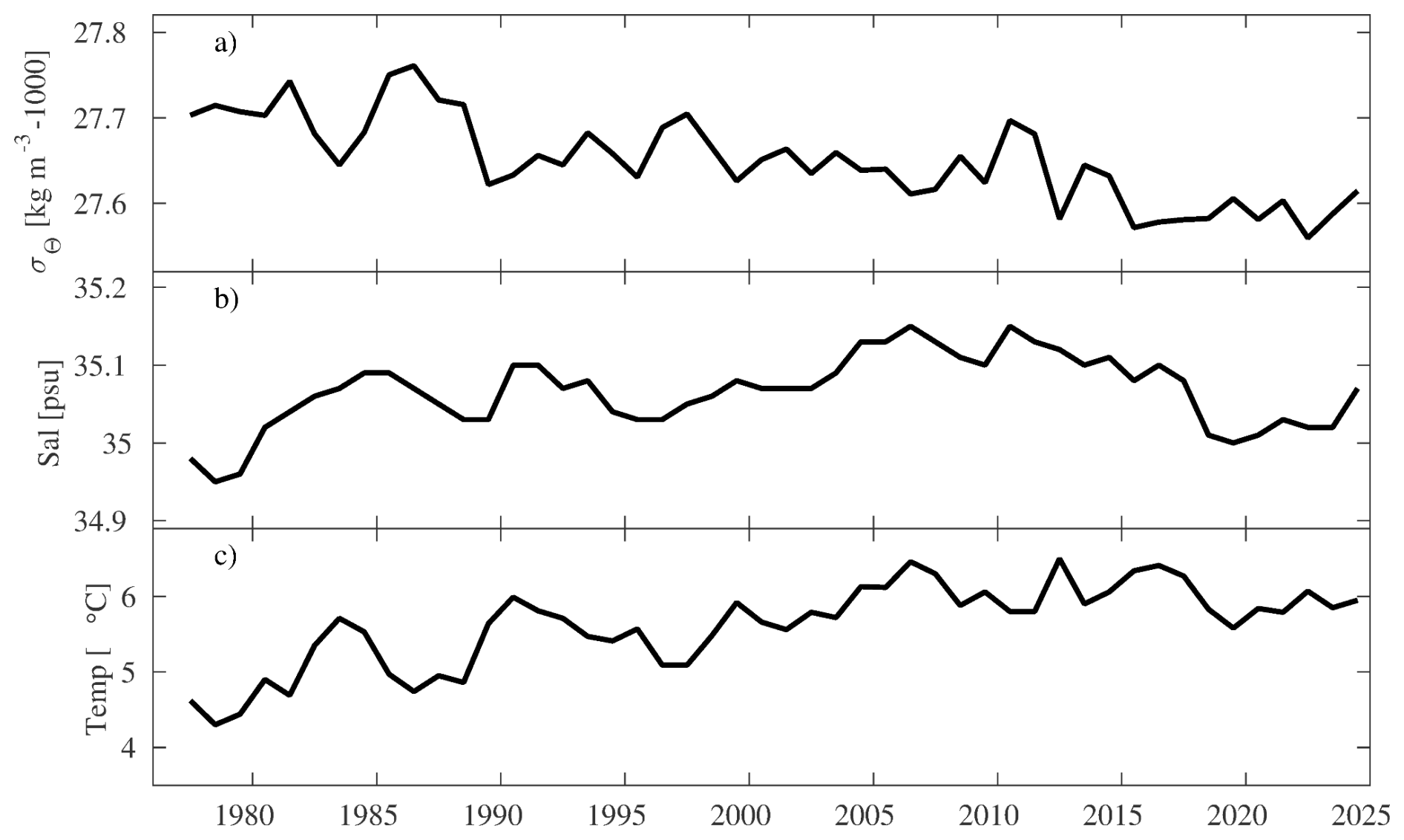
Figure 3Time series showing annual average (a) density, (b) salinity, and (c) temperature averaged over 50–200 m depth in the Barents Sea Opening section, based on CTD observations during the period 1978–2024.
Extending the analysis to the 1970s using observations from the BSO (Blindheim and Loeng, 1981; González-Pola et al., 2020; Fig. 3b) reveals that the salinity anomaly during 1978–1979 has been more pronounced than the one during 2018–2019. On the other hand, the salinity anomaly of the latest event is more pronounced than that during the late 1980s and late 1990s. Notably the temperature remained relatively high during the latest salinity anomaly event (Fig. 3c). The lower temperature during those earlier low salinity periods compensated for the lower salinity with respect to density changes. A consequence of the warming in recent decades is therefore an unprecedented (in the instrumental record) low AW density observed since 2016 in the Barents Sea (Fig. 3a).
3.2 Northern Barents Sea
We now shift our focus to the NBS, which, in addition to being influenced by AW, also is dominated by the exchanges of sea ice and less saline and colder Arctic Water from the Polar Basin (Pfirman et al., 1994; Lind et al., 2018). Moreover, the NBS has two sources of AW; inflow of AW from the SBS (Schauer et al., 2002), and the onshelf intrusion of AW flowing eastward along the northern Barents Sea shelf slope in the Polar Basin (Fig. 1, Lind and Ingvaldsen, 2012; Lundesgaard et al., 2022). Our analysis showed an increasing salinity in the NBS, especially during mid-2000s to mid-2010s (trend, 2004–2015: 0.05 ± 0.01 psu per decade, p < 0.05), followed by a rapid decline from 2016 onwards until 2022 (trend, 2016–2022: −0.11 ± 0.02 psu per decade, p < 0.05; Fig. 2a). A lag correlation analysis (deseasoned and detrended) found a correlation (r=0.4) between the salinity variability of BSO and NBS at a lag of 16 months, which is consistent with the travel time reported by Årthun and Eldevik (2016). Although the relationship becomes more pronounced (r=0.5) during 2016–2024 when salinity is declining, it is not significant (r=0.2) during 2004–2015 with increasing salinity in the NBS. This suggests that different processes govern salinity variability in the NBS during that time. Notably, Lind et al. (2018) has attributed the increased salinity in the NBS during the mid-2000 to mid-2010 to the reduced sea ice import from the central Arctic. As sea-ice import is anticipated to exert its strongest influence on regional SSS, we analyzed satellite-derived SSS data, which also showed a decrease in surface salinity after 2016 (figure not shown). A negative SSS anomaly is also evident during 2013 in the satellite-derived salinity data, likely linked to the exceptional sea-ice melt of 2012 (Parkinson and Comiso, 2013). Further analysis of TOPAZ4b reanalysis SSS for a longer time period (1991–2024) found an increase in SSS from the mid-2000s to mid-2010s. The positive trend is consistent with the results of Lind et al. (2018), who showed a similar trend during the time-period due to a decrease in sea ice import from the central Arctic. Our analysis further shows that in recent times (after 2016), this trend has changed due to a change in the atmospheric circulation pattern in the central Arctic (Fig. 4). The recent freshening in NBS is consistent with a stronger southward sea ice drift into the region from the central Arctic (Fig. 4a). When comparing the difference in MSLP during the time-period with increasing salinity in the northern Barents Sea (1993–2015) and the period of rapid decline and lower salinity (2016–2024), we find anomalous northwesterly geostrophic winds that favour increased sea ice import from the central Arctic into the NBS during the latter period (Fig. 4b). Furthermore, the period of increasing salinity (mid-2000s to mid-2010s) is also consistent with the negative trend in fresher Arctic water import from the eastern Barents Sea, which increased thereafter (Chatterjee et al., 2024).
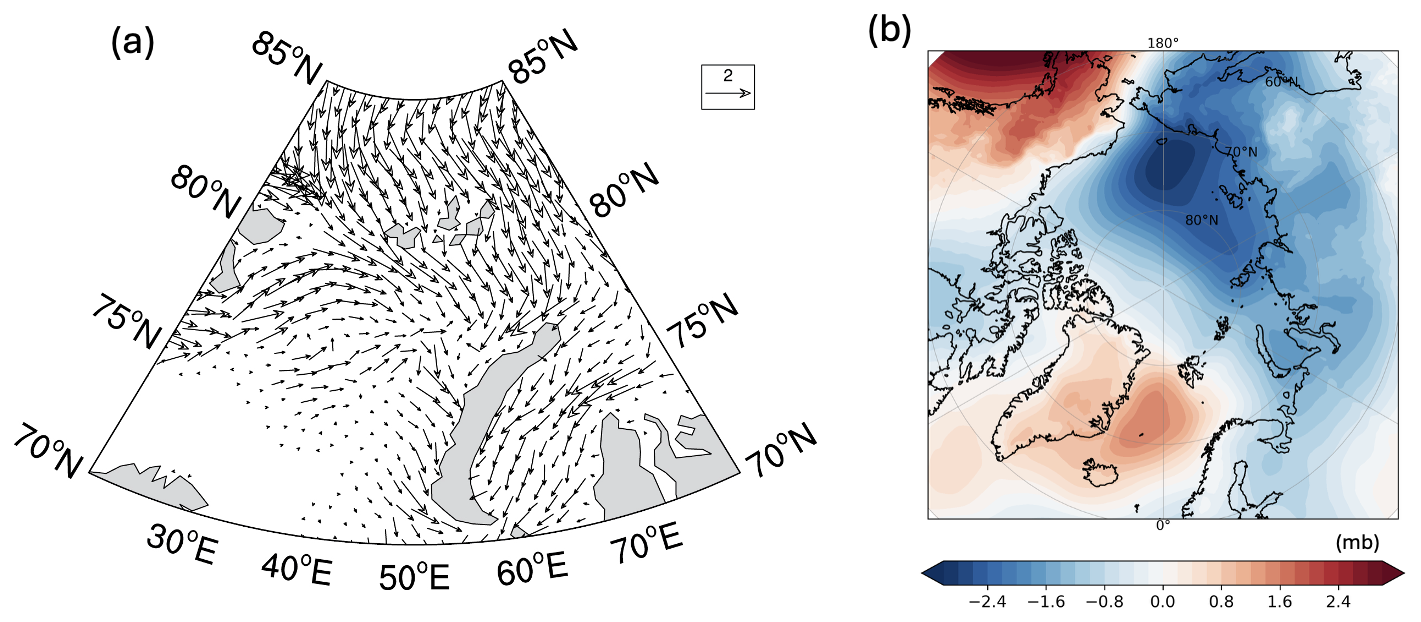
Figure 4(a) Difference in winter-mean (NDJFM) sea-ice drift velocity (cm s−1) from TOPAZ4b, defined as the mean over 2016–2024 minus the mean over 1993–2015. (b) Same as panel (a) but for MSLP difference from ERA-5.
3.3 Downstream effects
In the following, we investigate the downstream effects of the changes in the salinity of the Barents Sea on the dense outflow waters exiting the Barents Sea into the Nordic Seas and the central Arctic. Figure 5 shows the annually averaged temperature and salinity of the densest 5 % of the water masses in sections crossing the outflow of dense water from the Barents Sea into the Nordic Seas and into the central Arctic respectively at BSO and SAT (see Fig. 1 for locations). At BSO, the increase in temperature during the 2000s was partly offset in terms of density change by an increase in salinity. In the last ten years, however, the drop in salinity has further reduced density to levels unprecedented within the entire time-period (Fig. 5a, c). At SAT (Fig. 5b, d) the variability of the density of dense waters is in general dominated by temperature, however, in recent years the sharp drop in salinity contributed to form record low density. The cooling of the AW en route through the Barents Sea has been reported to decline in recent decades (Skagseth et al., 2020). A warming trend is also reflected in the reanalysis results, with the temperatures of the densest water being below 0 °C before 2005 and around or above 0 °C in all years after 2005 (Fig. 5b).
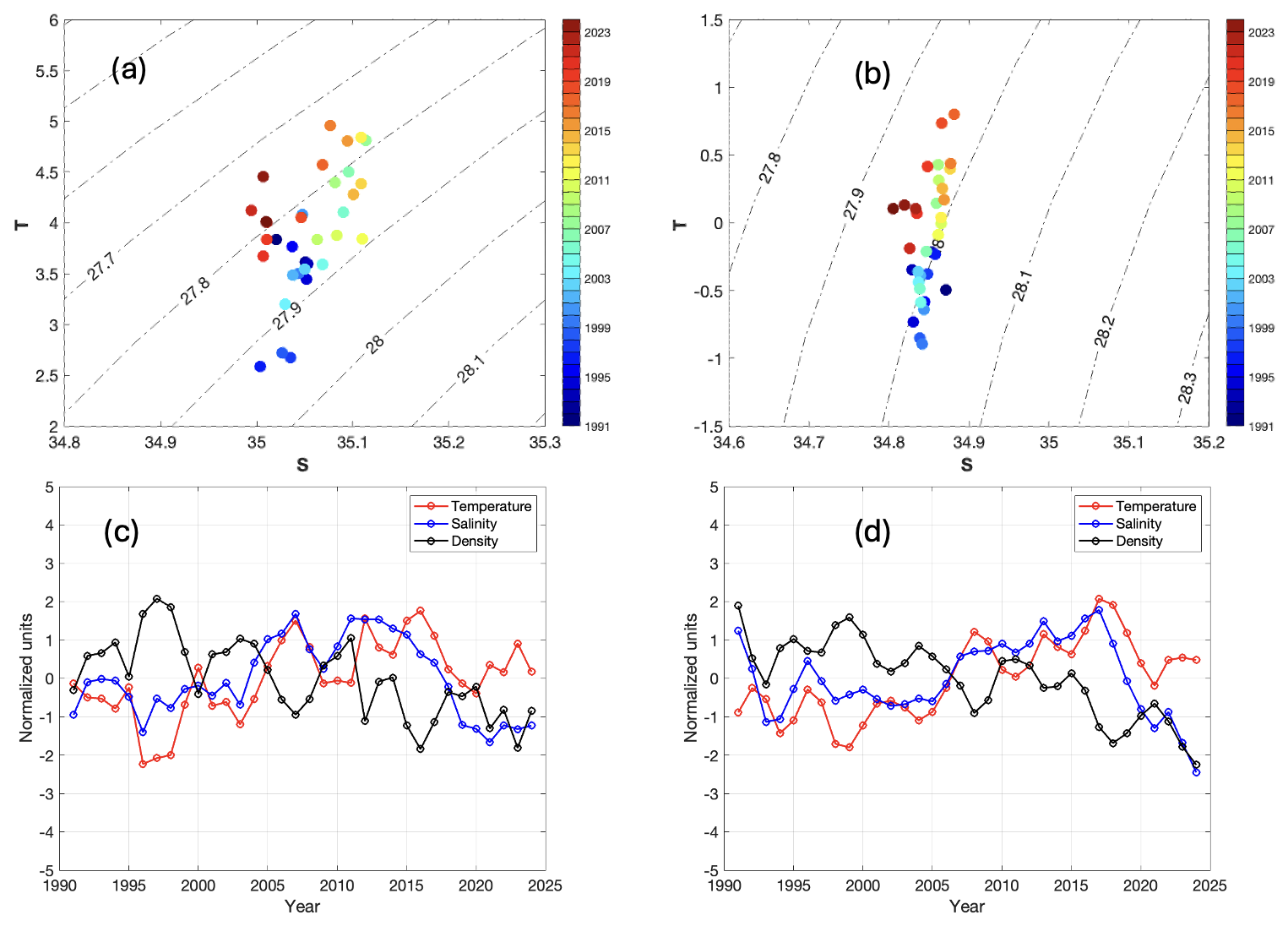
Figure 5Temperature-salinity diagram showing the hydrographic properties of the densest 5 % of the water masses in (a) BSO and (b) SAT. The data represent TOPAZ reanalysis annual averages. Color denotes the year of the annual average. The temporal evolution of temperature, salinity and density, shown in panels (a) and (b), after applying z-score normalisation are presented in panels (c) and (d) respectively.
In this study, we present the evidence of the recent freshening in the Barents Sea resulting from the unprecedented salinity anomaly observed in the northern North Atlantic during 2012–2016 (e.g., Holliday et al., 2020). The recent salinity anomaly transported into the SBS differs from previous low salinity anomalies (late 1970s and 1980s). During the recent salinity event, the temperature remained relatively high, whereas the temperature and salinity previously covaried (e.g., Furevik, 2001; Mork et al., 2019). A possible mechanism for the positive correlation between temperature and salinity was proposed by Sundby and Drinkwater (2007), suggesting that atmospheric conditions favoring (working against) increased flow along the Norwegian coast push the temperature and salinity gradients downstream (upstream), causing both temperature and salinity to locally increase (decrease). However, the most recent salinity anomaly was caused by lower salinity entering the Nordic Seas from the North Atlantic. This is further underpinned by the observation that while the 2012–2016 salinity anomaly in the North Atlantic was unprecedented for the last 120 years, direct hydrographic observations from the BSO (Blindheim and Loeng, 1981; González-Pola et al., 2020) dating back to the late 1970s, show that the negative salinity anomaly in the Barents Sea during 1977–1979 was even stronger (Fig. 3). Moreover, although relatively colder AW has intruded into the Norwegian Sea from the North Atlantic since the mid-2000s, a reduced heat loss from the ocean surface has helped in sustaining the temperature anomalies and thereby decoupling the temperature and salinity signal in the Nordic Seas (e.g. Skagseth et al., 2020; Mork and Skagseth et al., 2019; Chatterjee et al., 2024).
The salinity variability in the NBS is found to be more complex and is influenced by both the sea ice import from the central Arctic as well as the AW salinity variability transported from the SBS. The reduction in sea-ice import into the NBS, and associated weakened stratification and increased penetration of AW to the surface has been found to increase the salinity of the region during the time period 2003–2016 (e.g., Lind et al., 2018). Our study showed that the positive trend in the salinity of the NBS no longer exists after 2016; in fact, the salinity of the region has shown a rapid freshening since then. In addition to low saline waters from SBS, this drop in the salinity variability is also linked to the increased transport of sea ice into the region, an opposite scenario to that reported by Lind et al. (2018). During this time period after 2016, anomalous northwesterly geostrophic winds are found to favour increased sea ice import from the central Arctic to the NBS. An increased sea ice import and associated enhanced stratification of the upper ocean in NBS inhibits penetration of AW to the surface, pausing the Atlantication trend, and in turn favors a more direct downstream impact of SBS salinity anomaly through lateral advection (Fig. 6). Whereas, with reduced sea ice import during 2003–2016, as reported in Lind et al. (2018), the weakened stratification in the NBS region favours local vertical mixing, which may play a larger role in driving the NBS salinity over the lateral transport from SBS, as also confirmed by the weaker correlation between BSO and NBS salinity variability during 2003–2016.
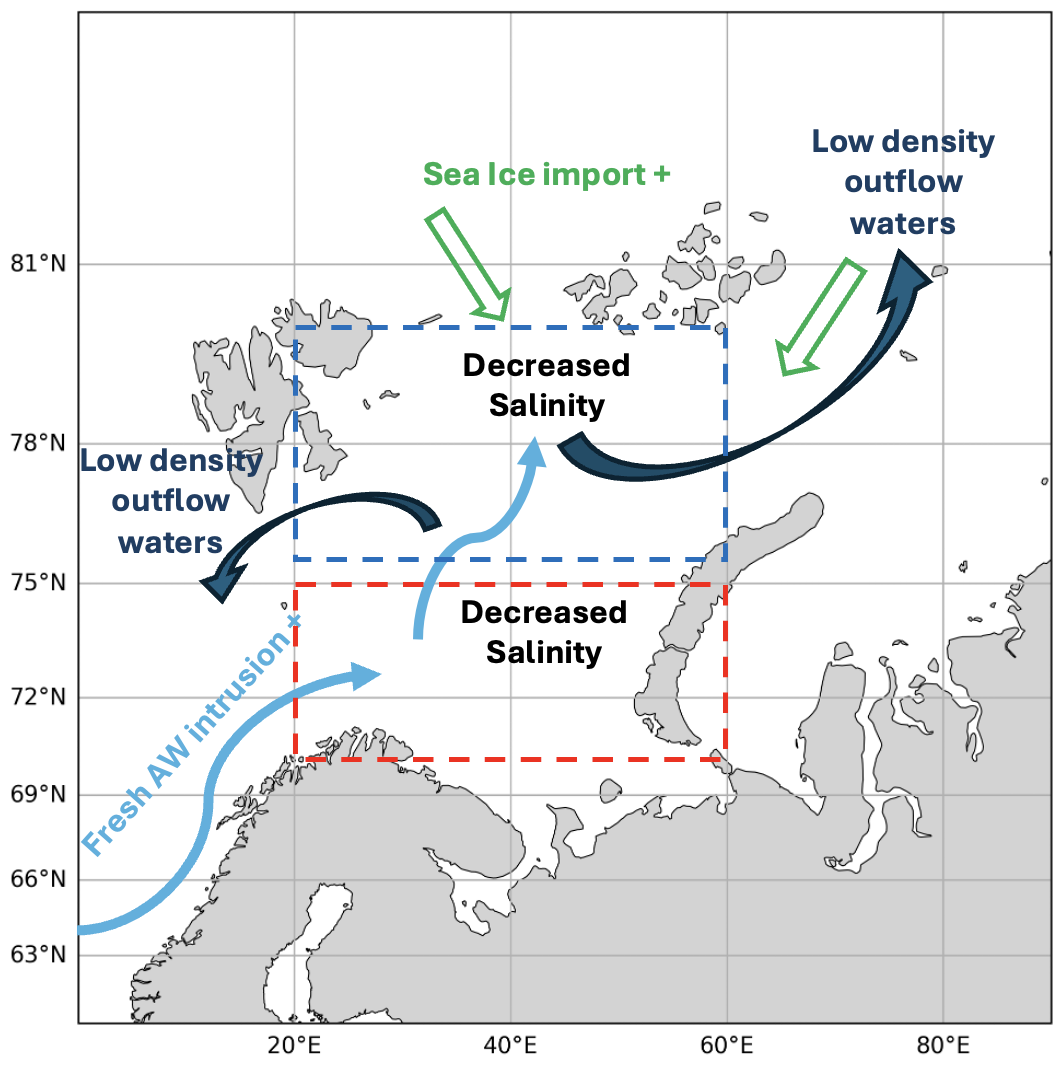
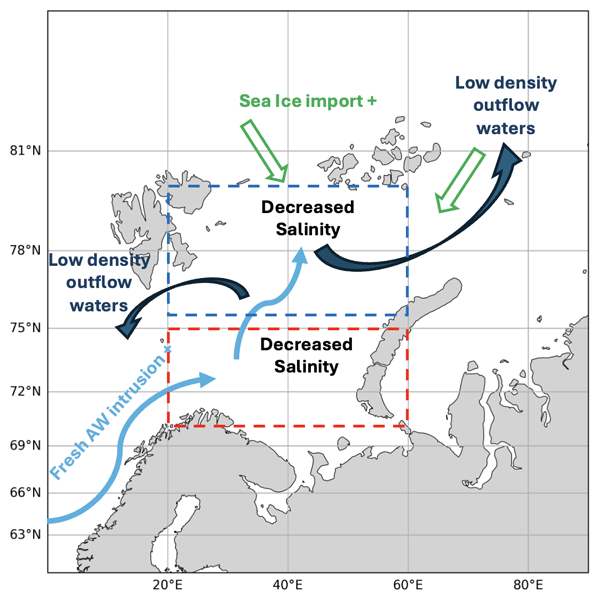
Figure 6Summary diagram of the mechanisms involved in the recent freshening in the NBS (dashed blue box) and SBS (dashed red box) and its implications on the outflow waters. The figure summarizes the influence of fresh water intrusion into the SBS and NBS via the BSO, the increased sea ice import into the NBS from the central Arctic that in turn impacts the stratification and dampens the surfacing of AW thereby affecting the salinity of the region.
Results (Fig. 5) show that in both outflow regions from the Barents Sea, the densest water masses were warming from 1993 to 2016 (BSO) and 2018 (SAT). Concurrent with the warming, the salinity was also increasing, partly offsetting the density decrease due to the warming. Then, during the most recent years, the temperature has declined, but a strong decline in salinity offset the increase in density from the cooling, resulting in the density being at the lowest for the full model timeseries. These hydrographic changes are in agreement with findings based on observations both in the BSO (Skagseth et al., 2020) and the SAT (Zabudkina et al., 2025). Moreover, our results indicate that the trends in the hydrographic properties of the dense water exiting the Barents Sea mainly reflect the trend in the hydrographic properties of the AW entering through the BSO. Historical records, however, indicate this has not always been the case. In the proximity of the Novaya Zemlya Bank, where polynya activity causes strong cooling and sea-ice formation and subsequent brine release, dense water with high salinity may form in winter (Nansen, 1906). Indeed, during the period of unprecedented low salinity of the inflowing AW in 1978–1979 (Fig. 3b), water with salinity exceeding 35.1 was observed near the bottom in the northeastern Barents Sea, yielding densities σΘ > 28.2 (Midttun, 1985). In 2008, during the period of maximum AW salinity in the BS, no brine-enriched bottom water was observed close to the Novaya Zemlya Bank and the maximum observed density of σΘ=28.09 (Lien and Trofimov, 2013) was less than the σΘ > 28.2 observed in 1979 (Midttun, 1985). These observations suggest that in today's warmer climate with strongly reduced sea-ice formation in the Barents Sea, the density of the bottom water in the Barents Sea is likely insufficiently large to contribute to intermediate and deep-water renewal during periods of anomalously low salinity.
| AW | Atlantic Water |
| AMOC | Atlantic Meridional Overturning Circulation |
| BS | Barents Sea |
| BSO | Barents Sea Opening |
| CCI | Climate Change Initiative |
| ESA | European Space Agency |
| ERA5 | ECMWF Reanalysis Version5 |
| ICES | International Council for the Exploration of the Sea |
| MSLP | mean sea level pressure |
| NAO | North Atlantic Oscillation |
| NBS | Northern Barents Sea |
| NwAFC | Norwegian Atlantic Front Current |
| NwASC | Norwegian Atlantic Slope Current |
| SAT | St.Anna Trough |
| SBS | Southern Barents Sea |
| SMAP | Soil Moisture Active Passive |
| SMOS | Soil Moisture and Ocean Salinity |
| SSS | Sea surface salinity |
Details of data avaibility are listed in Table 1. Codes used will be made accessible upon request.
RR, VSL, SC were involved in the intial study design, analysis, discussion and writing the manuscript. SS was involved in the analysis, while AB and LB were involved in discussions and the writing phase.
The contact author has declared that none of the authors has any competing interests.
The Copernicus Marine Service offering is regularly updated to ensure it remains at the forefront of user requirements. In this process, some products may undergo replacement or renaming, leading to the removal of certain product IDs from the catalogue. If readers have any questions or require assistance regarding these modifications, please feel free to reach out to the Copernicus Marine Service user support team for further guidance. They will be able to provide the necessary information to address concerns and find suitable alternatives.
Publisher's note: Copernicus Publications remains neutral with regard to jurisdictional claims made in the text, published maps, institutional affiliations, or any other geographical representation in this paper. The authors bear the ultimate responsibility for providing appropriate place names. Views expressed in the text are those of the authors and do not necessarily reflect the views of the publisher.
Authors acknowledge the computational support provided by the Norwegian Sigma2 infrastructure under project NS2993K. We also thank the two anonymous reviewers for their valuable comments and suggestions, which helped improve the manuscript.
This research was supported by the ObsSea4Clim project funded by the European Union, Horizon Europe Funding Programme for Research and Innovation (grant no. 101136548, ObsSea4Clim contribution no. 59), the Copernicus Marine Environment Monitoring Service (CMEMS) Arctic Marine Forecasting Centre project (ARC MFC; contract no. 21002L1), ESA CCI+SSS project (grant no. 4000123663/18/I-NB), ESA Dragon 6 Program (grant no. 95451), and ESA SLBC project (grant no. 4000140620/23/IBN).
This paper was edited by Pierre Brasseur and reviewed by two anonymous referees.
Aagaard, K.: On the deep circulation of the Arctic Ocean, Deep-Sea Res., 28, 251–268, https://doi.org/10.1016/0198-0149(81)90066-2, 1981.
Aagaard, K., Coachman, L. K., and Carmack, E.: On the halocline of the Arctic Ocean, Deep-Sea Res. Pt. A, 28, 529–545, https://doi.org/10.1016/0198-0149(81)90115-1, 1981.
Ali, A., Christensen, K. H., Breivik, Ø., Malila, M., Raj, R. P., Bertino, L., Chassignet, E. P., and Bakhoday-Paskyabi, M.: A comparison of Langmuir turbulence parameterizations and key wave effects in a numerical model of the North Atlantic and Arctic Oceans, Ocean Model., 137, 76–97, https://doi.org/10.1016/j.ocemod.2019.02.005, 2019.
Ali, A., Burud, A., Williams, T., Xie, J., Yumruktepe, C., Wakamatsu, T., Melsom, A., Bertino, L., and Gao, S.: EU Copernicus Marine Service Product User Manual for the Arctic Ocean Physics Reanalysis, ARCTIC_MULTIYEAR_PHY_002_003, issue 5.20, Mercator Ocean International, https://documentation.marine.copernicus.eu/PUM/CMEMS-ARC-PUM-002-ALL.pdf (last access: August 2025), 2025.
Årthun, M. and Eldevik, T.: On Anomalous ocean heat transport toward the Arctic and associated climate predictability, J. Clim., 29, 689–704, https://doi.org/10.1175/JCLI-D-15-0448.1, 2016.
Årthun, M., Eldevik, T., Smedsrud, L. H., Skagseth, Ø., and Ingvaldsen, R. B.: Quantifying the Influence of Atlantic Heat on Barents sea ice variability and retreat, J. Climate, 25, 4736–4743, https://doi.org/10.1175/JCLI-D-11-00466.1, 2012.
Barton, B. I., Lenn, Y., and Lique, C.: Observed Atlantification of the Barents Sea Causes the Polar Front to Limit the Expansion of Winter Sea Ice, J. Phys. Oceanogr., 48, 1849–1866, https://doi.org/10.1175/JPO-D-18-0003.1, 2018.
Bashmachnikov, I. L., Raj, R. P., Golubkin, P., and Kozlov, I. E.: Heat Transport by mesoscale eddies in the Norwegian and Greenland Seas, J. Geophys. Res.-Oceans, 128, e2022JC018987, https://doi.org/10.1029/2022JC018987, 2023.
Blindheim, J. and Loeng, H.: On the variability of Atlantic influence in the Norwegian and Barents Seas, Fiskeridirektoratets Skrevne Serie for Havundersøkelser, 17, 161–189, 1981.
Boutin, J., Vergely, J. L., Reul, N., Catany, R., Jouanno, J., Martin, A., Rouffi, F., Bertino, L., Bonjean, F., Corato, G., Gévaudan, M., Guimbard, S., Khvorostyanov, D., Kolodziejczyk, N., Matthews, M., Olivier, L., Raj, R., Rémy, E., Reverdin, G., Supply, A., Thouvenin-Masson, C., Vialard, J., Sabia, R., and Mecklenburg, S.: ESA Sea Surface Salinity Climate Change Initiative (Sea_Surface_Salinity_cci): Monthly sea surface salinity product for the Southern Hemisphere on a 25km EASE grid, v5.5, for 2010 to 2023, NERC EDS Centre for Environmental Data Analysis [data set], https://catalogue.ceda.ac.uk/uuid/0397ca6f625e47f489684bad2bd533bb (last access: August 2025), 2025.
Broomé, S. and Nilsson, J.: Shear dispersion and delayed propagation of temperature anomalies along the Norwegian Atlantic Slope Current, Tellus, 70, 1453215, https://doi.org/10.1080/16000870.2018.1453215, 2018.
Chafik, L., Nilsen, J. E. Ø., Dangendorf, S., Reverdin, G., and Frederikse, T.: North Atlantic Ocean Circulation and Decadal Sea Level Change During the Altimetry Era, Sci. Rep., 9, 1041, https://doi.org/10.1038/s41598-018-37603-6, 2019.
Challet, F., Raj, R. P., Chatterjee, S., Herbaut, C., and Bonaduce, A.: Weakening of the Arctic water outflow from the Barents Sea and consequences on the Fram Strait warming, J. Geophys. Res.-Oceans, 130, e2024JC021054, https://doi.org/10.1029/2024JC021054, 2025.
Chatterjee, S., Semmler, T., Screen, J. A., Furevik, T., Selivanova, J., Raj, R. P., Murukesh, N., and Ravichandran, M.: Atmosphere–Ocean–Sea Ice Feedbacks Sustain Recent Barents Sea Ice Loss despite Cooler Atlantic Water Inflow, J. Clim., 37, 6519–6532, https://doi.org/10.1175/JCLI-D-24-0020.1, 2024.
Coachman, L. K. and Barnes, C. A.: Surface waters in the Eurasian Basin of the Arctic Ocean, Arctic, 15, 251–277, https://doi.org/10.14430/arctic3581, 1963.
EU Copernicus Marine Service Product: Arctic Ocean Physics Reanalysis, Mercator Ocean International [data set], https://doi.org/10.48670/moi-00007, 2025.
Evensen, G.: The Ensemble Kalman Filter: theoretical formulation and practical implementation, Ocean Dynam., 53, 343–367, 2003.
Furevik, T.: Annual and interannual variability of Atlantic Water temperatures in the Norwegian and Barents Seas: 1980–1996, Deep-Sea Res. Pt.I, 48, 383–404, https://doi.org/10.1016/S0967-0637(00)00050-9, 2001.
González-Pola, C., Larsen, K. M. H., Fratantoni, P., and Beszczynska-Möller, A.: ICES Report on Ocean Climate 2019, ICES Cooperative Research Reports (CRR), https://doi.org/10.17895/ices.pub.7537, 2020.
González-Pola, C., Larsen, K. M. H., Fratantoni, P., and Beszczynska-Möller, A.: ICES Report on ocean climate, ICES Cooperative Research Reports (CRR), Vol. 358, https://doi.org/10.17895/ices.pub.24755574, 2023.
Hatun, H., Sandø, A. B., Drange, H., Hansen, B., and Valdimarsson, H.: Influence of the Atlantic subpolar gyre on the thermohaline circulation, Science, 309, 1841–1844, https://doi.org/10.1126/science.1114777, 2005.
Hersbach, H., Bell, B., Berrisford, P., Hirahara, S., Horányi, A., Muñoz-Sabater, J., Nicolas, J., Peubey, C., Radu, R., Schepers, D., Simmons, A., Soci, C., Abdalla, S., Abellan, X., Balsamo, G., Bechtold, P., Biavati, G., Bidlot, J., Bonavita, M., De Chiara, G., Dahlgren, P., Dee, D., Diamantakis, M., Dragani, R., Flemming, J., Forbes, R., Fuentes, M., Geer, A., Haimberger, L., Healy, S., Hogan, R. J., Hólm, E., Janisková, M., Keeley, S., Laloyaux, P., Lopez, P., Lupu, C., Radnoti, G., de Rosnay, P., Rozum, I., Vamborg, F., Villaume, S., and Thépaut, J.-N.: The ERA5 global reanalysis, Q. J. R. Meteorol. Soc., 146, 1999–2049, https://doi.org/10.1002/qj.3803, 2020.
Holliday, N. P., Bersch, M., Berx, B., Chafik, L., Cunningham, S., Florindo-López, C., Hátún, H., Johns, W., Josey, S. A., Larsen, K. M. H., Mulet, S., Oltmanns, M., Reverdin, G., Rossby, T., Thierry, V., Valdimarsson, H., and Yashayaev, I.: Ocean circulation causes the largest freshening event for 120 years in eastern subpolar North Atlantic, Nat. Commun., 11, 585, https://doi.org/10.1038/s41467-020-14474-y, 2020.
Jones, E. P., Rudels, B., and Anderson, L. G.: Deep waters of the Arctic Ocean: origins and circulation, Deep-Sea Res. Part I, 42, 737–760, https://doi.org/10.1016/0967-0637(95)00013-V, 1995.
Kenigson, J. S. and Timmermans, M.: Nordic Seas Hydrography in the Context of Arctic and North Atlantic Ocean Dynamics, J. Phys. Oceanogr., 51, 101–114, https://doi.org/10.1175/JPO-D-20-0071.1, 2021.
Lien, V. S. and Trofimov, A. G.: Formation of Barents Sea Branch Water in the north-eastern Barents Sea, Polar Res., 32, https://doi.org/10.3402/polar.v32i0.18905, 2013.
Lien, V. S., Raj, R. P., and Chatterjee, S.: Surface and bottom marine heatwave characteristics in the Barents Sea: a model study, in: 8th edition of the Copernicus Ocean State Report (OSR8), edited by: von Schuckmann, K., Moreira, L., Grégoire, M., Marcos, M., Staneva, J., Brasseur, P., Garric, G., Lionello, P., Karstensen, J., and Neukermans, G., Copernicus Publications, State Planet, 4-osr8, 8, https://doi.org/10.5194/sp-4-osr8-8-2024, 2024.
Lind, S. and Ingvaldsen, R. B.: Variability and Impacts of Atlantic Water Entering the Barents Sea from the North, Deep-Sea Res. Pt. I, 62, 70–88, https://doi.org/10.1016/j.dsr.2011.12.007, 2012.
Lind, S., Ingvaldsen, R. B., and Furevik, T.: Arctic warming hotspot in the northern Barents Sea linked to declining sea-ice import, Nat. Clim. Change, 8, 634–639, https://doi.org/10.1038/s41558-018-0205-y, 2018.
Lundesgaard, Ø., Sundfjord, A., Lind, S., Nilsen, F., and Renner, A. H. H.: Import of Atlantic Water and sea ice controls the ocean environment in the northern Barents Sea, Ocean Sci., 18, 1389–1418, https://doi.org/10.5194/os-18-1389-2022, 2022.
Martin, S. and Cavalieri, D. J.: Contributions of the Siberian shelf polynyas to the Arctic Ocean Intermediate and Deep Water, J. Geophys. Res.-Oceans, 94, 12725–12738, https://doi.org/10.1029/JC094iC09p12725, 1989.
Midttun, L.: Formation of dense bottom water in the Barents Sea, Deep-Sea Res Pt. A, 32, 1233–1241, https://doi.org/10.1016/0198-0149(85)90006-8, 1985.
Mork, K. A., Skagseth, Ø., and Søiland, H.: Recent warming and freshening of the Norwegian Sea observed by Argo data, J. Clim., 32, 3695–3705, https://doi.org/10.1175/JCLI-D-18-0591.1, 2019.
Nansen, F.: Northern Waters: Captain Roald Amundsen's Oceanographic Observations in the Arctic Seas in 1901, with a Discussion of the Origin of the Bottom Waters of the Northern Seas, Jacob Dybwad, Christiania, Norway, ISBN 9781107281035, https://doi.org/10.1017/CBO9781107281035, 1906.
Orvik, K. A., Skagseth, Ø., and Mork, M.: Atlantic in inflow to the Nordic Seas: current structure and volume fluxes from moored current meters, VM-ADCP and SeaSoar-CTD observations, 1995–1999, Deep-Sea Res. Pt. I, 48, 937–957, https://doi.org/10.1016/S0967-0637(00)00038-8, 2001.
Ozhigin, V. K. and Ivshin, V. A.: Water masses of the Barents Sea, PINRO Press, Murmansk, Russia, 48 pp., ISBN 5-86349-064-0, 1999 (in Russian).
Parkinson, C. L. and Comiso, J. C.: On the 2012 record low Arctic sea ice cover: Combined impact of preconditioning and an August storm, Geophys. Res. Lett., 40, 1356–1361, https://doi.org/10.1002/grl.50349, 2013.
Pfirman, S. L., Bauch, D., and Gammelsrød, T.: The Northern Barents Sea: Water Mass Distribution and Modification, in: The Role of the Polar Oceans in Shaping the Global Environment, edited by: Johannessen, O. M., Muench, R. D., and Overland, J. E., Geophys. Monogr. Ser., 85, 77–94, https://doi.org/10.1029/GM085p0077, 1994.
Raj, R. P. and Halo, I.: Monitoring the mesoscale eddies of the Lofoten Basin: Importance, progress, and challenges, Int. J. Remote Sens., 37, 3712–3728,https://doi.org/10.1080/01431161.2016.1201234, 2016.
Raj, R. P., Nilsen, J. E. Ø., Johannessen, J. A., Furevik, T., Andersen, O. B., and Bertino, L.: Quantifying Atlantic Water transport to the Nordic Seas by remote sensing, Remote Sens. Environ., 216, 758–769, https://doi.org/10.1016/j.rse.2018.04.055, 2018.
Raj, R. P., Chatterjee, S., Bertino, L., Turiel, A., and Portabella, M.: The Arctic Front and its variability in the Norwegian Sea, Ocean Sci., 15, 1729–1744, https://doi.org/10.5194/os-15-1729-2019, 2019.
Raj, R. P., Halo, I., Chatterjee, S., Belonenko, T., Bakhoday‐Paskyabi, M., Bashmachnikov, I., Fedorov, A., and Xie, J.: Interaction between mesoscale eddies and the gyre circulation in the Lofoten Basin, J. Geophys. Res.-Oceans, 125, e2020JC016102, https://doi.org/10.1029/2020JC016102, 2020.
Rudels, B., Jones, E. P., Anderson, L. G., and Kattner, G.: On the Intermediate depth waters of the Arctic Ocean, in: The Role of the Polar Oceans in Shaping the Global Environment, edited by: Johannessen, O. M., Muench, R. D., and Overland, J. E., Geophys. Monogr. Ser., 85, 33–46, https://doi.org/10.1029/GM085p0033, 1994.
Rudels, B., Muench, R. D., Gunn, J., Schauer, U., and Friedrich, H. J.: Evolution of the Arctic boundary current north of the Siberian shelves. J. Mar. Sys., 25, 77–99, https://doi.org/10.1016/S0924-7963(00)00009-9, 2000.
Rudels, B., Jones, E. P., Schauer, U., and Eriksson, P.: Atlantic sources of the Arctic Ocean surface and halocline waters, Polar Res., 23, 181–208, https://doi.org/10.1111/j.1751-8369.2004.tb00007.x, 2004.
Rudels, B., Korhonen, M., Schauer, U., Pisarev, S., Rabe, B., and Wisotzki, A.: Circulation and transformation of Atlantic water in the Eurasian Basin and the contribution of the Fram Strait inflow branch to the Arctic Ocean heat budget, Prog. Oceanogr., 132, 128–152, https://doi.org/10.1016/j.pocean.2014.04.003, 2015.
Sakov, P., Counillon, F., Bertino, L., Lisæter, K. A., Oke, P. R., and Korablev, A.: TOPAZ4: an ocean-sea ice data assimilation system for the North Atlantic and Arctic, Ocean Sci., 8, 633–656, https://doi.org/10.5194/os-8-633-2012, 2012.
Schauer, U., Loeng, H., Rudels, B., Ozhigin, V. K., and Dieck, W.: Atlantic water inflow through the Barents and Kara Seas, Deep-Sea Res. Pt. I, 49, 2281–2298, https://doi.org/10.1016/S0967-0637(02)00125-5, 2002.
Serreze, M. C., Holland, M. M., and Stroeve, J.: Perspectives on the Arctic's shrinking sea-ice cover, Science, 315, 1533–1536, https://doi.org/10.1126/science.1139426, 2007.
Skagseth, Ø., Eldevik, T., Årthun, M., Asbjørnsen, H., Lien, V. S., and Smedsrud, L. H.: Reduced efficiency of the Barents Sea cooling machine, Nat. Clim. Change, 10, 661–666, https://doi.org/10.1038/s41558-020-0772-6, 2020.
Smedsrud, L. H., Ingvaldsen, R., Nilsen, J. E. Ø., and Skagseth, Ø.: Heat in the Barents Sea: transport, storage, and surface fluxes, Ocean Sci., 6, 219–234, https://doi.org/10.5194/os-6-219-2010, 2010.
Smedsrud, L. H., Esau, I., Ingvaldsen, R. B., Eldevik, T., Haugan, P. M., Li, C., Lien, V. S., Olsen, A., Omar, A. M., Otterå, O. H., Risebrobakken, B., Sandø, A. B., Semenov, V. A., and Sorokina, S. A.: The role of the Barents Sea in the climate system, Rev. Geophys., 51, 415–449, https://doi.org/10.1002/rog.20017, 2013.
Steele, M., Morison, J. H., and Curtin, T. B.: Halocline water formation in the Barents Sea, J. Geophys. Res., 100, 881–894, https://doi.org/10.1029/94JC02310, 1995.
Sundby, S. and Drinkwater, K.: On the mechanisms behind salinity anomaly signals of the northern North Atlantic, Prog. Oceanogr., 73, 190–202, https://doi.org/10.1016/j.pocean.2007.02.002, 2007.
Sundfjord, A., Fer, I., Kasajima, Y., and Svendsen, H.: Observations of turbulent mixing and hydrography in the marginal ice zone of the Barents Sea, J. Geophys. Res., 112, C05008, https://doi.org/10.1029/2006JC003524, 2007.
Xie, J. and Bertino, L.: EU Copernicus Marine Service Quality Information Document for the Arctic Ocean Physics Reanalysis, ARCTIC_MULTIYEAR_PHY_002_003, issue 1.5, Mercator Ocean International, https://documentation.marine.copernicus.eu/QUID/CMEMS-ARC-QUID-002-003.pdf (last access: 5 August 2025), 2025.
Xie, J., Counillon, F., Bertino, L., Tian-Kunze, X., and Kaleschke, L.: Benefits of assimilating thin sea ice thickness from SMOS into the TOPAZ system, The Cryosphere, 10, 2745–2761, https://doi.org/10.5194/tc-10-2745-2016, 2016.
Xie, J., Raj, R. P., Bertino, L., Samuelsen, A., and Wakamatsu, T.: Evaluation of Arctic Ocean surface salinities from the Soil Moisture and Ocean Salinity (SMOS) mission against a regional reanalysis and in situ data, Ocean Sci., 15, 1191–1206, https://doi.org/10.5194/os-15-1191-2019, 2019.
Xie, J., Raj, R. P., Bertino, L., Martínez, J., Gabarró, C., and Catany, R.: Assimilation of sea surface salinities from SMOS in an Arctic coupled ocean and sea ice reanalysis, Ocean Sci., 19, 269–287, https://doi.org/10.5194/os-19-269-2023, 2023.
Zabudkina, Z., Osadchiev, A., Ivanov, V., Makhotin, M., and Merkulov, V.: Interannual variability of the Barents Sea branch water in the northeastern part of the Barents Sea and the St. Anna Trough, Front. Mar. Sci., 12, 1569186, https://doi.org/10.3389/fmars.2025.1569186, 2025.