the Creative Commons Attribution 4.0 License.
the Creative Commons Attribution 4.0 License.
 | 30 Sep 2026 | OSR10 | Chapter 2.2
Establishing a monitoring approach for marine heatwaves in the Black and Mediterranean Seas

Rafael Gomes de Menezes
Ehsan Sadighrad
Ronan McAdam
Filipe Costa
Pietro Miraglio
Mehmet Ilicak
Eric Jansen
Ali Aydogdu
Francesco Maicu
Emanuela Clementi
Increased frequency and intensity of marine heatwaves (MHWs) are contributing to cumulative thermal stress on marine systems, as extreme temperature events interact with long-term ocean warming. These impacts are particularly relevant in semi-enclosed basins such as the Mediterranean and Black Seas, where surface warming and rising ocean heat content (OHC) have been especially pronounced over the past decade. While MHW-related effects have been documented in the Mediterranean Sea, assessments remain limited for the Black Sea. Most studies to date have focused on sea surface manifestations of MHWs, although it is well established that such extremes can also extend into near-surface layers below the mixed layer. However, the vertical structure and persistence of MHWs beneath the surface remain less understood, particularly in the Black Sea. In this context, this study aims to identify and characterize MHWs in both surface and subsurface waters in the Mediterranean and Black Seas, and to provide a framework for monitoring MHWs within the upper water column. To this end, MHWs were detected using both sea surface temperature (SST) and OHC anomalies down to 40 m depth, allowing for the assessment of their spatial structure and vertical consistency. SST- and OHC-derived metrics generally show good agreement, particularly in the event's duration and frequency. Seasonal analysis further reveals that summer MHWs are typically more intense and show weaker surface–subsurface correlations, whereas winter events are more vertically coherent. Discrepancies between surface and subsurface MHW metrics are particularly evident in the Black Sea, where circulation patterns associated with the Rim Current appear to influence the vertical structure of heat extremes, leading to subsurface events that are not captured by surface-based metrics. In the Adriatic Sea, enhanced MHW occurrence promotes persistent stratification and reduced winter mixing, affecting both surface and subsurface layers. In 2024, both the Black Sea and Mediterranean Sea experienced record-high MHW intensities and durations, with events lasting over 30 d and temperature anomalies exceeding 4.6 °C in key regions such as the Anatolian coast, where summer upwelling commonly influences local ocean conditions. To improve MHW monitoring, we recommend integrating both SST- and OHC-based methods to capture surface and subsurface events in these regions. Nevertheless, due to regional variability, multiple MHW definitions such as threshold-based approaches, including the Hobday framework which also defines MHW categories, are necessary to accommodate diverse monitoring objectives and management strategies.
- Article
(8226 KB) - Full-text XML
- BibTeX
- EndNote


The rapid rise in ocean temperature due to global warming has led to a significant increase in the frequency and intensity of marine heatwaves (MHWs) in recent decades (Oliver et al., 2018; Fox-Kemper et al., 2021; Cooley et al., 2022). These extreme thermal events are typically characterized as periods lasting at least 5 d, during which sea surface temperatures (SSTs) exceed the 90th percentile relative to a historical baseline (Hobday et al., 2016; HD2016 hereafter). In recent years, favorable atmospheric conditions, such as weakened winds, increased shortwave radiation and reduced heat losses from the ocean, have contributed to the increased frequency and spatial extent of MHWs, resulting in severe disruptions to marine ecosystems and global biodiversity (Tan et al., 2022; Smith et al., 2023; Darmaraki et al., 2024). Large-scale climate modes, most notably the El Niño–Southern Oscillation (ENSO), also play a central role in driving prolonged MHW conditions, particularly when remote anomalies are reinforced by local atmospheric and oceanographic processes (Holbrook et al., 2019; Dutheil et al., 2024; Gregory et al., 2024). At the local scale, oceanographic mechanisms are also significant, as reduced upwelling limits the supply of cooler waters and enhanced eddy activity traps heat and prolongs events (Izquierdo et al., 2022; Su et al., 2025). The combined influence of large-scale climate modes and local ocean-atmosphere interactions has been recognized as a key driver of extreme events, as detailed by Sen Gupta et al. (2020) in their review of the most impactful MHWs globally.
In the Mediterranean Sea, Marullo et al. (2023) investigated the role of atmospheric forcing and linked the development of SST anomalies to the prevalence of anticyclonic atmospheric conditions during the well-known MHW event of 2022–2023. Pastor et al. (2024) revealed the co-occurrence of marine and atmospheric heatwaves, with their relationship exhibiting spatial variability throughout the region. Moreover, correlations of MHWs with large-scale climate modes, such as the East Atlantic and East Atlantic–West Russian patterns, combined with their concurrence with atmospheric heatwaves, may amplify intensity and spatial extent of MHWs in this region (Hamdeno and Alvera-Azcaráte, 2023). Darmaraki et al. (2024) provide a comprehensive overview of the local and large-scale mechanisms driving Mediterranean MHWs, which result in ecological consequences. These events are associated with the onset of mass mortality events in the regional ecosystem (Garrabou et al., 2022). In line with these ecological effects, a recent study demonstrated that they may also disrupt essential ecosystem processes, such as inhibiting the spring phytoplankton bloom in the northwestern Mediterranean (Li et al., 2024). During summer 2022, MHWs severely impacted benthic communities in the northwestern Mediterranean, causing extensive mortality of gorgonians and red corals in the Calanques National Park (Estaque et al., 2023) and pronounced subsurface warming down to 30–40 m in the northeastern Gulf of Lion, affecting gorgonian populations (Estournel et al., 2025). The potential to cause significant changes in ecosystems and biota, with vast socio-economic impacts, makes the research on MHWs indispensable.
From HD2016's MHW definition, several variants have been developed to define extreme sea temperature events. These typically vary in the way temperature anomalies are identified. For instance, some definitions use fixed SST thresholds, while others rely on climatology-based percentiles, which may be calculated using either a fixed baseline or a moving average (Rosselló et al., 2023). Higher thresholds (e.g. 99th percentile) detect fewer but more extreme MHW events (Cheng et al., 2023). To separate long-term ocean warming from short-term extremes, detrending methods are often used (Martínez et al., 2023; Capotondi et al., 2024). In a similar way, moving-average climatologies – which consider years close to the target year – can reduce the imprint of the warming trend. There are also approaches that include spatial characteristics to better reflect the extent and ecological importance of these temperature events (Bonino et al., 2023). However, when considering ecological impacts specifically, it remains challenging to adopt a single MHW definition that applies across all regions, ecosystems, and species, as temperature thresholds and biological responses can vary widely (Amaya et al., 2023).
Recent studies have characterized MHWs in the Mediterranean Sea, highlighting their spatial features, temporal evolution, and representation in observational and reanalysis datasets (e.g. Dayan et al., 2022, 2023; Marullo et al., 2023; Rossellò et al., 2023; Darmaraki et al., 2024; Pastor et al., 2024). For example, Dayan et al. (2022) have demonstrated the relevance of regional high-resolution reanalysis data for representing MHW statistics, showing high-skills of the regional reanalysis as compared to the remote sensing data.
In a subsequent study, Dayan et al. (2023) examined subsurface MHWs by employing an ocean heat content (OHC) indicator that integrates temperature across different depths and found that subsurface MHWs occur less frequently but with longer duration than surface events. Monitoring MHWs below the surface is essential because subsurface anomalies can persist longer than surface events and affect ecological and socio-economic systems, including fisheries, aquaculture, and biogeochemical cycles. Developing indicators which cover depth ranges therefore provides critical information beyond what is captured by SST alone, and the prolonged subsurface persistence may be linked to wind-driven processes that facilitate the downward propagation of thermal anomalies (Darmaraki et al., 2024). Similarly, McAdam et al. (2023) defined subsurface MHWs using OHC integrated over the upper 0–40 m and demonstrated that seasonal indicators of subsurface MHWs are predicted with greater accuracy than the more commonly-used surface-focused indicators, highlighting the added value of considering subsurface events.
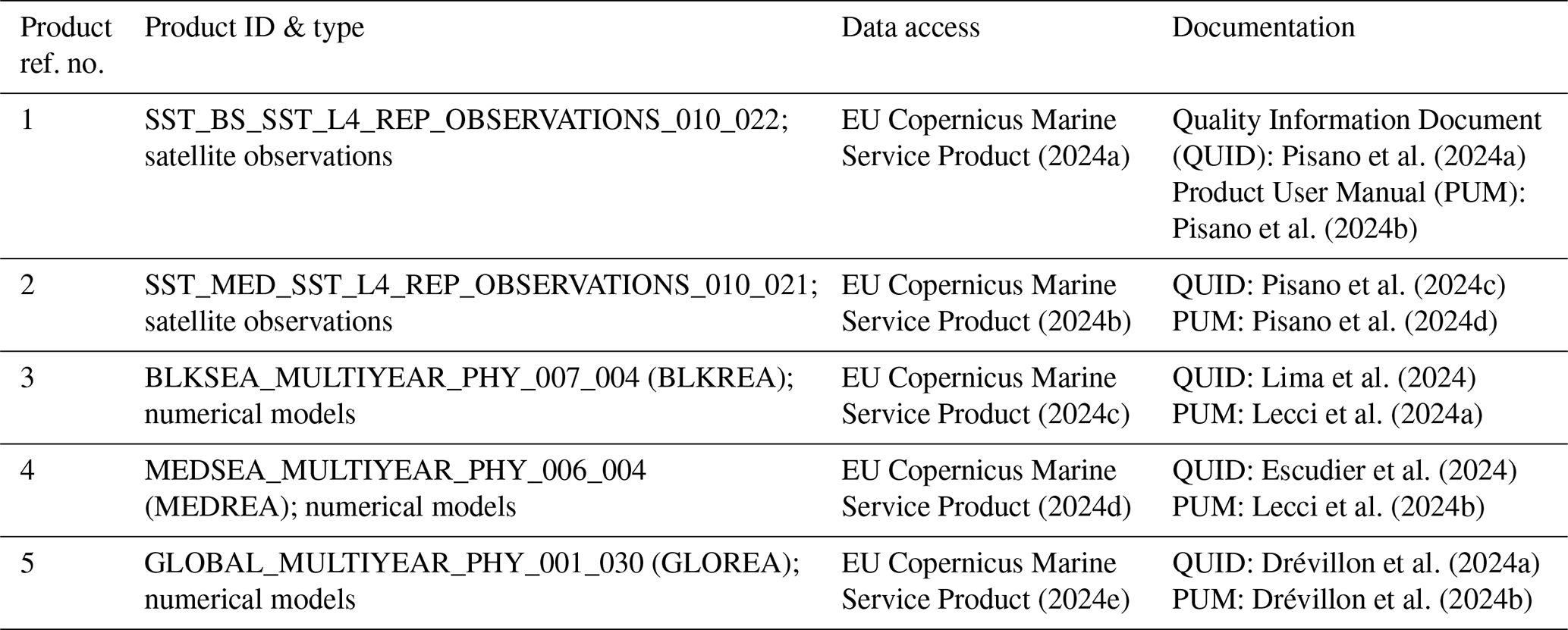
While studies on MHWs are extensive in the Mediterranean Sea, comparable research in the Black Sea remains limited. To our knowledge, Mohamed et al. (2022) is the only study to date that specifically investigates MHWs in this region using satellite data. Their analysis examined trends in MHW frequency in relation to the rate of SST warming. The new Copernicus Black Sea reanalysis (product ref. no. 3 in Table 1; Lima et al., 2026), configured at a horizontal resolution of ° with 121 vertical levels, has served as the foundation for developing Ocean Monitoring Indicators (OMIs) for the region. In particular, the OHC OMI indicates a warming trend of approximately 0.77 ± 0.07 W m−2 (2005–2022) in the Black Sea (EU Copernicus Marine Service Information, 2024a). This ocean warming signal, which has also impacted the formation of its cold intermediate layer (CIL) in recent years (Stanev et al., 2019; Lima et al. 2021, 2026), emphasizes the importance of studying MHWs in Black Sea.
We focus on OHC integrated over the upper 0–40 m layer, which encompasses the biologically productive epipelagic zone and the upper mixed layer in both the Mediterranean and Black Seas. This depth range is particularly relevant for ecology and coastal management, as it includes the main habitat of commercially important species and most aquaculture operations, where organisms are directly exposed to heat anomalies (Granata et al., 2011; Cheminée et al., 2021; Macias et al., 2019; Nenciu et al., 2023). Building on earlier efforts, this study revisits work on the Mediterranean Sea (e.g., Dayan et al., 2022, 2023) using an updated reference climatology and extends them by applying a consistent monitoring framework to both the Mediterranean and Black Seas. It includes an uncertainty assessment of key MHW metrics based on multiple datasets and provides insights into historical MHW characteristics in the less-studied Black Sea. Additionally, SST and upper-OHC indicators are integrated within a unified monitoring perspective, allowing the surface and subsurface expressions of MHWs to be jointly assessed. While the use of multiple observational and reanalysis products has been previously explored for the Mediterranean Sea, this multi-dataset approach is here applied consistently to both basins, providing new insights into historical MHW characteristics. The primary objective is to develop a comprehensive monitoring approach for MHWs in both regional seas.
The manuscript is structured as follows: Sect. 2 describes the datasets and methodologies used to detect MHWs across both basins. Section 3 presents and discusses key MHW metrics derived from the standard definition, applied to SST as well as OHC for subsurface detection. MHW metrics are subsequently examined with respect to the water mass structures in the Mediterranean and Black Seas. Section 4 concludes the study and proposes an OMI for tracking MHWs in these regions. The comparison between standard MHW metrics and those obtained using a detrending approach is presented exclusively in the Appendix as supplementary material.
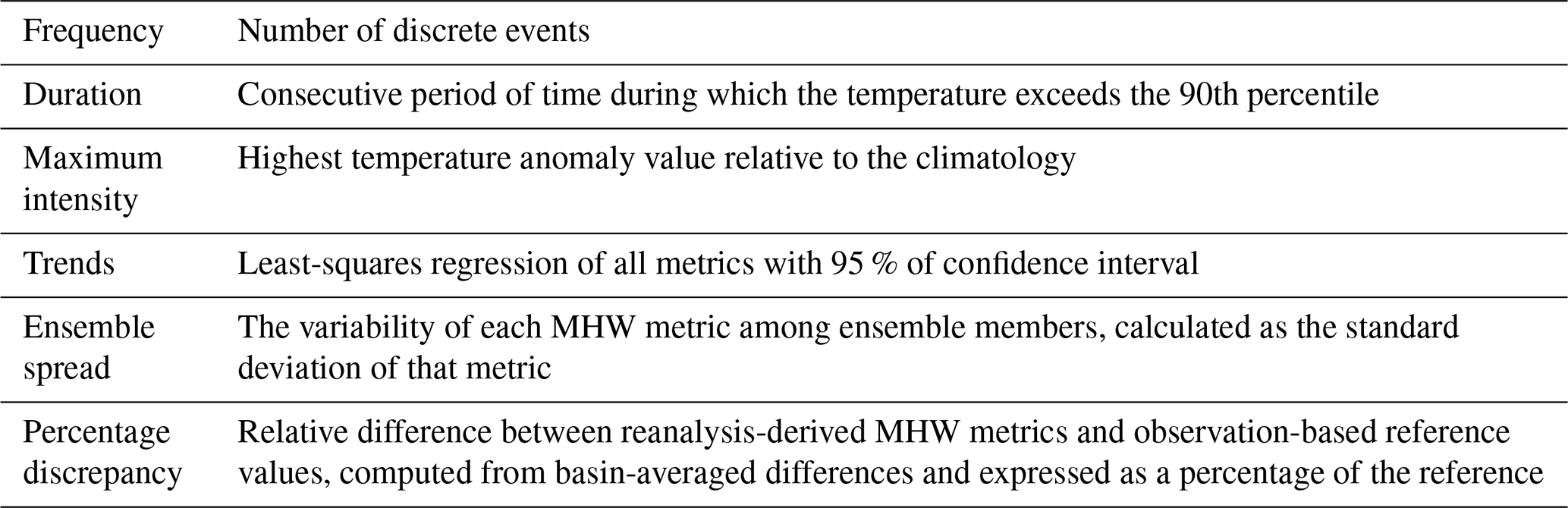
We follow the definition of MHWs from HD2016, originally formulated for SST, and extend it here to upper-OHC. The HD2016 detection framework is applied independently to each selected thermal field. A MHW is defined as a period in which the selected thermal field exceeds a set threshold for at least five consecutive days. This threshold corresponds to the 90th percentile of the local daily mean value computed over the long-term reference period (1993–2022), which was selected to ensure consistency across all datasets, as the Black Sea regional reanalysis starts in 1993, thereby accounting for the long-term warming signal present in each field. If two MHW events are separated by a gap of 2 d or fewer during which the selected field remains below the threshold, they are merged and treated as a single continuous event. In addition to the standard approach, we perform a separate analysis to examine how removing long-term trends affects MHW detection, applying a detrending method to Mediterranean subregions and to the Black Sea as a whole (Appendix A). Specifically, we remove the linear trend of SST or OHC individually at each grid point before applying the detection algorithm. Table 2 presents the MHW metrics analyzed and discussed in this study.
Table 2MHW metrics following Hobday et al. (2016) and Dayan et al. (2022), including additional diagnostic metrics used in this study.
We detect MHWs using both SST and upper-OHC integrated over the 0–40 m layer, based on regional and global reanalysis datasets, and additionally using observational SST products for SST-based analyses. The choice of the 0–40 m layer is primarily motivated by its biological relevance, as it represents the upper portion of the epipelagic zone, which concentrates most biological productivity and socio-economic activities in the Mediterranean and Black Sea (Kubryakov et al., 2020; Konsta et al., 2025), and therefore constitutes a relevant layer for assessing the biogeochemical impacts of MHWs. From a physical perspective, MLD is typically much shallower than 40 m in the Mediterranean Sea, particularly between spring and autumn (Houpert et al., 2015), and during surface MHWs (Darmaraki et al., 2024). Therefore, the 0–40 m range can also be used to identify upper ocean events which are not reflected by surface-only monitoring (Juza et al., 2022; Dayan et al., 2023). In this work, we further explore this assumption, for example during winter when MLD extends to depths beyond 40 m. Identifying extremes in heat content over a depth range is favoured over focusing on specific depth levels, given that many marine species migrate vertically throughout the day and to avoid surface-only extremes (Ma and Chen, 2025).
The Mediterranean Sea regional reanalysis (product ref. no. 4 in Table 1) is configured with a horizontal grid resolution of ° (approximately 4–5 km) and 141 unevenly spaced vertical levels (Escudier et al., 2021). In contrast, the Black Sea regional reanalysis (product ref. no. 3 in Table 1) employs a finer horizontal resolution of ° and 121 unevenly spaced vertical levels (Lima et al., 2026). Both regional reanalyses are forced with atmospheric data from the ERA5 reanalysis (Hersbach et al., 2020), assimilate in situ temperature and salinity profiles, along-track sea level anomaly observations, and apply SST relaxation to correct surface heat fluxes. They serve as the basis for MHW detection in this study. For broader comparison, MHWs are also identified using a global reanalysis product (product ref. no. 5 in Table 1), which has a coarser horizontal resolution of ° and includes 50 vertical levels (Lellouche et al., 2021). This global product is forced with ERA-Interim atmospheric reanalysis (Dee et al., 2011) until end of 2018 and ERA5 reanalysis thereafter and assimilates in situ observations, along-track SLA, and SST data. Additionally, for validation and complementarity, we compare reanalysis-derived MHW metrics based on SST with those obtained from an observational-based Level 4 SST product (product refs. no. 1 and 2 in Table 1; Pisano et al., 2016; Embury et al., 2024). All datasets can be accessed through the Copernicus Marine Service catalogue, which provides comprehensive documentation on their specifications and quality assessments.
For evaluating the OHC anomaly, we apply a formula similar to that used by Lima et al. (2020, 2021), which has also been adopted for calculating the OHC OMI for the Black and Mediterranean Seas within the Copernicus Marine Service framework (EU Copernicus Marine Service Information, 2024a, b). The OHC anomaly is defined here as the deviation from the long-term reference period and is closely proportional to the average temperature change from z1 = 0 m to z2 = 40 m depth:
with a reference density ρ0 = 1020 kg m−3 and a specific heat capacity cp = 3980 J kg−1 °C−1; Tm corresponds to the daily average temperature and Tclim denotes the climatological temperature for the corresponding day, calculated over a 30-year period (1993–2022), consistent with the baseline period used to define MHWs.
3.1 SST-Derived Surface Marine Heatwave Characterization
The surface MHW metrics in the regional reanalyses (product refs. no. 3 and 4 in Table 1) over the period 1993–2024 (Fig. 1) confirm and update the basin-scale patterns of the Mediterranean Sea previously reported (e.g. Dayan et al., 2022, 2023). The average number of MHW events is slightly lower along certain coastal regions of North Africa, particularly between 10 and 35° E (Fig. 1a). Despite this lower frequency, the average duration of events in these areas is relatively high, exceeding 30 d (Fig. 1b), suggesting fewer but more persistent heatwaves. Mignot et al. (2022) define persistent MHWs as events lasting over 38 d with SST anomalies above 2.3 °C at the global ocean scale. In contrast, most of the Adriatic Sea, as well as the Ionian Sea, Gulf of Lion, and the area extending from the Algerian current to Crete exhibit higher average numbers of events (e.g. > 2.4 per year), but shorter durations (< 18 d), indicating frequent but brief MHW occurrences (Fi. 1a–b).
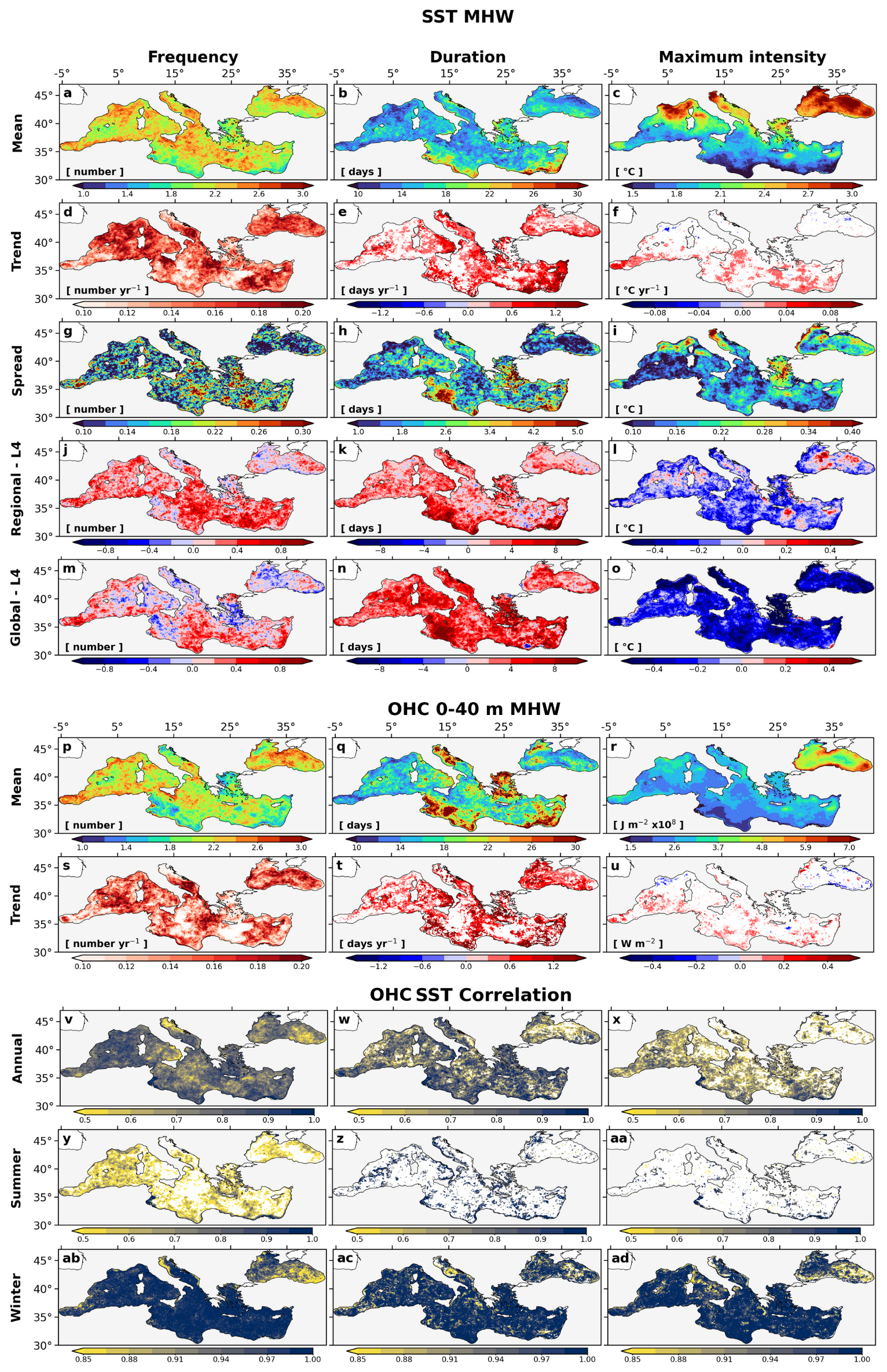
Figure 1Spatial distribution of MHW metrics derived from SST and upper OHC (0–40 m) in the regional reanalyses (product refs. no. 3 and 4 in Table 1) for the period 1993–2024. Panels (a)–(c) show the spatial patterns of mean values of annual MHW metrics based on the SST definition, while panels (d)–(f) display the corresponding statistically significant trends of annual MHW metrics (p < 0.05). Panels (g)–(i) present the spread of annual MHW metrics based on the SST definition across the regional reanalysis, global reanalysis (product ref. no. 5 in Table 1), and SST-L4 observational products (product refs. no. 1 and 2 in Table 1). Panels (j)–(l) and (m)–(o) show the differences in annual SST-derived MHW metrics between the regional and global reanalyses relative to the SST-L4 observational product. Panels (p)–(r) display the spatial patterns of mean values of annual MHW metrics derived from OHC in the regional reanalysis, while panels (s)–(u) show the corresponding statistically significant trends of annual MHW metrics (p < 0.05). Panels (v)–(x) shows the significant Pearson correlation (p < 0.05) between MHW metrics estimated from SST and OHC. Panels (y)–(aa) show the Pearson correlation between SST- and OHC-derived MHW metrics computed for summer, while panels (ab)–(ad) show the corresponding Pearson correlation based on winter MHW metrics (p < 0.05).
A similar spatial pattern is observed in the northern Black Sea, particularly in the area near the Kerch Strait, where MHWs occur more frequently but are shorter in duration, with approximately 2.6 events per year lasting between 10 to 14 d (Fig. 1a–b). In contrast, the central and southern regions of the basin, highlighted by green shading in both the spatial maps of mean frequency and duration, exhibit a lower frequency of events, ranging from around 1.8 to 2.2 events per year, but with longer average durations of approximately 18 to 22 d (Fig. 1a–b). This spatial differentiation is generally consistent with the findings of Mohamed et al. (2022), especially regarding the northern sector.
The mean intensity of MHWs is notably high in the Black Sea, exceeding 2.85 °C relative to the daily climatology for 1993–2022 in specific areas such as the northwestern shelf, the Anatolian and Caucasian coasts (Fig. 1c). In the Mediterranean Sea, similarly elevated intensities are observed in the northern Adriatic Sea and the Gulf of Lion, extending offshore towards the regions surrounding Corsica. In these areas, the results suggest that MHWs tend to be short and frequent but exhibit relatively high intensity.
The number of MHW events has increased over time, showing positive trends of similar magnitude in both the Mediterranean and Black Seas (considering only statistically significant trends, p < 0.05) (Fig. 1d). Notably, in the Mediterranean Sea the highest increases – exceeding 2 events per decade – are observed south of Sicily, in the southern Adriatic Sea, Cretan Passage (south of Greece and east of Ionian Sea), parts of the Balearic Sea, and east of Corsica and Sardinia. Regarding event duration, the most pronounced positive trends are observed in the eastern Mediterranean Sea, exceeding 12 d per decade (p < 0.05) (Fig. 1e). Meanwhile, intensity trends are strongest near the Alboran Sea, increasing around 0.5 °C per decade, and extending across the central and eastern Mediterranean with generally positive values (p < 0.05) (Fig. 1f). However, this spatial extension is irregular and lacks a coherent pattern that would suggest a continuous or regionally connected increase. In the Black Sea, significant trends exceeding 1.5 events per decade (p < 0.05) cover much of the basin, with the highest values observed south of the Crimean Peninsula (Fig. 1d). Duration trends reach maximum values between 6 and 12 d per decade, particularly in peripheral zones of the basin and over the northwestern shelf (Fig. 1e). In contrast, intensity trends are predominantly non-significant throughout the region (Fig. 1f).
We compute the spread of the main MHW metrics using the regional and global reanalyses (product refs. no. 3, 4 and 5 in Table 1) alongside the SST-L4 observational products (product refs. no. 1 and 2 in Table 1). For the number of events, relatively high spread values are observed throughout the domain (Fig. 1g); notably, the highest values, exceeding 0.3, are found in the Aegean Sea, the Alboran Sea, the eastern Mediterranean Sea. For event duration, the largest spread is observed in parts of the Aegean Sea and along the southern Mediterranean, particularly near the African coast south of Sicily, where values exceed 5 d (Fig. 1h). In comparison, the spread in duration values is generally lower across the Black Sea. The highest spread in MHW intensity, above 0.34 °C, is observed in localized areas within the Gulf of Lion and continues along the coasts surrounding Corsica into the Tyrrhenian Sea, as well as in the northern part of the Adriatic Sea and in the Aegean Sea (Fig. 1i). In the Black Sea, intensity spread values of similar magnitude are found along the western coast and west of the Crimean Peninsula.
Table 3Percentage discrepancies (%) based on basin-averaged differences in MHW metrics of the regional and global reanalyses (product refs. no. 3, 4 and 5 in Table 1) relative to the SST-L4 observational product (product refs. no. 1 and 2 in Table 1) for the period 1993–2024. Percentage discrepancies are derived from basin-averaged differences and are reported for MHW metrics at the annual scale (number of events per year, mean duration, and mean intensity), as well as for seasonal MHW metrics computed separately for summer and winter. Reanalysis products that produce MHW metrics closest to the observational SST-L4 product are highlighted in bold. The subdomain definition follows Dayan et al. (2022) and considers metrics for the entire Mediterranean (MED), as well as for the western (WMED) and eastern (EMED) Mediterranean basins, in addition to the Adriatic, Aegean, and Black Seas.
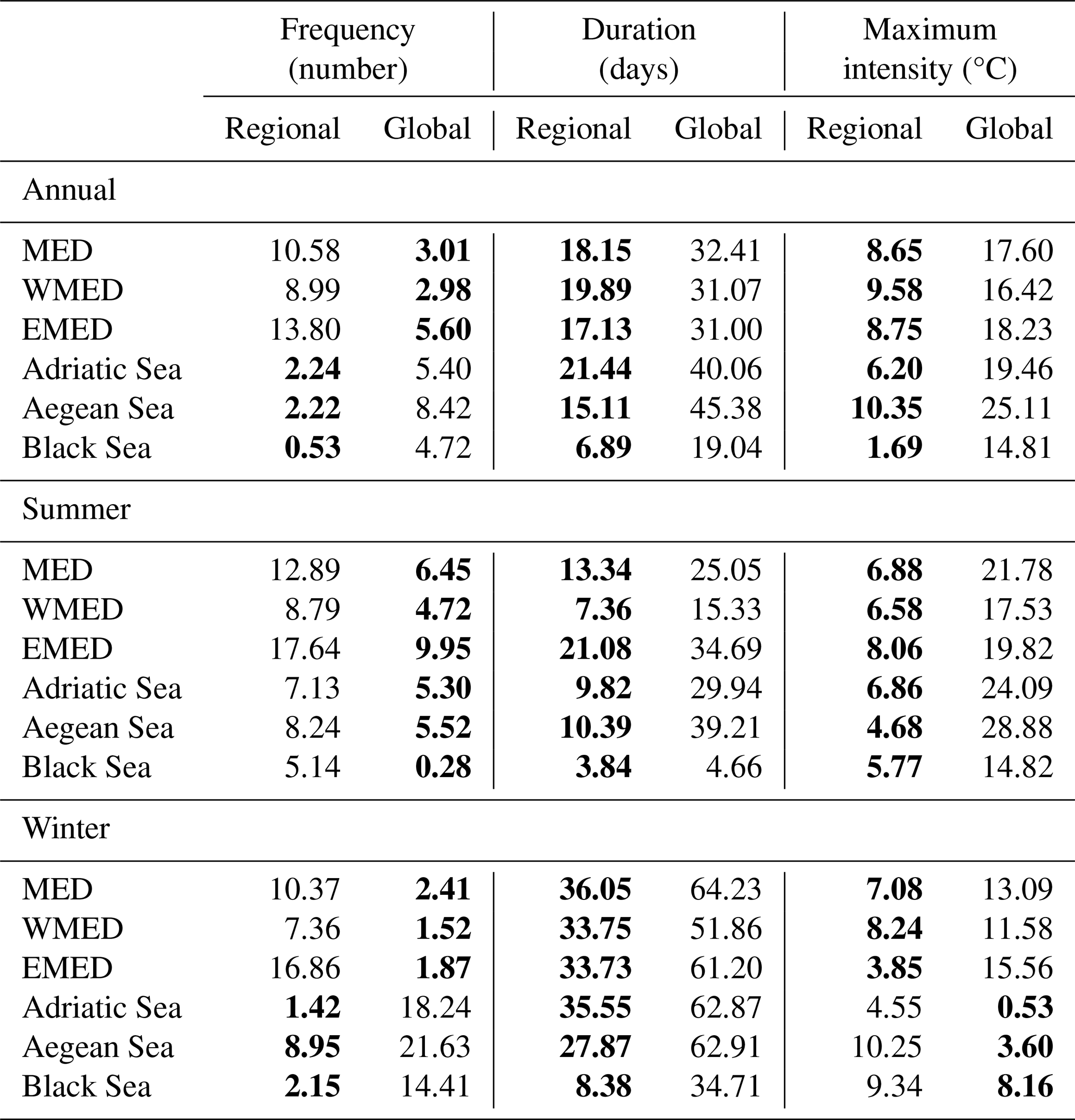
For validation, we computed the differences between metrics derived from both regional and global reanalysis data with respect to observed SST-L4 data (Fig. 1j–o), while percentage discrepancies are used to summarize basin-averaged results in Table 3. The MHW metrics derived from the regional reanalysis generally exhibit positive biases relative to the SST-L4 product in terms of number and duration, while MHW intensity from both reanalyses is lower than the observed one (Fig. 1j–o). For a more specific assessment, the Mediterranean Sea is divided into geographic subregions as proposed by Dayan et al. (2022) (Table 3). Overall, the regional reanalysis demonstrates superior performance compared to the global reanalysis, producing results that more closely match the SST-L4 reference data, as reported for the Mediterranean Sea in previous analyses by Dayan et al. (2022). An exception is observed in the number of detected events in the whole Mediterranean Sea (MED) and the West and East Mediterranean regions (WMED and EMED), where the global reanalysis typically outperforms the regional analysis.
Based on the annual SST-based MHW metrics summarized in Table 3, the overall mean percentage discrepancies in the number of MHWs per year across the entire Mediterranean and Black Seas are 10.58 % and 0.53 %, respectively, for the regional reanalysis, and 3.01 % and 4.72 % for the global reanalysis. While the regional reanalysis exhibits higher discrepancies for this metric in the Mediterranean Sea, it performs comparably overall and clearly outperforms the global reanalysis for other MHW characteristics, including duration and maximum intensity, with lower discrepancies in both basins. When considering summer MHW metrics, percentage discrepancies in the number of events are larger for the regional reanalysis across all subdomains, whereas the regional reanalysis outperforms the global reanalysis for all subdomains in terms of MHW duration and intensity (Table 3). Winter results are generally similar, with the regional reanalysis outperforming the global product across most of the domain (Table 3). Exceptions occur for frequency when considering either the Mediterranean basin as a whole or the western and eastern Mediterranean individually, and also for MHW intensity over the Adriatic, Aegean and Black Seas, where the ensemble spread of SST-derived intensity metrics is relatively high (Fig. 1i).
An overview of surface MHWs, highlighting the key findings, follows.
-
Based on annual average metrics, MHWs show clear spatial differences: the northern Mediterranean and northern Black Sea generally experience frequent but short events, while the southern Mediterranean and central-southern Black Sea generally have fewer but longer-lasting heatwaves.
-
According to annual average intensities, intensity hotspots are identified, with the strongest heatwaves in the northwestern Black Sea, Anatolian and Caucasian coasts, northern Adriatic, Gulf of Lion, and areas surrounding Corsica.
-
Trends calculated from annual averages generally show significant increases in the number and duration of MHWs in both seas, with regional differences in intensity trends.
3.2 OHC-Derived Subsurface Marine Heatwave Characterization
We also compute analogous MHW metrics based on upper OHC (0–40 m; Fig. 1p–u). In the Mediterranean Sea, the average number of MHW events decreases compared to those derived from SST, particularly along the African coast (from 10 to 35° E), in the Adriatic Sea, around the Gulf of Lion, and throughout much of the central basin between 15 and 30° E (Fig. 1p). These results are consistent with the conclusions of Dayan et al. (2023). In contrast, the number of subsurface MHW events increases in certain regions, such as parts of the Alboran Sea, though this increase is spatially limited, and across most of the Black Sea.
Unlike the number of events, the mean duration of subsurface MHWs is generally longer as compared to the events observed at the sea surface across many regions in both the Mediterranean and Black Seas (Fig. 1q). In the Mediterranean Sea, notable increases in event duration are observed in the Aegean Sea, the northern and central Adriatic Sea, and the central basin – particularly between 10 and 20° E. This includes the Gulf of Gabès and the adjacent coasts of Tunisia and Libya, where average event durations can exceed 28 d. In the Black Sea, duration increases are observed particularly in the western part, between 25 and 35° E, with values exceeding 24 d along the northwestern coast.
For intensity, the OHC-based results reveal patterns (Fig. 1r) that are not captured by the SST-based definition (Fig. 1c). A shared feature of both SST- and OHC-derived MHW intensity is the elevated values consistently observed in the Black Sea relative to most of the Mediterranean Sea. Notably, in the Black Sea, the mean intensity from OHC shows distinct signals associated with the Rim Current and mesoscale eddies. For example, values exceed 7.0 × 10⁸ J m−2 in the Batumi region, located in the southeastern part of the basin, and reach approximately 6.0 × 10⁸ J m−2 west of Crimea, near the Sevastopol eddy region. Similar to the SST-derived metric, the OHC-derived intensity also shows relatively higher values in the northern Mediterranean, particularly over the Gulf of Lion, Strait of Otranto, the Crete gyre, southeast of Cyprus (Latakia eddies), Antalya Bay (Asia minor current) and the Alboran Sea. In these regions, the mean intensity can reach values above 3.7 × 10⁸ J m−2.
Similarly to the SST-derived metric, the OHC-based trends show positive values for both the number and duration of MHW events (Fig. 1s–t). In the Mediterranean Sea, strong trends, exceeding 2 events per decade, are observed in the central and south Adriatic Sea, Cretan Passage (east of the Ionian Sea and south of Greece), parts of the Balearic Sea and Algerian basin (Fig. 1s). These regions coincide with areas where the SST-based trends in the number of events are also elevated (Fig. 1d). In contrast, the OHC-derived trends are relatively lower in regions such as the southern coast of Sicily and the eastern coasts of Corsica and Sardinia, when compared to the corresponding SST-derived trends. In the Black Sea, the number of events exhibits stronger increasing trends along the Rim Current, a signal not captured by the SST-based metric. For event duration, the OHC-based trends display more spatial gaps (areas with no statistically significant trend), particularly in the eastern Mediterranean (Fig. 1t), where trend values are also slightly lower compared to those derived from SST (Fig. 1e). An interesting finding emerges for MHW intensity: OHC-based trends show localized negative values along the Rim Current pathway, especially near the Anatolian coast and in areas adjacent to the Kerch Strait (Fig. 1u). In the Mediterranean Sea, small areas of negative trends in intensity are observed in regions such as the Gulf of Lion and the Crete gyre (Fig. 1u). Among these, only the Gulf of Lion also exhibits similar negative trends in the SST-based definition (Fig. 1f).
Correlation maps for the period 1993–2024 show statistically significant agreement between annual-average MHW metrics derived from SST and OHC in the upper 0–40 m throughout large areas of the western and central Mediterranean Sea (Fig. 1v–x). Considering the number of events, significant correlations are observed in most of the Mediterranean, but this decreases toward the central and eastern basins and in the Black Sea. Event duration exhibits generally stronger and more spatially consistent correlations, particularly in the Mediterranean Sea, with r values often exceeding 0.8, while correlations in the Black Sea are weaker overall. Correlations for event intensity tend to be lower and more variable, with non-significant values covering nearly the entire Black Sea and the central and northern Adriatic Sea.
While correlations indicate agreement between surface and subsurface MHW metrics on an annual scale (particularly for frequency and duration; Fig. 1v–x), they may mask differences in timing, depth structure, or seasonal behavior. To partially address this limitation, we further examine seasonal correlations, which reveal marked contrasts between summer and winter conditions. During summer (Fig. 1y–aa), correlations are generally weaker, which is consistent with enhanced upper-ocean stratification and a shallower mixed layer. Given that OHC is defined over the upper 0–40 m and that summer mixed-layer depths are typically shallower than 40 m in both basins (Kara et al., 2009; Houpert et al., 2015), SST- and OHC-derived MHW metrics tend to diverge, suggesting that additional subsurface processes below the mixed layer may contribute to summer MHW development. This seasonal decoupling highlights the relevance of a combined detection approach using both surface and subsurface indicators. In contrast, during winter (Fig. 1ab–ad), increased vertical mixing and convective processes deepen the mixed layer, in some regions exceeding 70 m, resulting in consistently high significant correlations between SST- and OHC-based MHW metrics across most of the Mediterranean and Black Seas, with values above 0.85 (p < 0.05). Overall, these seasonal correlation patterns are consistent with the findings of Juza et al. (2022), who associated shallow, intense MHWs during summer with strong stratification and deeper penetration of thermal anomalies in winter when vertical mixing is enhanced.
The following highlights summarize the main patterns and trends of MHWs identified using the upper-OHC (0–40 m) definition:
-
Subsurface MHWs generally last longer than surface events. The average number of events is lower in some Mediterranean regions (e.g., African coast, Adriatic Sea, central basin) and higher across most of the Black Sea.
-
Subsurface MHW intensities are highest in the Black Sea, particularly near the Rim Current and mesoscale eddies. In the Mediterranean, average intensities are lower, with relatively elevated values in some regions such as the Gulf of Lion, Crete gyre, and Alboran Sea.
-
Trends calculated from annual averages show increasing numbers and durations of subsurface MHWs, with the strongest increases in the central and south Adriatic Sea and Cretan Passage for the number of events (Mediterranean), and along the Rim Current for the number of events and in the western Black Sea for duration; very localized negative intensity trends occur in both seas.
-
Correlations between SST- and upper-OHC-derived MHW metrics increase in winter with deeper mixing and convection, but are weaker in summer due to stratification and shallow mixed layers, highlighting the added value of combining surface and subsurface indicators.
3.3 Sensitivity of SST- and OHC-Based MHW Metrics and Water Mass Structure
The objective of this section is to characterize MHW events using both definitions and to assess the sensitivity of each approach to the vertical structure of water masses. This section does not explore causal relationships or feedbacks between MHWs and water mass formation. Instead, it provides a descriptive evaluation of how different MHW definitions respond to varying water mass structures.
3.3.1 Black Sea Cold Intermediate Layer
In the Black Sea, a prominent feature is the CIL, a subsurface cold water mass that forms during winter through surface cooling and convective mixing. The CIL, typically characterized by temperatures below 8 °C and found at depths of 30 and 80 m (Ivanov et al., 2001), contributes significantly to subsurface ventilation (Özsoy and Ünlüata, 1997). Its seasonal formation is driven by dense surface waters sinking during cold winters, and it can modulate heat distribution in the upper ocean. The warming of the Black Sea has led to an increased occurrence and intensity of MHWs and has significantly contributed to the gradual disappearance of the CIL, as evidenced by both observational and reanalysis datasets (Stanev et al., 2019; Lima et al., 2021, 2026).
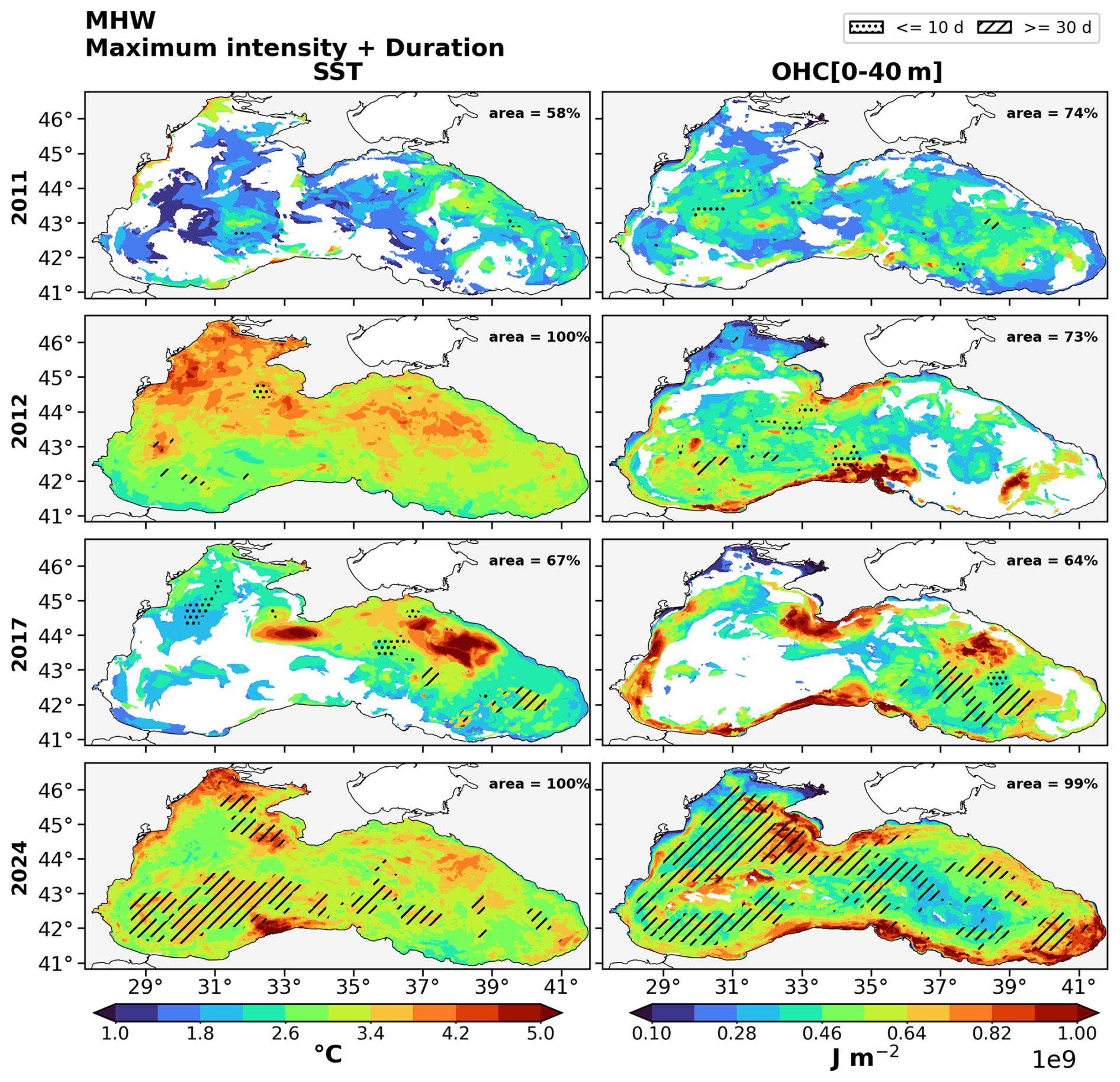
Figure 2Spatial distribution of the yearly average of maximum intensity of MHW events for selected years in the Black Sea using SST-based (left) and OHC-based (right) definition. Hatched areas highlight regions where events lasted less than 10 d or more than 30 d. Results are derived from the Black Sea regional reanalysis (product ref. no. 3 in Table 1).
In the Black Sea, the detection of MHWs differs significantly between surface- and subsurface-based metrics, particularly in years marked by the formation of the CIL (e.g. 2012) which alters the thermal structure of the water column. Figure 2 shows MHWs intensity and duration evaluated using both SST-based (left) and OHC-based (right) definitions for selected years: 2011 is included due to a pronounced negative surface temperature anomaly. The years 2012 and 2017 feature the presence of the CIL, with 2012 showing a well-developed CIL and 2017 a less pronounced presence (Stanev et al., 2019; Lima et al., 2026). The year 2024 is included as it exhibited record breaking MHW intensity. In 2011, reanalysis data revealed negative temperature anomalies confined to the near-surface layers, promoting the subduction of cold water and contributing to the development of a well-defined CIL in 2012 (Lima et al., 2026). These thermal structures influence MHWs detection differently depending on the metric applied. In 2011, SST-based metrics indicate limited MHW coverage due to cooler surface conditions. However, in 2012, OHC-based metrics show significantly reduced MHW spatial extent compared to SST-based estimates (see also Fig. 4, discussed in a later section), highlighting the importance of vertical heat distribution in accurately characterizing MHWs. In 2017, another year marked by the presence of the CIL, cold temperatures were more uniformly distributed throughout the upper layers in the Black Sea. In this case, SST- and OHC-based definitions produced closely aligned metrics, both indicating diminished MHW coverage, particularly in the western Black Sea. These findings demonstrate how the presence and vertical structure of the CIL influence the detection and apparent intensity of MHWs, depending on whether surface or subsurface indicators are used.
In 2017 and 2024, the OHC-based metric detected a more pronounced signal, with intensified MHW events notably concentrated along the Rim Current and in eddy-dominated areas, such as the Sevastopol eddy located west of Crimea. This spatial distribution aligns with the long-term pattern observed in OHC-derived metrics over the period 1993–2024 (Fig. 1r), reinforcing the consistency of subsurface-driven MHW signals in these dynamically active regions. In contrast, the SST-based approach does not completely capture these features, highlighting the added value of incorporating subsurface heat content to more accurately represent MHW intensity and spatial variability. In 2024, surface MHW intensity increased substantially, surpassing 4.6 °C along the Anatolian coast, a region influenced by summer upwelling (Gunduz et al., 2022), and reaching up to 1 × 10⁹ J m−2 in areas along both the southern and northern branches of the Rim Current. Furthermore, both SST- and OHC-based definitions identify events with durations exceeding 30 d, with consistent detections particularly evident west of Crimea and in the central and southwestern parts of the basin.
To summarize the interaction between MHWs and the CIL in the Black Sea:
-
Long-term warming has led to an increased occurrence of MHWs and to a progressive reduction or even absence of the CIL in recent years (see also Fig. 4 later).
-
Nevertheless, in years characterized by more severe winters (e.g., 2012 and 2017), the CIL can still develop, altering the upper-ocean thermal structure and leading to substantial differences between SST- and OHC-based metrics when the CIL is well developed (e.g., 2012), and to more convergent estimates when subsurface cooling is more vertically uniform (e.g., 2017).
-
OHC-based metrics consistently emphasize dynamically active regions, such as the Rim Current and associated eddies, highlighting the importance of subsurface heat content for resolving the spatial structure and intensity of Black Sea MHWs.
3.3.2 Southern Adriatic Sea Pit and the Eastern Mediterranean Deep Water
To better understand how MHW metrics respond to changes in water mass structure in the Mediterranean Sea, we focus on the Southern Adriatic Sea Pit (SAP), a key area for the formation of Eastern Mediterranean Deep Water (EMDW), which occurs during winter. Since this process affects how deep the surface layer mixes, it can influence how MHWs are detected.
The Adriatic Deep Water (ADW), along with the North Adriatic Dense Water (NAdDW), is identified as one of the main sources of EDMW (Gačić et al., 2001; Paladini de Mendoza et al., 2022; Parras-Berrocal et al., 2023). The southward spread of NAdDW along the western Adriatic coast, together with open-ocean convection in the center of the permanent cyclonic gyre over the SAP, contributes to the formation of ADW (Denamiel et al., 2025). ADW plays a significant role in maintaining the overturning circulation of the Mediterranean Sea.
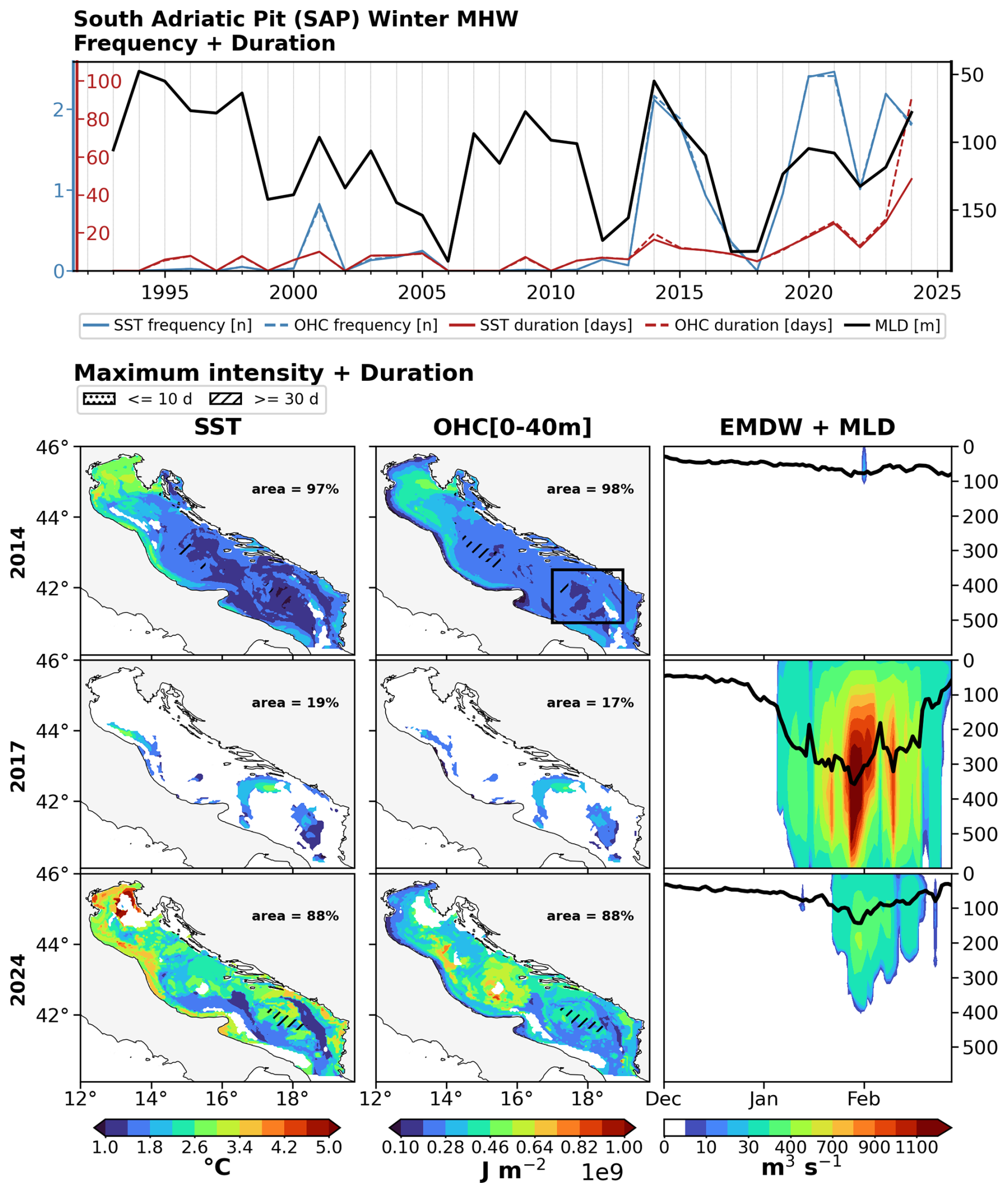
Figure 3Upper plot: Time series show basin-averaged MHW frequency and duration (days) from two definitions based on SST and OHC, together with mean MLD during winter (1993–2024) in the SAP region. Lower plot: Spatial maps exhibit MHW maximum intensity based on SST (°C) on the left and OHC (0–40 m, J m−2) in the middle for 2014, 2017, and 2024 in the Adriatic Sea. The black rectangle on the 2014 OHC map indicates the SAP region. Hatched areas highlight regions where events lasted less than 10 d or more than 30 d. Hovmöller diagrams on the right panels reveal water mass formation rates of the EMDW (m3 s−1) overlapped by daily mean MLD values for the winter months in the SAP region. Results are derived from the Mediterranean Sea regional reanalysis (product ref. no. 4 in Table 1).
Figure 3 presents a time series of wintertime mean values for the number, duration, and intensity of MHW events evaluated using both SST-based and OHC-based approaches, together with the winter mean MLD, defined as the depth where potential density increases by 0.01 kg m−3 relative to 10 m, all averaged over the SAP basin. In most years, lower MHW frequency and shorter event durations are associated with deeper MLDs, typically exceeding 100 m. An interesting observation occurs in 2014, when relatively higher MHW metrics – exceeding two events with durations longer than 15 d based on both SST- and OHC-derived estimates – coincide with a relatively shallow winter MLD, averaging approximately 50 m. This suggests that the increased presence of MHWs may have contributed to a more stratified winter, a behavior that may be partly explained by anomalous atmospheric forcing, consistent with the findings of Le Meur et al. (2025), who reported positive wintertime heat flux anomalies from ERA5 reanalysis in the South Adriatic during 2014.
Similarly, data from the Copernicus OMI on Mediterranean Water Mass Formation Rates (EU Copernicus Marine Service Information, 2024c) indicate an abrupt decline in EMDW formation, with notably low transport (in Sverdrups), during the 2014–2016 period. Kokkini et al. (2020) reported that 2014 was characterized by less saline water dominating the upper layers across the entire pit, accompanied by a significant heat gain in the whole Adriatic Sea. These conditions likely suppressed winter convection, leading to weakened ADW formation, while the associated heat gain may have contributed to the observed increase in MHW activity. In 2017, EMDW formation was reestablished, consequently accompanied by a marked increase in winter MLD and a sharp decline in MHW events.
The Hovmöller diagrams in Fig. 3 presents the wintertime EMDW formation rates for key years, illustrating a significant increase in 2017 compared to 2014. The methodology for estimating EMDW formation follows Simoncelli and Pinardi (2018), consistent with the approach applied in the OMI analysis described in the paragraph above. These years were selected to illustrate contrasting MHW detection patterns under varying deep-water formation regimes (see spatial maps in Fig. 3). In 2014, widespread MHWs across the Adriatic Sea, particularly in the SAP, indicate inhibited convective mixing, leading to weaker EMDW formation and a shallower winter MLD. Conversely, in 2017, stronger convective conditions prevailed, reflected in deeper MLDs and higher EMDW formation rates, coinciding with a substantial reduction in MHW activity.
We also present the results for 2024, when the MHW assumed a higher intensity in the Adriatic Sea and events lasted more than 30 d in the SAP region (Fig. 3; top). In that year, the time series also indicates a reduction in winter MLD, which is accompanied by elevated MHW metrics, underscoring how MHWs influence the ocean's stratified state. Unlike in 2014, when vertical convection ceased, the Hovmöller diagram for 2024 reveals signs of vertical convection that may be influenced by regional salinity.
Overall, time series of wintertime MHW estimates derived from both SST- and OHC-based definitions demonstrate strong spatial agreement in the Adriatic Sea, although intensity maps reveal differing spatial patterns, with distinct regions of higher intensity depending on the metric used (Fig. 3). To summarize, the wintertime interaction between MHWs, upper-ocean stratification, and deep-water formation in the Southern Adriatic Sea reveals that:
-
Enhanced wintertime MHW activity is associated with increased upper-ocean stratification, expressed by a shallower MLD, whereas deeper winter mixing is consistently linked to reduced or absent MHW occurrence.
-
High wintertime MHW activity and associated heat gain (e.g., 2014) coincide with weakened winter convection and reduced EMDW formation, while years characterized by stronger convection (e.g., 2017) exhibit deeper mixed layers and suppressed MHW activity.
3.4 Intensity-Based Analysis of MHW in the Black and Mediterranean Seas
Our findings indicate that the use of a single method for monitoring MHWs, whether based exclusively on SST or OHC, is insufficient to fully characterize and monitor MHWs across both the Black and Mediterranean Seas. Each index reflects different aspects of ocean warming and is influenced by distinct physical drivers, with SST closely linked to atmospheric conditions and OHC representing heat stored beneath the surface. When applied separately, these indices may offer an incomplete representation of thermal anomalies, limiting their effectiveness in capturing the full scope and variability of MHWs in both seas. Our results support previous findings (e.g., McAdam et al., 2023) that highlight the importance of incorporating subsurface information into monitoring strategies. Therefore, we recommend a combined approach that integrates SST- and OHC-based definitions, including event intensity levels based on the categorization framework such as established by Hobday et al. (2018). Figures 4 and 5 show this combined approach applied to the Black Sea and Mediterranean Sea respectively.
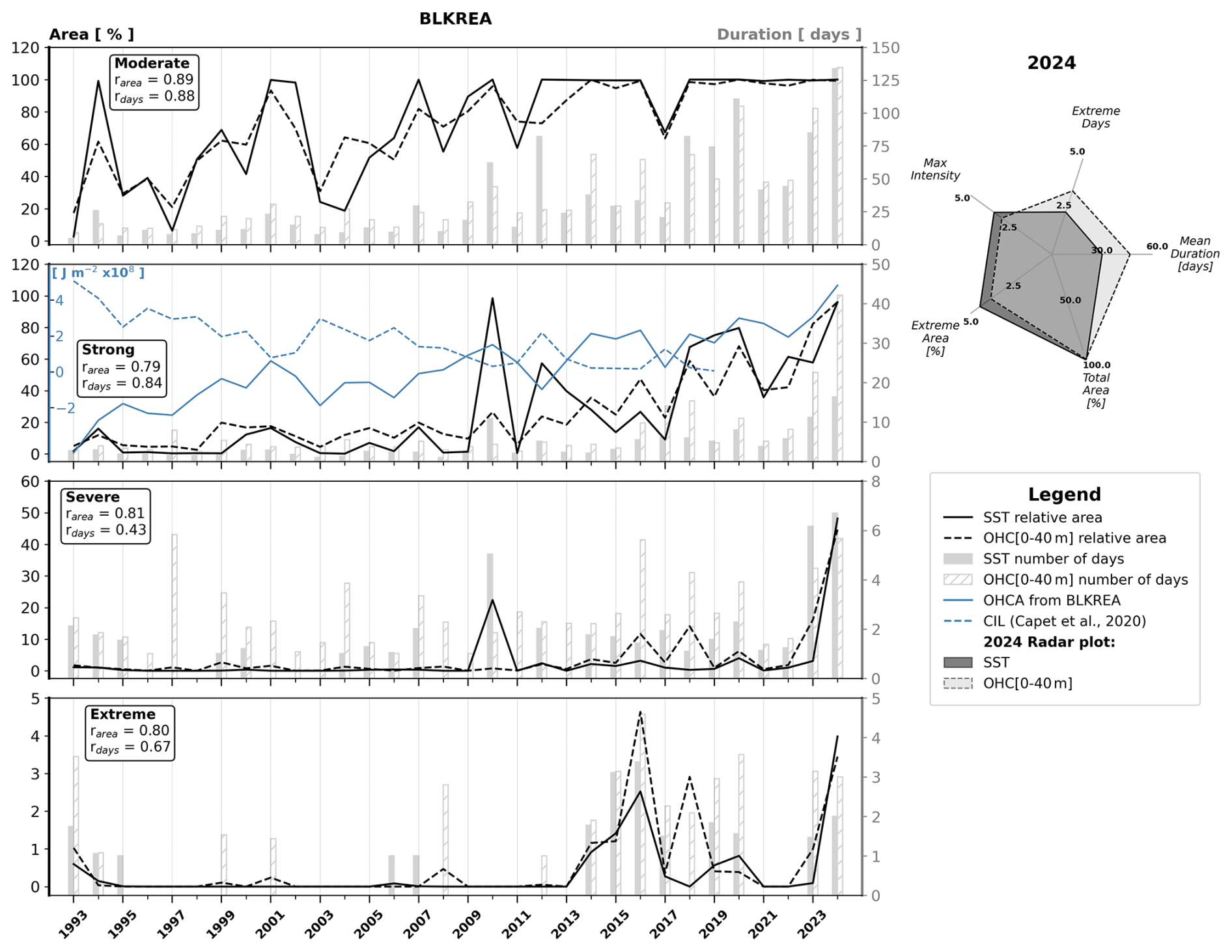
Figure 4Time series of the temporal and basin-wide mean spatial coverage of MHW events in the Black Sea based on SST (solid line) and OHC (dashed line) definitions. Results are derived from the Black Sea regional reanalysis (product ref. no. 3 in Table 1). The bars show the mean number of days of events for each category over the years, with SST-based values in grey and OHC-based values shown with hatching. On the right, the radar chart summarizes selected MHW metrics using both definitions for the year 2024. Events are categorized as moderate, strong, severe, or extreme, following the classification by Hobday et al. (2018). The correlations between the spatial coverage (rarea) and number of days (rdays) are also presented for each category. For the “strong” category, blue curves show the time series of OHC anomalies within 0–100 m (solid blue line) and CIL cold content from observations (dashed blue line; Capet et al., 2020).
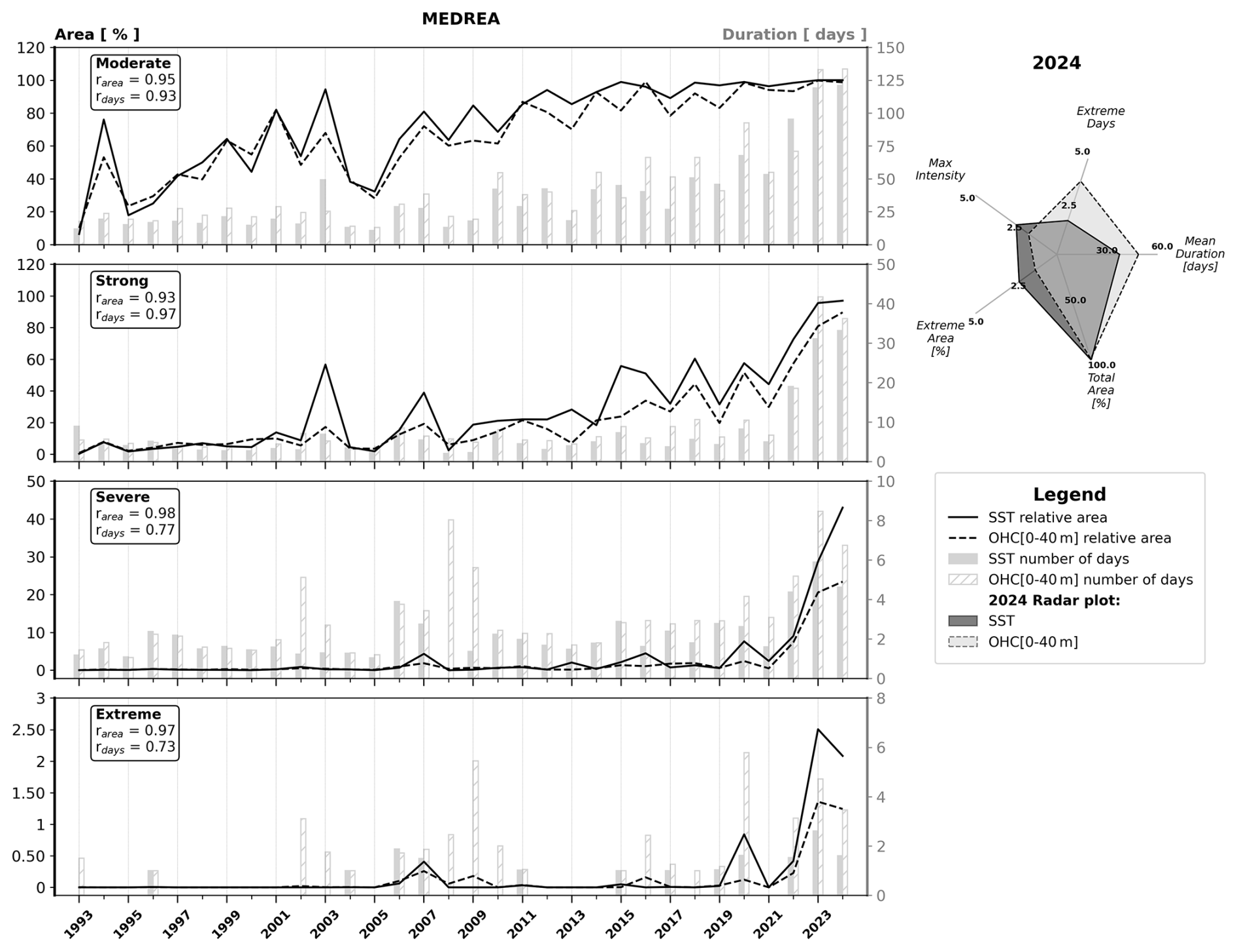
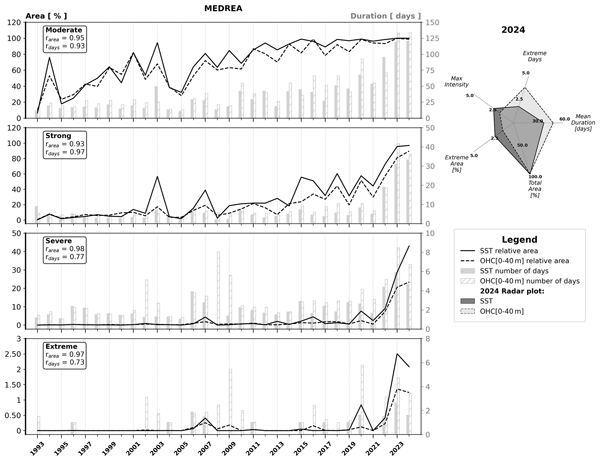
Figure 5Time series of the temporal and basin-wide mean spatial coverage of MHW events in the Mediterranean Sea based on SST (solid line) and OHC (dashed line) definitions. Results are derived from the Mediterranean Sea regional reanalysis (product ref. no. 4 in Table 1). The bars show the mean number of days of events for each category over the years, with SST-based values in grey and OHC-based values shown with hatching. On the right, the radar chart summarizes selected MHW metrics using both definitions for the year 2024. Events are categorized as moderate, strong, severe, or extreme, following the classification by Hobday et al. (2018). The correlations between the spatial coverage (rarea) and number of days (rdays) are also presented for each category.
In the Black Sea, both the average spatial extent and basin-average number of days of moderate MHW events have increased over time, with recent years showing coverage extending across nearly the entire basin (Fig. 4). A notable result is found in 1994, when the SST-based definition indicates that moderate events cover almost the entire sea, with the basin-average number of days exceeding 25. By comparison, the OHC-based definition for the same year shows spatial coverage of about 60 % and a slightly lower basin-average number of days, just below 25. As discussed in the previous section, years marked by the presence of the CIL can exhibit distinct behavior depending on the MHW definition applied. In 2012, the SST-based definition indicates nearly complete basin-wide coverage of moderate MHWs on an annual scale, whereas the OHC-based definition shows less than 80 % coverage. In contrast, during 2017, when the cold signal associated with the CIL was more uniformly distributed throughout the water column, both definitions produced similar metrics for moderate events, with spatial coverage around 60 % and a basin-average of approximately 25 d. The correlation between moderate MHW metrics derived from SST and OHC definitions is 0.89 for spatial coverage and 0.88 for the basin-average number of days, both statistically significant (p < 0.05).
The spatial coverage of strong MHW events shows a positive trend over time for both definitions. In contrast, no clear trend is observed in the basin-averaged number of days, although elevated values are noted in recent years, particularly in 2023 and 2024. The year 2010 is particularly notable, with the SST-based definition indicating that strong events affect nearly the entire basin and the basin-average number of days exceeded 10. This signal is not captured by the OHC-based definition. Similarly, SST-based metrics indicate that more than 20 % of the basin was affected by severe events in 2010, a pattern not detected using the OHC approach. Mohamed et al. (2022) associated the exceptionally high MHW activity in 2010 with the influence of El Niño, suggesting a potential link between large-scale climate variability and surface heatwave manifestations in the Black Sea. The presence of the CIL is also reflected in the detection of strong events in 2012, when the SST-based definition shows a wider spatial extent than the OHC-based definition, further highlighting the impact of subsurface thermal structure on MHW detection in the Black Sea. To further illustrate this, we include the 0–100 m OHC anomaly from the Black Sea regional reanalysis, together with observational estimates of CIL cold content from Capet et al. (2020). These datasets respectively show a decline in OHC and an increase in CIL cold content in both 2012 and 2017, consistent with a more pronounced CIL presence during those years, which may have affected the detection of MHWs using the OHC-based definition. Correlation coefficients between SST- and OHC-based metrics are statistically significant (p < 0.05). For spatial coverage, the coefficients are 0.79, 0.81, and 0.80 for the strong, severe, and extreme categories, respectively. For the basin-average number of days, the corresponding correlations are 0.84, 0.43, and 0.67.
Considering all categories, the year 2024 exhibits record-high values in both spatial coverage and basin-average number of days for MHW events, based on both SST- and OHC-based definitions. In this year, moderate events were detected on more than 125 d according to both definitions, while the OHC-based definition indicates that strong events occurred with a basin-average duration of approximately 40 d. Detection based on either SST or OHC reveals spatial coverage exceeding 80 % for strong events and approaching 50 % for severe events. Although extreme events covered a smaller area in 2024, their occurrence remains relatively high compared to previous years in the time series. Additional MHW metrics for 2024 are summarized in the radar chart (Fig. 4, right).
In the Mediterranean Sea (Fig. 5), both the basin-averaged number of days and spatial extent of moderate and strong MHW events have increased in recent years, with peaks occurring in 2023 or 2024 depending on the metric and definition used. In 2023 and 2024, moderate events nearly cover the entire basin, with the mean number of days exceeding 100. Although strong events occur less frequently and affect smaller areas, their spatial extent and mean total days have increased significantly since 2021, peaking in 2024 with values exceeding 80 % coverage and approximately 40 d. An exception to this overall increasing trend occurred in 2005, when a notable decline in the spatial extent of both moderate and strong MHWs was observed. This anomaly coincides with an abrupt disruption in the long-term warming trend reported in the Mediterranean Sea that year, which had consequences for the formation of Western Mediterranean Deep Water (López-Jurado et al., 2005; Beuvier et al., 2012).
When comparing definitions, OHC-based metrics generally indicate lower spatial coverage for both moderate and strong MHW events relative to SST-based estimates. Severe events cover less than 10 % of the basin for most years in the study period, although recent years show an increase, with SST- and OHC-based values reaching approximately 40 % and 20 %, respectively, in 2024. Despite this expansion in spatial extent, the frequency of severe events remains low, with these events typically occurring on fewer than 7 d.
Overall, metrics derived from SST- and OHC-based definitions exhibit strong and statistically significant correlations (r > 0.9, p < 0.05). However, the mean total days of severe and extreme events show lower correlations of 0.77 and 0.73, respectively. The year 2024 displays notably high values across multiple MHW metrics, as illustrated in the radar chart (Fig. 5, right).
To synthesize the intensity-based analysis of MHWs in the Black and Mediterranean Seas, the main findings are summarized as follows:
-
SST- and OHC-based definitions provide complementary information, and their combined use is required to robustly characterize MHW intensity, duration, and spatial extent across both basins.
-
Subsurface thermal structure, particularly the presence of the CIL, strongly modulates MHW detection in the Black Sea.
-
The Mediterranean Sea exhibits recent MHW intensification consistent with the Black Sea. The year 2024 represents an unprecedented MHW year, with record-high spatial coverage and basin-averaged duration across multiple intensity categories in both seas.
We update and expand the analysis of MHW metrics in the Mediterranean Sea and apply a similar assessment to the Black Sea, following HD2016. For both regions, we estimate the uncertainty of SST-based MHW metrics using three different products and extend the analysis to sub-surface MHWs by means of an OHC-based formulation. This ensemble-based approach can be further strengthened by including additional reanalyses and observational datasets, thereby allowing for a more robust quantification of uncertainties. The regional reanalysis provides more reliable estimates than the global reanalysis, closely aligning MHW metrics with observational SST data. MHW metrics derived from SST and OHC are generally consistent, with high correlation in event duration (r > 0.8, p < 0.05) across the central and eastern Mediterranean. The number of MHW events also exhibits generally high correlations, though values decline toward the central and eastern Mediterranean and parts of the Black Sea, where correlation coefficients fall below 0.6 (p < 0.05) and become non-significant (p > 0.05) over a more extensive area (Fig. 1v–x). However, substantial differences also emerge, including variations in intensity patterns and cases where surface anomalies are not accompanied by subsurface warming, and vice versa. These contrasts highlight the importance of using SST- and OHC-based formulations as complementary sub-indicators to better characterize the full vertical structure and spatial complexity of MHWs.
Our seasonal analysis further refines these conclusions by showing that the agreement between surface and subsurface MHW metrics is strongly season-dependent. Although annual correlations are generally high, they mask pronounced summer–winter contrasts. During summer, enhanced upper-ocean stratification and shallow mixed-layer depths lead to weaker correlations between SST- and OHC-derived metrics, indicating that surface-only definitions do not fully capture the subsurface structure of MHWs (and vice versa). This limitation is particularly relevant because summer MHWs are typically more intense and associated with the strongest ecological and socio-economic impacts (Wang and Zhou, 2024). In contrast, winter conditions are characterized by deeper mixed layers and enhanced vertical mixing, resulting in consistently high and significant correlations between SST- and OHC-based metrics across most of the Mediterranean and Black Seas. Together, these results demonstrate that while surface and subsurface indicators converge under well-mixed winter conditions, a combined SST–OHC monitoring approach is essential to adequately characterize the vertical structure and impacts of MHWs, particularly during summer.
In the Black Sea, OHC-derived MHW intensity highlights subsurface processes associated with the Rim Current, capturing localized maxima that are absent in SST-based estimates. In 2012, the presence of a well-developed CIL led to subsurface cooling, which masked the MHW signal in OHC, while surface temperature anomalies remained detectable using the SST-based definition. In the Adriatic Sea, surface and subsurface MHWs show generally consistent frequency and duration over time, particularly in the SAP region. However, the spatial distribution of maximum intensity often diverges between SST- and OHC-based definitions, with peak values located in different areas depending on the definition used. These variations highlight the limitations of using either SST- or OHC-based definitions alone. Radar plots that integrate intensity, duration, and spatial extent are useful for monitoring the temporal evolution of MHW characteristics. They serve as synthetic indicators for ocean monitoring and help synthesize interannual differences as well as those arising from the use of SST versus OHC definitions.
In 2024, both the Black Sea and Mediterranean Sea experienced record-high MHW intensities and durations, with events lasting over 30 d and temperature anomalies exceeding 4.6 °C in key regions such as the Anatolian coast (Fig. 2, bottom left), where summer upwelling commonly influences local ocean conditions. These extreme recent events underscore the urgency of refining monitoring strategies and understanding the mechanisms behind MHW development in these semi-enclosed basins.
Our findings provide valuable insights for monitoring MHWs in both seas. We recommend a MHW OMI that integrates both SST and OHC definitions to capture surface and subsurface heatwave signals in the Mediterranean and Black Seas. While the HD2016 definition remains practical for current monitoring, future studies may benefit from refined methods such as higher percentiles, moving average climatologies, or detrending to better separate extremes from long-term warming (Appendix A). Since the 90th percentile may be less restrictive for some regions, categorizing MHWs according to their intensity remains essential, and the Hobday framework provides a robust basis by classifying events as moderate, strong, severe, or extreme.
While the need to provide information on both surface and subsurface characteristics of MHWs is made clear in this study for the Mediterranean and Black Sea, and in Sun et al. (2023) at global scale, the depth ranges of interest depend greatly on region and application. The 0–40 m layer was selected here to capture the biologically productive upper epipelagic zone, which supports key ecological functions and socio-economic activities. Incorporating a subsurface MHW indicator provides valuable insights for ecosystem management and early warning systems. Monitoring OHC-based heat anomalies can help anticipate thermal stress on sensitive habitats, aquaculture sites, or commercial fisheries before surface signals appear, enabling timely management actions and reducing the impacts of mass mortality events and disruptions in biological productivity. Future studies should therefore explore region-specific depth thresholds that account for local oceanographic dynamics and ecological sensitivities.
An additional analysis is performed to assess the impact of using a detrending approach for MHW detection by removing the mean trend value over the full spatial domain of each product from the original SST and OHC time series before applying the detection algorithm. Specifically, the linear trend is removed individually at each grid point to account for local variations in long-term change.
According to the standard SST-based definition, basin-averaged values for both the number and duration of MHW events exhibit marked interannual variability in both the Black and Mediterranean Seas, with particularly pronounced fluctuations in the former. For example, the number of events in the Black Sea ranged from fewer than one to nearly five per year during relatively short intervals, such as between 2009 and 2013. Additional peaks approaching or exceeding five events were observed in 2018, 2020, and 2024. In recent years, the number of events has increased in both basins, with 2024 marking a record year for both. Elevated frequency in 2024 also extends to event duration, highlighting it as an exceptionally warm year in both regions. In that year, the spatially averaged duration of extreme temperatures exceeds 30 d in the Mediterranean Sea and approaches 30 d in the Black Sea. In the first part of the analyzed period, the detrended metrics are larger until around 2007–2008, then they become lower than the “reference” metrics. Instead, the intensity of events is not significantly influenced by detrending over the years. The intensity time series begins with elevated values exceeding 5 °C in 1993 in the Black Sea and over time, intensity decreases and stabilizes around 3 °C, whereas in the Mediterranean Sea, values consistently remain close to 2 °C.
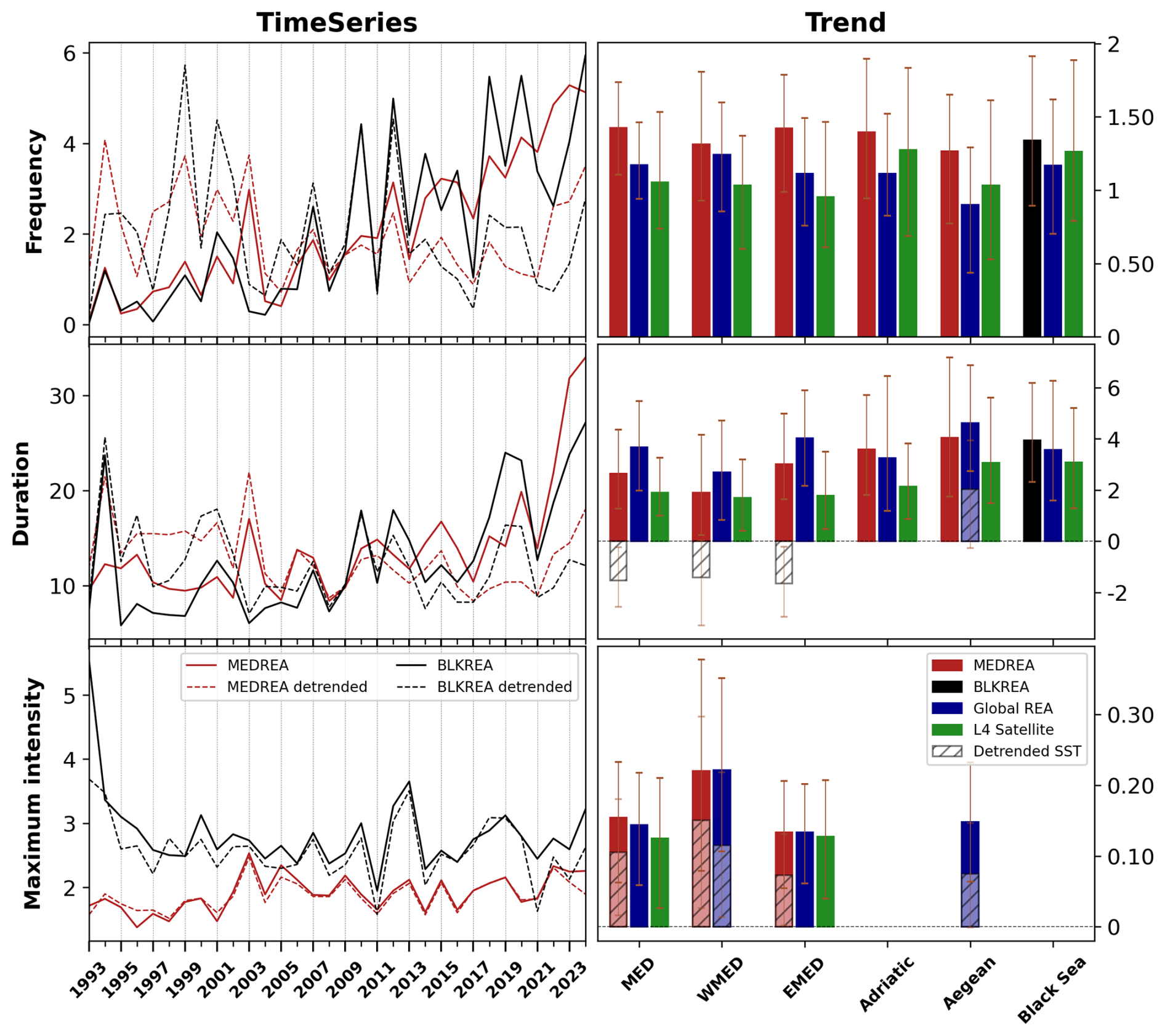
Figure A1Left: Time series of annual MHWs metrics – number, duration (in days), and maximum intensity (in °C) – averaged over the entire Mediterranean (red lines) and Black Seas (black lines), comparing the SST definition (solid lines) with the detrended approach (dashed lines), based on the regional reanalysis (product refs. no. 3 and 4 in Table 1). Right: significant (p < 0.05) long-term trends (1993–2024) in MHWs number (events per decade), duration (days per decade), and maximum intensity (°C per decade), derived from regional and global reanalysis (product ref. no. 3, 4 and 5 in Table 1) as well as the SST-L4 observation product (product refs. no. 1 and 2 in Table 1), for selected (sub)regions following Dayan et al. (2022): the entire Mediterranean (MED), the western (WMED) and eastern (EMED) Mediterranean basins, and the Adriatic, Aegean, and Black Seas. Brown lines indicate the 95 % confidence interval. Solid bars show standard metrics definition, striped bars show SST de-trended metrics.
Table A1Long-term trends (1993–2024) with 95 % confidence interval indicated in brackets of MHW number, duration, and maximum intensity per year, derived from regional and global reanalysis (product refs. no. 3, 4 and 5 in Table 1) as well as the SST-L4 observation products (product refs. no. 1 and 2 in Table 1), for selected (sub)regions. The subdomain definition follows Dayan et al. (2022) and considers metrics for the entire Mediterranean (MED), as well as for the western (WMED) and eastern (EMED) Mediterranean basins, in addition to the Adriatic, Aegean, and Black Seas. Non-significant trends (p ≥ 0.05) are indicated by hyphens. Both SST (top) and OHC (bottom) derived metrics are presented. Trends calculated from the detrended approach are highlighted in bold.
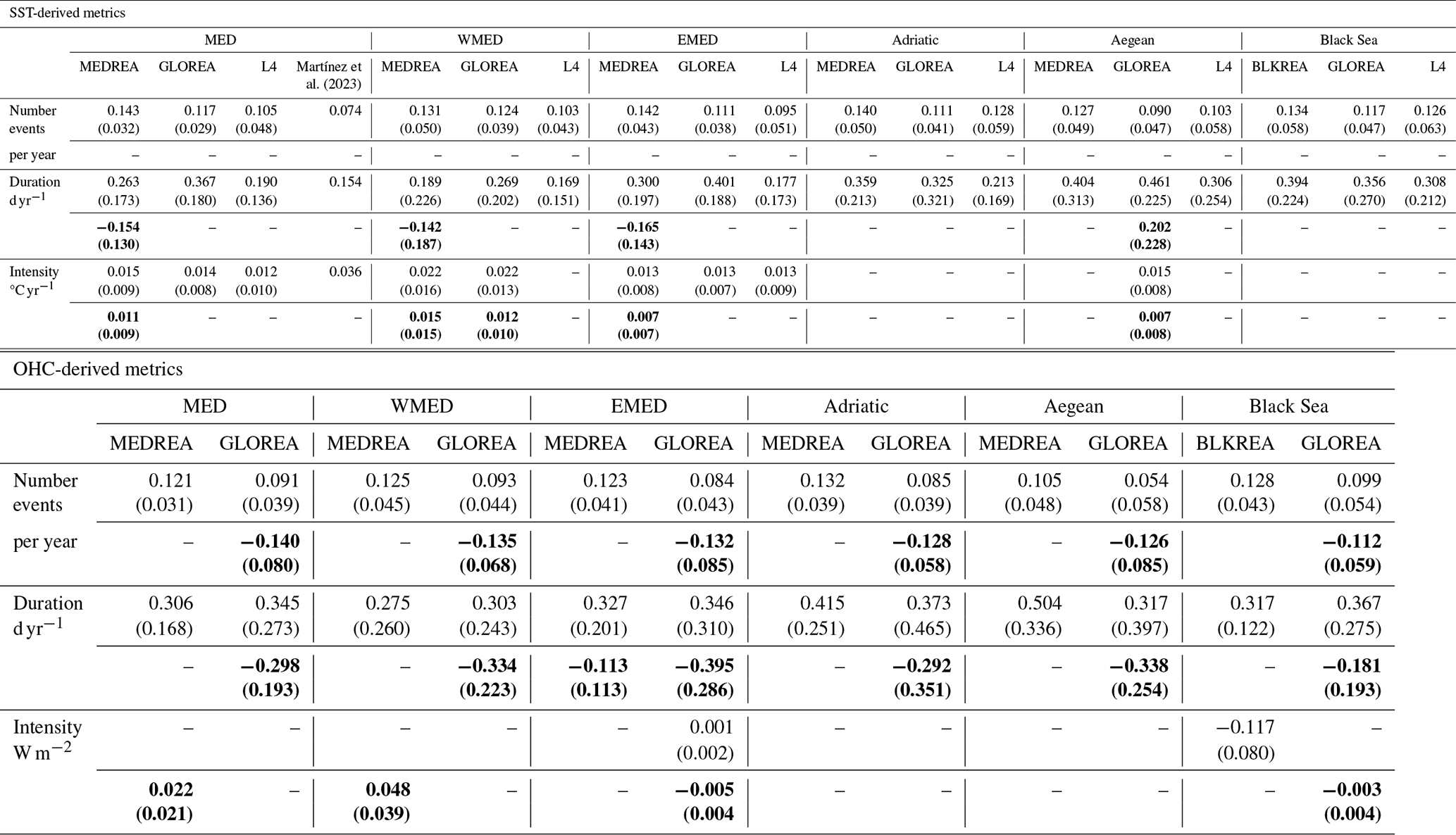
The analysis is further extended beyond regional reanalysis products to assess the impact of detrending within a multi-product framework (Fig. A1, right and Table A1). We first describe the results obtained using the formulation without detrending the SST. Considering the number of events, regional reanalysis products always show higher trends with respect to the global reanalysis and satellite observations. In contrast, the global reanalysis exhibits the highest trends in event duration, surpassing both regional reanalysis and the observed SST except for the Adriatic and Black Seas, where the duration trend is higher in the regional reanalysis. In these two regions, however, no product shows a statistically significant intensity trend. After detrending SST, most trends in the number and duration of events become non-significant (Fig. A1 and Table A1 exclude trends that are not statistically significant). Exceptions include the regional reanalysis in the western, eastern, and entire Mediterranean Sea, where the duration of events shows small and negative trends. In the Aegean Sea, the duration trend derived from the global reanalysis remains positive, although its magnitude is reduced to approximately half of that observed under the standard (non-detrended) definition. Regarding MHW intensity, either the global or regional reanalysis indicates increasing trends across most of the Mediterranean Sea. Again, in the Adriatic and Black Seas, no product shows a statistically significant trend.
To distinguish the warming signal, Martínez et al. (2023) analyzed MHW metrics in the Mediterranean Sea by applying detections to the SST-L4 observational product and comparing results from the standard definition with those obtained after detrending. Similarly, their findings reveal positive trends using the standard method, whereas the detrended approach shows no statistically significant trends. Consistent with our findings, their results indicate that the occurrence of MHWs is predominantly driven by the underlying temperature trend.
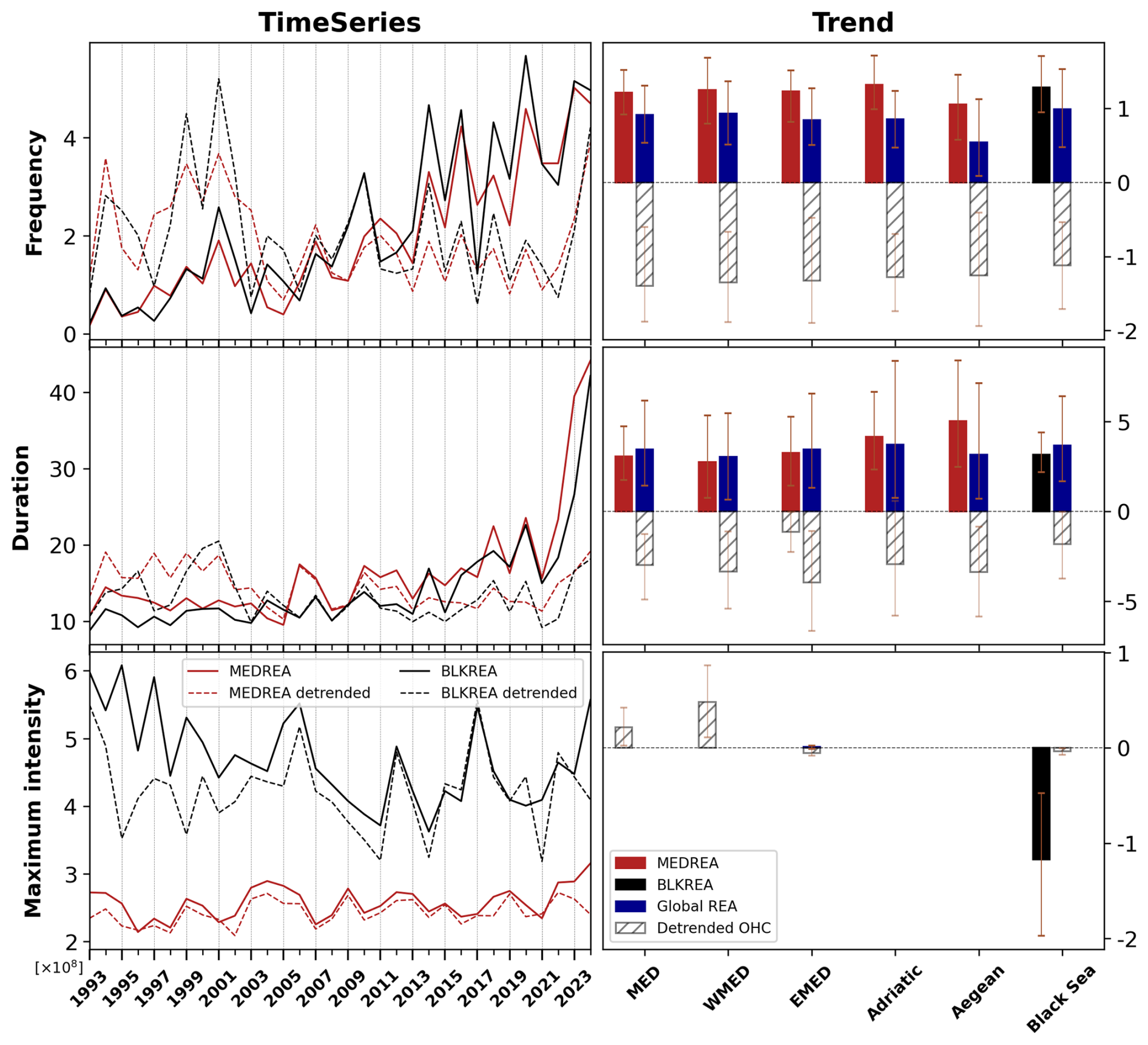
Figure A2Left: time series of annual MHWs metrics number, duration (in days), and maximum intensity (in J m−2) – averaged over the entire Mediterranean (red lines) and Black (black lines) Seas, comparing the OHC (0–40 m) definition without detrending (solid lines) with the OHC-detrended approach (dashed lines), based on regional reanalysis data (product refs. no. 3 and 4 in Table 1). Right: long-term trends (1993–2024) in MHWs number (events per decade), duration (days per decade), and maximum intensity (W m−2), derived from regional and global reanalyses (product ref. no. 3, 4 and 5 in Table 1), for selected (sub)regions following Dayan et al. (2022): the entire Mediterranean (MED), the western (WMED) and eastern (EMED) Mediterranean basins, and the Adriatic, Aegean, and Black Seas. Brown lines indicate the 95 % confidence interval. Solid bars show standard metrics definition, striped bars show SST de-trended metrics.
A similar pattern is observed using the OHC-based definition, with the number of MHWs exhibiting interannual variability (Fig. A2 and Table A1). The annual count ranges from 1 event to a peak of over 5 events in 2020 in the Black Sea and in 2023 in both basins. When the time series is detrended, high MHW frequencies are also evident at the beginning of the period, with more than 4 events occurring in 1999 and 2001 in the Black Sea, compared to less than 3 events in the non-detrended data. Regarding the duration, maximum values of approximately 40 d are observed in both seas in 2024, whereas the detrended data consistently show durations below 20 d. When considering MHWs intensity, consistently with SST-based metrics, the Black Sea constantly shows larger values with respect to the Mediterranean Sea.
After removing the warming trend, the number of MHW events shows negative trends in all regions, with statistically significant values observed in the global reanalysis (Fig. A2, right and Table A1). In contrast, most trends from the regional reanalysis become non-significant after detrending. The global reanalysis also shows lower event frequency trends compared to the regional reanalysis across the study areas. Event duration exhibits the strongest trend of 5 d per decade in the Aegean Sea. In some areas, such as the entire Mediterranean, the WMED and EMED, and the Black Sea, duration trends from the global reanalysis are higher than those evaluated from the regional datasets. Furthermore, all duration trends become negative, or not significant, after detrending. Considering the MHWs intensity, most of the analyzed regions show not statistically significant values, with positive trends in the Mediterranean Sea and especially in the WMED basin when detrended OHC values are used.
This study is based on public databases, and their references are listed in Table 1. For marine heatwave detection, this study employs the Python-based toolbox available at https://github.com/ecjoliver/marineHeatWaves (Oliver, 2016).
LL led the organization of the study, prepared the manuscript, defined plots and figure layout, participated in code implementation, and presented the results during meetings. RM contributed to key decisions and analysis discussions, which were essential to shaping the final form of the manuscript, worked on the code, especially for figure preparation, and reviewed the manuscript. ES provided useful input to the analyses throughout the study, contributed to the understanding of the code, and played a very important role in analyses related to the Mediterranean Sea, particularly the Adriatic Sea. He also reviewed the manuscript. RMcA provided scientific guidance from the early stages, helped define objectives and conclusions, contributed with the initial analysis using the original code, and revised the manuscript, including scientific content and English writing. FC parallelized the processing code for MHW detection, which was crucial in accelerating the analyses, and actively contributed to scientific discussions. EC revised the manuscript in depth, improved analyses, results presentation, and conclusions, and contributed to leadership and planning. MI, EJ, and PM participated in technical discussions, supported the interpretation of results, and reviewed the manuscript. AA contributed to specific analyses and helped improve the manuscript. FM participated in meetings where key aspects were discussed and followed the manuscript development.
The contact author has declared that none of the authors has any competing interests.
The Copernicus Marine Service offering is regularly updated to ensure it remains at the forefront of user requirements. In this process, some products may undergo replacement or renaming, leading to the removal of certain product IDs from the catalogue. If readers have any questions or require assistance regarding these modifications, please feel free to reach out to the Copernicus Marine Service user support team for further guidance. They will be able to provide the necessary information to address concerns and find suitable alternatives.
Publisher's note: Copernicus Publications remains neutral with regard to jurisdictional claims made in the text, published maps, institutional affiliations, or any other geographical representation in this paper. The authors bear the ultimate responsibility for providing appropriate place names. Views expressed in the text are those of the authors and do not necessarily reflect the views of the publisher.
The authors thank the coordination team of the Copernicus Ocean State Report issue 10 (OSR10), especially Karina Von Schuckmann, for her valuable suggestions that significantly improved the manuscript at all levels. We also acknowledge Lorena Moreira Mendez and Alvaro de Pascual for their technical support and for organizing the OSR10 meetings, which provided a very fruitful environment for discussion with a group of researchers. The authors thank Urmas Raudsepp and other anonymous referees for their constructive comments that improved the manuscript.
This research was funded by the Copernicus Marine Service through the Black Sea Monitoring and Forecasting Centre (Contract No. 2425L04-COP-MFC BLK-5400) and the Mediterranean Sea Monitoring and Forecasting Centre (Contract No. 2425L05-COP-MFC MED-5500). RMcA was supported by ObsSea4Clim “Ocean observations and indicators for climate and assessments” funded by the European Union, grant agreement number: 101136548, contribution number 43.
This paper was edited by Pierre-Marie Poulain and reviewed by Urmas Raudsepp, Mélanie Juza, and two anonymous referees.
Amaya, D. J., Jacox, M. G., Fewings, M. R., Saba, V. S., Stuecker, M. F., Rykaczewski, R. R., Ross, A. C., Stock, C. A., Capotondi, A., Petrik, C. M., Bograd, S. J., Alexander, M. A., Cheng, W., Hermann, A. J., Kearney, K. A., and Powell, B. S.: Marine heatwaves need clear definitions so coastal communities can adapt, Nature, 616, 29–32, https://doi.org/10.1038/d41586-023-00924-2, 2023.
Beuvier, J., Béranger, K., Lebeaupin Brossier, C., Somot, S., Sevault, F., Drillet, Y., Bourdallé-Badie, R., Ferry, N., and Lyard, F.: Spreading of the Western Mediterranean Deep Water after winter 2005: Time scales and deep cyclone transport, J. Geophys. Res.-Oceans, 117, https://doi.org/10.1029/2011JC007679, 2012.
Bonino, G., Masina, S., Galimberti, G., and Moretti, M.: Southern Europe and western Asian marine heatwaves (SEWA-MHWs): a dataset based on macroevents, Earth Syst. Sci. Data, 15, 1269–1285, https://doi.org/10.5194/essd-15-1269-2023, 2023.
Capet, A., Vandenbulcke, L., and Grégoire, M.: A new intermittent regime of convective ventilation threatens the Black Sea oxygenation status, Biogeosciences, 17, 6507–6525, https://doi.org/10.5194/bg-17-6507-2020, 2020.
Capotondi, A., Rodrigues, R. R., Sen Gupta, A., Benthuysen, J. A., Deser, C., Frölicher, T. L., Lovenduski, N. S., Amaya, D. J., Le Grix, N., Xu, T., Hermes, J., Holbrook, N. J., Martinez-Villalobos, C., Masina, S., Koll Roxy, M., Schaeffer, A., Schlegel, R. W., Smith, K. E., and Wang, C.: A global overview of marine heatwaves in a changing climate, Commun. Earth Environ., 5, 701, https://doi.org/10.1038/s43247-024-01806-9, 2024.
Cheminée, A., Le Direach, L., Rouanet, E., Astruch, P., Goujard, A., Blanfuné, A., Bonhomme, D., Chassaing, L., Jouvenel, J.-Y., Ruitton, S., Thibaut, T., and Harmelin-Vivien, M.: All shallow coastal habitats matter as nurseries for Mediterranean juvenile fish, Sci. Rep., 11, 14631, https://doi.org/10.1038/s41598-021-93557-2, 2021.
Cheng, Y., Zhang, M., Song, Z., Wang, G., Zhao, C., Shu, Q., Zhang, Y., and Qiao, F.: A quantitative analysis of marine heatwaves in response to rising sea surface temperature, Sci. Total Environ., 881, 163396, https://doi.org/10.1016/j.scitotenv.2023.163396, 2023.
Cooley, S., D. Schoeman, L. Bopp, P. Boyd, S. Donner, D. Y. Ghebrehiwet, S.-I. Ito, W. Kiessling, P. Martinetto, E. Ojea, M.-F. Racault, B. Rost, and M. Skern-Mauritzen: Oceans and Coastal Ecosystems and Their Services, In: Climate Change 2022: Impacts, Adaptation and Vulnerability. Contribution of Working Group II to the Sixth Assessment Report of the Intergovernmental Panel on Climate Change, edited by: Pörtner, H.-O., Roberts, D. C., Tignor, M., Poloczanska, E. S., Mintenbeck, K., Alegría, A., Craig, M., Langsdorf, S., Löschke, S., Möller, V., Okem, A., and Rama, B., Cambridge University Press, Cambridge, UK and New York, NY, USA, 379–550, https://doi.org/10.1017/9781009325844.005, 2022.
Darmaraki, S., Denaxa, D., Theodorou, I., Livanou, E., Rigatou, D., Raitsos, D. E., Stavrakidis-Zachou, O., Dimarchopoulou, D., Bonino, G., McAdam, R., Organelli, E., Pitsouni, A., and Parasyris, A.: Marine heatwaves in the Mediterranean Sea: A literature review, Mediterr. Mar. Sci., 25, 586–620, https://doi.org/10.12681/mms.38392, 2024.
Dayan, H., McAdam, R., Masina, S., and Speich, S.: Diversity of marine heatwave trends across the Mediterranean Sea over the last decades, Copernicus Marine Service Ocean State Report, 6, 205–210, https://doi.org/10.1080/1755876X.2022.2095169, 2022.
Dayan, H., McAdam, R., Juza, M., Masina, S., and Speich, S.: Marine heat waves in the Mediterranean Sea: An assessment from the surface to the subsurface to meet national needs, Frontiers in Marine Science, 10, 1045138, https://doi.org/10.3389/fmars.2023.1045138, 2023.
Dee, D. P., Uppala, S. M., Simmons, A. J., Berrisford, P., Poli, P., Kobayashi, S., Andrae, U., Balmaseda, M. A., Balsamo, G., Bauer, P., Bechtold, P., Beljaars, A. C. M., van de Berg, L., Bidlot, J., Bormann, N., Delsol, C., Dragani, R., Fuentes, M., Geer, A. J., Haimberger, L., Healy, S. B., Hersbach, H., Hólm, E. V., Isaksen, L., Kållberg, P., Köhler, M., Matricardi, M., McNally, A. P., Monge-Sanz, B. M., Morcrette, J.-J., Park, B.-K., Peubey, C., de Rosnay, P., Tavolato, C., Thépaut, J.-N., and Vitart, F.: The ERA-Interim reanalysis: Configuration and performance of the data assimilation system, Q. J. R. Meteorol. Soc., 137, 553–597, https://doi.org/10.1002/qj.828, 2011.
Denamiel, C., Tojčić, I., and Pranić, P.: A new vision of the Adriatic Dense Water future under extreme warming, Ocean Sci., 21, 37–62, https://doi.org/10.5194/os-21-37-2025, 2025.
Drévillon, M., Lellouche, J.-M., Régnier, C., Garric, G., Bricaud, C., Hernandez, O., and Bourdallé-Badie, R.: EU Copernicus Marine Service Quality Information Document for the Global Ocean Physics Reanalysis, GLOBAL_MULTIYEAR_PHY_001_030, issue 1.6, Mercator Ocean International, https://documentation.marine.copernicus.eu/QUID/CMEMS-GLO-QUID-001-030.pdf (last access: 31 October 2025), 2024a.
Drévillon, M., Fernandez, E., and Lellouche, J.-M.: EU Copernicus Marine Service Product User Manual for the Global Ocean Physics Reanalysis, GLOBAL_MULTIYEAR_PHY_001_030, issue 1.6, Mercator Ocean International, https://documentation.marine.copernicus.eu/PUM/CMEMS-GLO-PUM-001-030.pdf (last access: 31 October 2025), 2024b.
Dutheil, C., Lal, S., Lengaigne, M., Cravatte, S., Menkès, C., Receveur, A., Börgel, F., Gröger, M., Houlbreque, F., Le Gendre, R., Mangolte, I., Peltier, A., and Meier, H. E. M.: The massive 2016 marine heatwave in the Southwest Pacific: An “El Niño–Madden-Julian Oscillation” compound event, Sci. Adv., 10, https://doi.org/10.1126/sciadv.adp2948, 2024.
Embury, O., Merchant, C. J., Good, S. A., Rayner, N. A., Høyer, J. L., Atkinson, C., Block, T., Alerskans, E., Pearson, K. J., Worsfold, M., McCarroll, N., and Donlon, C.: Satellite-based time-series of sea-surface temperature since 1980 for climate applications, Sci. Data, 11, 326, https://doi.org/10.1038/s41597-024-03147-w, 2024.
Escudier, R., Clementi, E., Cipollone, A., Pistoia, J., Drudi, M., Grandi, A., Lyubartsev, V., Lecci, R., Aydoğdu, A., Delrosso, D., Omar, M., Masina, S., Coppini, G., and Pinardi, N.: A high resolution reanalysis for the Mediterranean Sea, Front. Earth Sci., 9, 702285, https://doi.org/10.3389/feart.2021.702285, 2021.
Escudier, R., Clementi, E., Nigam, T., Aydogdu, A., Fini, E., Pistoia, J., Grandi, A., and Miraglio, P.: EU Copernicus Marine Service Quality Information Document for the Mediterranean Sea Physics Reanalysis, MEDSEA_MULTIYEAR_PHY_006_004, issue 2.4, Mercator Ocean International, https://documentation.marine.copernicus.eu/QUID/CMEMS-MED-QUID-006-004.pdf (last access: 31 October 2025), 2024.
Estaque, T., Richaume, J., Bianchimani, O., Schull, Q., Mérigot, B., Bensoussan, N., Bonhomme, P., Vouriot, P., Sartoretto, S., Monfort, T., Basthard-Bogain, S., Fargetton, M., Gatti, G., Barth, L., Cheminée, A., and Garrabou, J.: Marine heatwaves on the rise: One of the strongest ever observed mass mortality event in temperate gorgonians, Glob. Change Biol., 29, 6159–6162, https://doi.org/10.1111/gcb.16931, 2023.
Estournel, C., Estaque, T., Ulses, C., Barral, Q.-B., and Marsaleix, P.: Extreme sensitivity of the northeastern Gulf of Lion (western Mediterranean) to subsurface heatwaves: physical processes and insights into effects on gorgonian populations in the summer of 2022, Ocean Sci., 21, 1487–1503, https://doi.org/10.5194/os-21-1487-2025, 2025.
EU Copernicus Marine Service Product: Black Sea – High Resolution L4 Sea Surface Temperature Reprocessed, Mercator Ocean International [data set], https://doi.org/10.48670/moi-00160, 2024a.
EU Copernicus Marine Service Product: Mediterranean Sea – High Resolution L4 Sea Surface Temperature Reprocessed, Mercator Ocean International [data set], https://doi.org/10.48670/moi-00173, 2024b.
EU Copernicus Marine Service Product: Black Sea Physics Reanalysis, Mercator Ocean International [data set], https://doi.org/10.48670/mds-00356, 2024c.
EU Copernicus Marine Service Product: Mediterranean Sea Physics Reanalysis, Mercator Ocean International [data set], https://doi.org/10.25423/CMCC/MEDSEA_MULTIYEAR_PHY_006_004_E3R1, 2024d.
EU Copernicus Marine Service Product: Global Ocean Physics Reanalysis, Mercator Ocean International [data set], https://doi.org/10.48670/moi-00021, 2024e.
EU Copernicus Marine Service Information: Black Sea Ocean Heat Content Anomaly (0–300 m) time series and trend from Reanalysis & Multi-Observations Reprocessing, Mercator Ocean International, https://doi.org/10.48670/moi-00306, 2024a.
EU Copernicus Marine Service Information: Mediterranean Ocean Heat Content Anomaly (0–700 m) time series and trend from Reanalysis & Multi-Observations Reprocessing, Mercator Ocean International, https://doi.org/10.48670/moi-00261, 2024b.
EU Copernicus Marine Service Information: Mediterranean Water Mass Formation Rates from Reanalysis, Mercator Ocean International, https://doi.org/10.48670/mds-00318, 2024c.
Fox-Kemper, B., Hewitt, H. T., Xiao, C., Aðalgeirsdóttir, G., Drijfhout, S. S., Edwards, T. L., Golledge, N. R., Hemer, M., Kopp, R. E., Krinner, G., Mix, A., Notz, D., Nowicki, S., Nurhati, I. S., Ruiz, L., Sallée, J.-B., Slangen, A. B. A., and Yu, Y.: Ocean, Cryosphere and Sea Level Change, In: Climate Change 2021: The Physical Science Basis. Contribution of Working Group I to the Sixth Assessment Report of the Intergovernmental Panel on Climate Change, edited by: Masson-Delmotte, V., Zhai, P., Pirani, A., Connors, S. L., Péan, C., Berger, S., Caud, N., Chen, Y., Goldfarb, L., Gomis, M. I., Huang, M., Leitzell, K., Lonnoy, E., Matthews, J. B. R., Maycock, T. K., Waterfield, T., Yelekçi, O., Yu, R., and Zhou, B., Cambridge University Press, Cambridge, United Kingdom and New York, NY, USA, 1211–1362, https://doi.org/10.1017/9781009157896.011, 2021.
Gačić, M., Lascaratos, A., Manca, B. B., and Mantziafou, A.: Adriatic deep water and interaction with the Eastern Mediterranean Sea, in: Physical oceanography of the Adriatic Sea: Past, present and future, Springer Netherlands, Dordrecht, 111–142, https://doi.org/10.1007/978-94-015-9819-4_4, 2001.
Garrabou, J., Gómez-Gras, D., Medrano, A., Cerrano, C., Ponti, M., Schlegel, R., Bensoussan, N., Turicchia, E., Sini, M., Gerovasileiou, V., Teixido, N., Mirasole, A., Tamburello, L., Cebrian, E., Rilov, G., Ledoux, J.-B., Ben Souissi, J., Khamassi, F., Ghanem, R., Benabdi, M., Grimes, S., Ocaña, O., Bazairi, H., Hereu, B., Linares, C., Kersting, D. K., la Rovira, G., Ortega, J., Casals, D., Pagès-Escolà, M., Margarit, N., Capdevila, P., Verdura, J., Ramos, A., Izquierdo, A., Barbera, C., Rubio-Portillo, E., Anton, I., López-Sendino, P., Díaz, D., Vázquez-Luis, M., Duarte, C., Marbà, N., Aspillaga, E., Espinosa, F., Grech, D., Guala, I., Azzurro, E., Farina, S., Gambi, M. C., Chimienti, G., Montefalcone, M., Azzola, A., Pulido Mantas, T., Fraschetti, S., Ceccherelli, G., Kipson, S., Bakran-Petricioli, T., Petricioli, D., Jimenez, C., Katsanevakis, S., Kizilkaya, I. T., Kizilkaya, Z., Sartoretto, S., Elodie, R., Ruitton, S., Comeau, S., Gattuso, J.-P., and Harmelin, J.-G.: Marine heatwaves drive recurrent mass mortalities in the Mediterranean Sea, Glob. Change Biol., 28, 5708–5725, https://doi.org/10.1111/gcb.16301, 2022.
Granata, A., Cubeta, A., Minutoli, R., Bergamasco, A., and Guglielmo, L.: Distribution and abundance of fish larvae in the northern Ionian Sea (Eastern Mediterranean), Helgoland Mar. Res., 65, 381–398, https://doi.org/10.1007/s10152-010-0231-2, 2011.
Gregory, C. H., Artana, C., Lama, S., León-FonFay, D., Sala, J., Xiao, F., Xu, T., Capotondi, A., Martinez-Villalobos, C., and Holbrook, N. J.: Global marine heatwaves under different flavors of ENSO, Geophys. Res. Lett., 51, e2024GL110399, https://doi.org/10.1029/2024GL110399, 2024.
Gunduz, G., Causio, S., Bonino, G., Vandenbulcke, L., Gregorie, M., Lima, L., Ciliberti, S., Ilicak, M., Aydogdu, A., Masina, S., Coppini, G., and Pinardi, N.: Coastal upwelling along the Turkish coast of the Black Sea: Its role in the distribution of the hydrographic properties, in: Copernicus Ocean State Report, issue 6, J. Oper. Oceanogr., 15, s205–s211, https://doi.org/10.1080/1755876X.2022.2095169, 2022.
Hamdeno, M. and Alvera-Azcaráte, A.: Marine heatwaves characteristics in the Mediterranean Sea: Case study the 2019 heatwave events, Front. Mar. Sci., 10, 1093760, https://doi.org/10.3389/fmars.2023.1093760, 2023.
Hersbach, H., Bell, B., Berrisford, P., Hirahara, S., Horányi, A., Munoz-Sabater, J., Nicolas, J., Peubey, C., Radu, R., Schepers, D., Simmons, A., Soci, C., Abdalla, S., Abellan, X., Balsamo, G., Bechtold, P., Biavati, G., Bidlot, J., Bonavita, M., De Chiara, G., Dahlgren, P., Dee, D., Diamantakis, M., Dragani, R., Flemming, J., Forbes, R., Fuentes, M., Geer, A., Haimberger, L., Healy, S., Hogan, R. J., Hólm, E. V., Janisková, M., Keeley, S., Laloyaux, P., Lopez, P., Lupu, C., Radnoti, G., de Rosnay, P., Rozum, I., Vamborg, F., Villaume, S., and Thépaut, J.-N.: The ERA5 global reanalysis, Q. J. R. Meteorol. Soc., 146, 1999–2049, https://doi.org/10.1002/qj.3803, 2020.
Hobday, A. J., Alexander, L. V., Perkins, S. E., Smale, D. A., Straub, S. C., Oliver, E. C. J., Benthuysen, J. A., Burrows, M. T., Donat, M. G., Feng, M., Holbrook, N. J., Moore, P. J., Scannell, H. A., Sen Gupta, A., and Wernberg, T.: A hierarchical approach to defining marine heatwaves, Prog. Oceanogr., 141, 227–238, https://doi.org/10.1016/j.pocean.2015.12.014, 2016.
Hobday, A. J., Oliver, E. C. J., Sen Gupta, A., Benthuysen, J. A., Burrows, M. T., Donat, M. G., Holbrook, N. J., Moore, P. J., Thomsen, M. S., Wernberg, T., and Smale, D. A.: Categorizing and naming marine heatwaves, Oceanography, 31, 162–173, https://doi.org/10.5670/oceanog.2018.205, 2018.
Holbrook, N. J., Scannell, H. A., Sen Gupta, A., Benthuysen, J. A., Feng, M., Oliver, E. C. J., Alexander, L. V., Burrows, M. T., Donat, M. G., Hobday, A. J., Moore, P. J., Perkins-Kirkpatrick, S. E., Smale, D. A., Straub, S. C., and Wernberg, T.: A global assessment of marine heatwaves and their drivers, Nat. Commun., 10, 2624, https://doi.org/10.1038/s41467-019-10206-z, 2019.
Houpert, L., Testor, P., Durrieu de Madron, X., Somot, S., D'Ortenzio, F., Estournel, C., and Lavigne, H.: Seasonal cycle of the mixed layer, the seasonal thermocline and the upper-ocean heat storage rate in the Mediterranean Sea derived from observations, Prog. Oceanogr., 132, 333–352, https://doi.org/10.1016/j.pocean.2014.11.004, 2015.
Ivanov, L. I., Backhaus, J. O., Özsoy, E., and Wehde, H.: Convection in the Black Sea during cold winters, J. Marine Syst., 31, 65–76, https://doi.org/10.1016/S0924-7963(01)00047-1, 2001.
Izquierdo, P., González Taboada, F., González-Gil, R., Arrontes, J., and Rico, J. M.: Alongshore upwelling modulates the intensity of marine heatwaves in a temperate coastal sea, Sci. Total Environ., 835, 155478, https://doi.org/10.1016/j.scitotenv.2022.155478, 2022.
Juza, M., Fernández-Mora, À., and Tintoré, J.: Sub-regional marine heat waves in the Mediterranean Sea from observations: Long-term surface changes, sub-surface and coastal responses, Front. Mar. Sci., 9, 785771, https://doi.org/10.3389/fmars.2022.785771, 2022.
Kara, A. B., Helber, R. W., Boyer, T. P., and Elsner, J. B.: Mixed layer depth in the Aegean, Marmara, Black and Azov Seas: Part I: General features, J. Marine Syst., 78, S169–S180, https://doi.org/10.1016/j.jmarsys.2009.01.022, 2009.
Kokkini, Z., Mauri, E., Gerin, R., Poulain, P. M., Simoncelli, S., and Notarstefano, G.: On the salinity structure in the South Adriatic as derived from float and glider observations in 2013–2016, Deep-Sea Res. Pt. II, https://doi.org/10.1016/j.dsr2.2019.07.013, 2020.
Konsta, K., Doxa, A., Katsanevakis, S., and Mazaris, A. D.: Projected marine heatwaves over the Mediterranean Sea and the network of marine protected areas: A three-dimensional assessment, Climatic Change, 178, https://doi.org/10.1007/s10584-025-03860-4, 2025.
Kubryakov, A. A., Mikaelyan, A. S., Stanichny, S. V., and Kubryakova, E. A.: Seasonal stages of chlorophyll-a vertical distribution and its relation to the light conditions in the Black Sea from Bio-Argo measurements, J. Geophys. Res.-Oceans, 125, e2020JC016790, https://doi.org/10.1029/2020JC016790, 2020.
Lecci, R., Lima, L., Cretì, S., and Jansen, E.: EU Copernicus Marine Service Product User Manual for the Black Sea Physics Reanalysis, BLKSEA_MULTIYEAR_PHY_007_004, issue 4.0, Mercator Ocean International, https://documentation.marine.copernicus.eu/PUM/CMEMS-BLK-PUM-007-004.pdf (last access: 31 October 2025), 2024a.
Lecci, R., Drudi, M., Grandi, A., and Clementi, E.: EU Copernicus Marine Service Product User Manual for the Black Sea Physics Reanalysis, MEDSEA_MULTIYEAR_PHY_006_004, issue 2.4, Mercator Ocean International, https://documentation.marine.copernicus.eu/PUM/CMEMS-MED-PUM-006-004.pdf (last access: 31 October 2025), 2024b.
Lellouche, J.-M., Greiner, E., Bourdallé-Badie, R., Garric, G., Melet, A., Drévillon, M., Bricaud, C., Hamon, M., Le Galloudec, O., Regnier, C., Candela, T., Testut, C.-E., Gasparin, F., Ruggiero, G., Benkiran, M., Drillet, Y., and Le Traon, P.-Y.: The Copernicus Global ° oceanic and sea ice GLORYS12 reanalysis, Front. Earth Sci., 9, 698876, https://doi.org/10.3389/feart.2021.698876, 2021.
Le Meur, J., Wirth, A., Paladini de Mendoza, F., Miserocchi, S., and Cardin, V.: Intermittent supply of dense water to the deep South Adriatic Pit: An observational study, Front. Mar. Sci., 12, https://doi.org/10.3389/fmars.2025.1516780, 2025.
Li, M., Organelli, E., Serva, F., Bellacicco, M., Landolfi, A., Pisano, A., Marullo, S., Shen, F., Mignot, A., van Gennip, S., and Santoleri, R.: Phytoplankton spring bloom inhibited by marine heatwaves in the north-western Mediterranean Sea, Geophys. Res. Lett., 51, https://doi.org/10.1029/2024GL109141, 2024.
Lima, L., Peneva, E., Ciliberti, S., Masina, S., Lemieux, B., Storto, A., and Chtirkova, B.: Section 2.6: Ocean heat content in the Black Sea, in: Copernicus Marine Service Ocean State Report, Issue 4, J. Oper. Oceanogr., 13, s41–s47, https://doi.org/10.1080/1755876X.2020.1785097, 2020.
Lima, L., Ciliberti, S. A., Aydoğdu, A., Masina, S., Escudier, R., Cipollone, A., Azevedo, D., Causio, S., Peneva, E., Lecci, R., Clementi, E., Jansen, E., Ilicak, M., Cretì, S., Stefanizzi, L., Palermo, F., and Coppini, G.: Climate signals in the Black Sea from a multidecadal eddy-resolving reanalysis, Front. Mar. Sci., 8, 710973, https://doi.org/10.3389/fmars.2021.710973, 2021.
Lima, L., Azevedo, D., Ilicak, M., Jansen, E., Costa, F., Causio, S., Cretí, S., and Clementi, E.: EU Copernicus Marine Service Quality Information Document for the Black Sea Physics Reanalysis, BLKSEA_MULTIYEAR_PHY_007_004, issue 5.0, Mercator Ocean International, https://documentation.marine.copernicus.eu/QUID/CMEMS-BLK-QUID-007-004.pdf (last access: 31 October 2025), 2024.
Lima, L., Azevedo, D., Ilicak, M., Jansen, E., Costa, F., Sozer, A., Miraglio, P., and Clementi, E.: Advances in monitoring the Black Sea: a new regional multidecadal ocean reanalysis at ° resolution, Ocean Sci., 22, 1051–1072, https://doi.org/10.5194/os-22-1051-2026, 2026.
López-Jurado, J.-L., González-Pola, C., and Vélez-Belchi, P.: Observation of an abrupt disruption of the long-term warming trend at the Balearic Sea, western Mediterranean Sea, in summer 2005, Geophys. Res. Lett., 32, L24606, https://doi.org/10.1029/2005GL024430, 2005.
Ma, X. and Chen, G.: Marine heatwaves are shaping the vertical structure of phytoplankton in the global ocean, Commun. Earth Environ., 6, 715, https://doi.org/10.1038/s43247-025-02718-y, 2025.
Macias, J. C., Avila Zaragozá, P., Karakassis, I., Sanchez-Jerez, P., Massa, F., Fezzardi, D., Yücel Gier, G., Franičević, V., Borg, J. A., Chapela Pérez, R. M., Tomassetti, P., Angel, D. L., Marino, G., Nhhala, H., Hamza, H., Carmignac, C., and Fourdain, L.: Allocated zones for aquaculture: A guide for the establishment of coastal zones dedicated to aquaculture in the Mediterranean and the Black Sea, General Fisheries Commission for the Mediterranean: Studies and Reviews, 97, 1–90, FAO, https://openknowledge.fao.org/server/api/core/bitstreams/5c494a74-d1f9-4f9d-9b26-9ff8f3b0f634/content (last access: 21 January 2026), 2019.
Martínez, J., Leonelli, F. E., García-Ladona, E., Garrabou, J., Kersting, D. K., Bensoussan, N., and Pisano, A.: Evolution of marine heatwaves in warming seas: The Mediterranean Sea case study, Front. Mar. Sci., 10, https://doi.org/10.3389/fmars.2023.1193164, 2023.
Marullo, S., Serva, F., Iacono, R., Napolitano, E., di Sarra, A., Meloni, D., Monteleone, F., Sferlazzo, D., De Silvestri, L., and de Toma, V.: Record-breaking persistence of the 2022/23 marine heatwave in the Mediterranean Sea, Environ. Res. Lett., 18, 114041, https://doi.org/10.1088/1748-9326/ad02ae, 2023.
McAdam, R., Masina, S., and Gualdi, S.: Seasonal forecasting of subsurface marine heatwaves, Commun. Earth Environ., 4, 225, https://doi.org/10.1038/s43247-023-00892-5, 2023.
Mignot, A., von Schuckmann, K., Landschützer, P., Gasparin, F., van Gennip, S., Perruche, C., Lamouroux, J., and Amm, T.: Decrease in air-sea CO2 fluxes caused by persistent marine heatwaves, Nat. Commun., 13, 4300, https://doi.org/10.1038/s41467-022-31983-0, 2022.
Mohamed, B., Ibrahim, O., and Nagy, H.: Sea Surface temperature variability and marine heatwaves in the Black Sea, Remote Sens., 14, 2383, https://doi.org/10.3390/rs14102383, 2022.
Nenciu, M., Ni?ă, V., Lazăr, L., Spînu, A., and Vlăsceanu-Mateescu, E.: Fostering the Development of Western Black Sea Aquaculture: A Scientific Case Study for Finfish Cage Farming Allocated Zone Designation, Fishes, 8, 104, https://doi.org/10.3390/fishes8020104, 2023.
Oliver, E. C. J.: marineHeatWaves, GitHub [code], https://github.com/ecjoliver/marineHeatWaves (last access: 1 April 2026), 2016.
Oliver, E. C. J., Donat, M. G., Burrows, M. T., Moore, P. J., Smale, D. A., Alexander, L. V., Benthuysen, J. A., Feng, M., Sen Gupta, A., Hobday, A. J., Holbrook, N. J., Perkins-Kirkpatrick, S. E., Scannell, H. A., Straub, S. C., and Wernberg, T.: Longer and more frequent marine heatwaves over the past century, Nat. Commun., 9, 1324, https://doi.org/10.1038/s41467-018-03732-9, 2018.
Özsoy, E. and Ünlüata, Ü.: Oceanography of the Black Sea: a review of some recent results, Earth-Sci. Rev., 42, 231–272, https://doi.org/10.1016/S0012-8252(97)81859-4, 1997.
Paladini de Mendoza, F., Schroeder, K., Langone, L., Chiggiato, J., Borghini, M., Giordano, P., Verazzo, G., and Miserocchi, S.: Deep-water hydrodynamic observations of two moorings sites on the continental slope of the southern Adriatic Sea (Mediterranean Sea), Earth Syst. Sci. Data, 14, 5617–5635, https://doi.org/10.5194/essd-14-5617-2022, 2022.
Parras-Berrocal, I. M., Vázquez, R., Cabos, W., Sein, D. V., Álvarez, O., Bruno, M., and Izquierdo, A.: Dense water formation in the eastern Mediterranean under a global warming scenario, Ocean Sci., 19, 941–952, https://doi.org/10.5194/os-19-941-2023, 2023.
Pastor, F., Paredes-Fortuny, L., and Khodayar, S.: Mediterranean marine heatwaves intensify in the presence of concurrent atmospheric heatwaves, Commun. Earth Environ., 5, 797, https://doi.org/10.1038/s43247-024-01982-8, 2024.
Pisano, A., Nardelli, B. B., Tronconi, C., and Santoleri, R.: The new Mediterranean optimally interpolated pathfinder AVHRR SST dataset (1982–2012), Remote Sens. Environ., 176, 107–116, https://doi.org/10.1016/j.rse.2016.01.019, 2016.
Pisano, A., Fanelli, C., Massi, A., Tronconi, C., Cesarini, C., La Padula, F., Buongiorno Nardelli, B., and Ciani, D.: EU Copernicus Marine Service Quality Information Document for the Black Sea – High Resolution L4 Sea Surface Temperature Reprocessed, SST_BS_SST_L4_REP_OBSERVATIONS_010_022, Issue 4.0, Mercator Ocean International, https://documentation.marine.copernicus.eu/QUID/CMEMS-SST-QUID-010-021-022-041-042.pdf (last access: 31 October 2025), 2024a.
Pisano, A., Fanelli, C., Massi, A., Tronconi, C., Cesarini, C., La Padula, F., Buongiorno Nardelli, B., and Ciani, D.: EU Copernicus Marine Service Product User Manual for the Black Sea - High Resolution L4 Sea Surface Temperature Reprocessed, SST_BS_SST_L4_REP_OBSERVATIONS_010_022, Issue 4.0, Mercator Ocean International, https://documentation.marine.copernicus.eu/PUM/CMEMS-SST-PUM-010-021-022-041-042.pdf (last access: 31 October 2025), 2024b.
Pisano, A., Fanelli, C., Massi, A., Tronconi, C., Cesarini, C., La Padula, F., Buongiorno Nardelli, B., and Ciani, D.: EU Copernicus Marine Service Quality Information Document for the Mediterranean Sea – High Resolution L4 Sea Surface Temperature Reprocessed, SST_MED_SST_L4_REP_OBSERVATIONS_010_021, Issue 4.0, Mercator Ocean International, https://documentation.marine.copernicus.eu/QUID/CMEMS-SST-QUID-010-021-022-041-042.pdf (last access: 31 October 2025), 2024c.
Pisano, A., Fanelli, C., Massi, A., Tronconi, C., Cesarini, C., La Padula, F., Buongiorno Nardelli, B., and Ciani, D.: EU Copernicus Marine Service Product User Manual for the Mediterranean Sea - High Resolution L4 Sea Surface Temperature Reprocessed, SST_MED_SST_L4_REP_OBSERVATIONS_010_021, Issue 4.0, Mercator Ocean International, https://documentation.marine.copernicus.eu/PUM/CMEMS-SST-PUM-010-021-022-041-042.pdf (last access: 31 October 2025), 2024d.
Rosselló, P., Pascual, A., and Combes, V.: Assessing marine heat waves in the Mediterranean Sea: A comparison of fixed and moving baseline methods, Front. Mar. Sci., 10, 1168368, https://doi.org/10.3389/fmars.2023.1168368, 2023.
Sen Gupta, A., Thomsen, M., Benthuysen, J. A., Hobday, A. J., Oliver, E., Alexander, L. V., Burrows, M. T., Donat, M. G., Feng, M., Holbrook, N. J., Perkins-Kirkpatrick, S., Moore, P. J., Rodrigues, R. R., Scannell, H. A., Taschetto, A. S., Ummenhofer, C. C., Wernberg, T., and Smale, D. A.: Drivers and impacts of the most extreme marine heatwave events, Sci. Rep., 10, 19359, https://doi.org/10.1038/s41598-020-75445-3, 2020.
Simoncelli, S. and Pinardi, N.: Water mass formation processes in the Mediterranean Sea over the past 30 years, in: Copernicus Marine Service Ocean State Report, Issue 2, J. Oper. Oceanogr., 11, s13–s16, https://doi.org/10.1080/1755876X.2018.1489208, 2018.
Smith, K. E., Burrows, M. T., Hobday, A. J., King, N. G., Moore, P. J., Sen Gupta, A., Thomsen, M. S., Wernberg, T., and Smale, D. A.: Biological impacts of marine heatwaves, Annu. Rev. Mar. Sci., 15, 119–145, https://doi.org/10.1146/annurev-marine-032122-121437, 2023.
Stanev, E. V., Peneva, E., and Chtirkova, B.: Climate change and regional ocean water mass disappearance: Case of the Black Sea, J. Geophys. Res.-Oceans, 124, 4803–4819, https://doi.org/10.1029/2019JC015076, 2019.
Su, S., Fu, Y.-X., Sun, W., and Dong, J.: Marine heatwaves and cold spells accompanied by mesoscale eddies globally, Remote Sens., 17, 2468, https://doi.org/10.3390/rs17142468, 2025.
Sun, D., Li, F., Jing, Z., Hu, S., and Zhang, B.: Frequent marine heatwaves hidden below the surface of the global ocean, Nat. Geosci., 16, 1099–1104, 2023.
Tan, H. J., Cai, R. S., and Wu, R. G.: Summer marine heatwaves in the South China Sea: Trend, variability and possible causes, Advances in Climate Change Research, 13, 323–332, https://doi.org/10.1016/j.accre.2022.04.003, 2022.
Wang, Y. and Zhou, Y.: Seasonal dynamics of global marine heatwaves over the last four decades, Front. Mar. Sci., 11, https://doi.org/10.3389/fmars.2024.1406416, 2024.