the Creative Commons Attribution 4.0 License.
the Creative Commons Attribution 4.0 License.
 | 30 Sep 2026 | OSR10 | Chapter 1.1
Ocean changes and the impacts in the Polar Regions
Karina von Schuckmann

Flora Gues
Mahé Butel
Gilles Garric
Alvaro de Pascual
Axel Alonso Valle
Aurélien Liné
Lorena Moreira Mendez
Covering about 20 % of the global ocean, the polar ocean areas are among the most sensitive regions of the Earth climate system, where today climate change is reshaping processes that influence global circulation, sea level, and climate far beyond the poles. Here, we develop an ocean narrative that integrates physical, ecological, and societal indicators, to illustrate polar ocean change. Across the region defined by the Arctic Monitoring and Assessment Programme (AMAP), which is a key scientific framework supporting environmental assessments of the Arctic Council, combined sea surface and sea-ice surface temperature has increased at an average rate of 1 °C per decade over 1982–2024, equivalent to approximately 4.2 °C of warming over the observational period. Strongest warming rates exceeding 1 °C per decade observed in the Large Marine Ecosystems (LMEs) Kara Sea, East Siberian and Laptev Sea, Barent Sea, Beauford Sea, Chukchi Sea, and Arctic Ocean. All Arctic polar LMEs with seasonal sea-ice cover have experienced sea-ice decline over the 1982–2024. LMEs, an ecologically defined framework that supports coordinated management of fisheries, biodiversity, habitat conservation, and other shared marine resources, show the strongest sea-ice cover losses in the Hudson Bay, Barents Sea, East Greenland Shelf, Chukchi Sea and Kara Sea. Also, areas of substantial sea-ice retreat consistently coincide with rapid coastal erosion in the Arctic, as sea-ice loss increases the exposure of Arctic coastlines to waves action, thereby further exacerbating coastal erosion and increasing risks to infrastructure and coastal communities. In the Southern Ocean, the spatial overlap between long-term sea-ice retreat and major penguin colonies illustrates a fundamental conservation challenge: the habitat supporting Southern Ocean biodiversity is itself changing. Effective biodiversity protection therefore requires both reducing local pressures through conservation and addressing the climate drivers of sea-ice loss through global mitigation. Together, these examples demonstrate that polar ocean change is not a collection of isolated environmental trends, but an interconnected transformation of physical systems, ecosystems, and societies, requiring integrated observations and coordinated climate, biodiversity, and ocean governance responses.
- Article
(2102 KB) - Full-text XML
- BibTeX
- EndNote


The polar ocean areas occupy about 20 % of the global ocean surface, and they have a disproportionate influence on the trajectory of the Earth system (IPCC, 2019): they absorb and store large amounts of anthropogenic heat and carbon; they sustain the global overturning circulation that redistributes heat and carbon across the planet and shapes regional and global climate patterns; and they host some of the most rapidly changing components of the climate system, where strong feedbacks and potential tipping elements are concentrated. Consequently, changes in the polar ocean areas extend far beyond the high latitudes, influencing climate, sea level, and weather worldwide (IPCC, 2019), deeply affect Arctic communities and ecosystems (Baudry et al., 2026; Bronen, 2015; Bronen and Chapin, 2013; Deb and Bailey, 2023; Naik et al., 2026), and are crucial for local to global sustainability (Li et al., 2025). The growing recognition of the critical role of polar regions in the Earth system is reflected in the United Nations General Assembly's declaration of 2025–2034 as the “Decade of Action for Cryospheric Sciences”, highlighting the increasing importance of coordinated scientific efforts and policy responses to understand and address cryospheric changes (Luo and Alverson, 2025).
The scale of the buffering role through polar ocean areas is remarkable: the Southern Ocean alone is responsible for about 70 ± 30 % of the anthropogenic heat absorbed by the world ocean each year, and about half of the uptake of anthropogenic carbon (e.g., Cheng et al., 2022; Frölicher et al., 2015; Gruber et al., 2009; Khatiwala et al., 2013; SO-CHIC et al., 2023). However, this buffering capacity is coupled to a rapidly changing cryosphere: warming polar ocean waters contribute to ice-shelf thinning and glacier discharge, enhancing continental ice loss and sea-level rise (Rignot et al., 2019, 2026; Slater et al., 2021). Also, ocean warming and more frequent Arctic marine heatwaves are transforming marine food webs, species distributions, fisheries, and biodiversity, with consequences for Indigenous communities and Arctic economies, necessitating targeted conservation and adaptive strategies (He et al., 2024).
Both polar ocean areas host some of the most rapidly changing components of the climate system. The Arctic has warmed nearly six times faster than the global mean since 1980, with 2025 bringing the warmest autumn on record, and summer sea-ice extent declining at more than 10 % per decade since satellite records began (Englyst et al., 2026; WMO, 2026; Zhou et al., 2024). In addition, the Arctic ocean is experiencing a transformation from the northward influx of warmer, saltier Atlantic water (so-called Atlantification), which is reshaping the Arctic Ocean itself (Årthun et al., 2025; Polyakov et al., 2025; Wang et al., 2024). In the Antarctic, a regime shift in 2016 has driven sea-ice extent far below its natural range of variability (Mercator Ocean international, 2026), and, in some respects, is more abrupt, non-linear, and potentially irreversible than Arctic sea-ice loss (Abram et al., 2025; Hobbs et al., 2024; Purich and Doddridge, 2023). A decline in sea-ice formation linked to the observed regime shift has been suggested as a primary cause for an observed 30 % slowdown in bottom water production in the Weddell Sea since 1992 (Kusahara and Tatebe, 2025; Spira et al., 2026; Wu et al., 2025; Zhang et al., 2022; Zhou et al., 2023), known as a key process driving the Antarctic Overturning Circulation (Abram et al., 2025). Antarctic and Southern Ocean ecosystems are experiencing regime shifts as environmental change transforms habitats and pushes species beyond physiological limits (Griffiths et al., 2024). Arctic marine ecosystems are undergoing comparable transformations, as sea-ice loss and the Atlantification restructure habitats, disrupt historical pelagic-benthic coupling, and push species toward or beyond their thermal limits (Stern, 2025).
The polar ocean areas also host major climate feedbacks that can amplify or modulate future Earth system change. The sea-ice albedo feedback is one of the most prominent examples: the loss of reflective sea ice increases solar absorption by the ocean, amplifying regional and global warming (Goessling et al., 2025; Riihelä et al., 2021; Zhou et al., 2024). Another feedback includes ice-sheet melt that freshens surrounding ocean surface waters, affecting stratification, suppressing deep-water formation, and increasing basal melting of ice shelves (Lambert et al., 2025; Silvano et al., 2025; Zhang et al., 2025). Another important process includes the atmosphere-ocean coupling and cloud feedback. Declining sea-ice cover favours the formation of low-level liquid clouds over newly exposed open water. These clouds trap outgoing surface radiation that would otherwise escape to space, warming the surface and slowing sea-ice regrowth, thereby reinforcing sea-ice loss (Arouf et al., 2024). Together, these feedbacks illustrate how polar ocean changes can modify the response of the Earth system to ongoing warming, with consequences extending well beyond the high latitudes.
The Arctic and Southern Ocean areas are critical arenas for international governance, science diplomacy, and multilateral cooperation, where environmental protection, resource management, scientific collaboration, and geopolitical interests converge to shape the stewardship of globally significant marine commons (Berkman, 2025; Gaffey et al., 2024; Jayaram, 2022; Szkarłat et al., 2025). Unlike most ocean basins, large parts of the Arctic Ocean and especially the Southern Ocean cannot be managed by a single nation. Their governance relies on a mosaic of international agreements, including the United Nations Convention on the Law of the Sea (United Nations, 1982a), the Antarctic Treaty (https://www.ats.aq/index_e.html, last access: 14 July 2026), including the Commission for the Conservation of Antarctic Marine Living Resources (CCAMLR, https://www.ccamlr.org/en/organisation/home-page, last access: 14 July 2026), and the Arctic Council (https://arctic-council.org/, last access: 14 July 2026). As climate change reshapes these regions, governance increasingly requires multi-functional arrangements through international coordination across jurisdictions, sectors, and scientific disciplines, and genuine participation of nations, including Indigenous communities (Gaffey et al., 2024; IPCC, 2019, 2023; Young, 2016). This includes the need to track progress based on available science, enhancing data sharing practices, and securing long-term financing to sustain research (Gaffey et al., 2024).
Climate change is creating new governance challenges, challenging regional cooperation with a problem that is global by nature (Argüello and Rafaly, 2023; Nanni et al., 2024; Stokke, 2021; Wood-Donnelly, 2023; Young, 2016). In the Arctic for example, rapid sea-ice decline is opening new shipping routes, expanding access to fisheries, hydrocarbons, minerals, and tourism, while simultaneously increasing environmental risks (Crate and Nuttall, 2024). Notably, the Arctic Shipping recorded a 40 % increase from 2013 to 2025, with this growth coinciding with diminishing sea-ice (PAME, 2026). These changes are transforming the Arctic from a relatively isolated region into a globally connected governance space, where conservation, economic development, Indigenous and Local Peoples rights, maritime law, and geopolitical interests must be balanced (Crate and Nuttall, 2024; IPCC, 2019). In the Antarctic Ocean, rapid environmental change, particularly sea-ice decline and ecosystem shifts, is increasing accessibility to the region, and enabling expanded shipping, fisheries, and tourism, while simultaneously increasing environmental risks and governance challenges (Chavez-Molina et al., 2023; Constable, 2022, 2025; IPCC, 2019). Across both poles, these dynamics reflect a fragmented, multilevel governance landscape, where polar governance capacity has strengthened in recent years, but not rapidly or robustly enough to keep pace with the cascading risks and new external interests reshaping both regions (IPCC, 2019).
Together, these interconnected functions position the polar ocean areas as critical components of the Earth system, where physical changes translate into consequences for climate, ecosystems and societies worldwide. As Arctic and Antarctic change increases and governance challenges become increasingly interconnected, sustained ocean observations, indicators, and assessments are essential to understand emerging risks, track system responses, and support effective ocean governance. Here, we provide 3 themes for the polar ocean narrative, with focus on the ocean areas relevant for the polar regions, and their wider implications for the Earth system, ecosystems, and societies. The first theme sets the focus on Arctic Ocean change through the lens of sea-ice decline and surface warming, across different regions relevant for regional to international ocean governance. The second explores how Arctic Ocean change translates into societal exposure, including coastal erosion, permafrost change, and communities. The third focuses on the Southern Ocean, where changes in sea ice, marine ecosystems, and biodiversity are closely linked to questions of conservation, climate change mitigation, and international governance.
Ocean change is increasingly monitored and reported on through a growing range of physical, biological, and chemical ocean indicators, including ocean warming, sea-level rise, deoxygenation, and acidification. At the same time, socioeconomic datasets provide detailed information on, for example, human vulnerability, economic dependence, protection efforts, or governance capacity. However, these two domains are often analysed separately, making it difficult to understand how changes in the ocean translate into societal impacts and opportunities. The concept of ocean narratives addresses this gap, as they establish scientific linkages between ocean and socioeconomic indicators within a specific thematic context. By combining these datasets and scientific knowledge, the approach helps identify where ocean changes may be having the most impact on human well-being, economic development, and environmental sustainability.
Ocean narratives are a new concept to connect ocean data and indicators to human relevance. The concept has been introduced by an international and multidisciplinary team of scientists (Von Schuckmann et al., 2026), and implemented for the first time in the 9th Copernicus Ocean State Report (von Schuckmann et al., 2025a, b). Ocean narratives create a systematic bridge between ocean science, societal outcomes, and evidence-based knowledge transfer. They are based on the combination of ocean indicators such as ocean warming, sea level rise, ocean acidification, or sea ice change, together with socioeconomic data relevant to specific themes or regions. A key innovation of the framework is its integration of data-driven exploration with evidence-based interpretation. Spatial and temporal patterns of ocean change revealed by indicators can highlight potential socioeconomic relationships and emerging areas of concern, while peer-reviewed scientific literature is used to validate and explain these connections. Therefore, the narrative development follows a strict evidence-based approach: links between ocean change and socioeconomic data are only integrated in the ocean narrative when peer-reviewed literature shows scientifically quantified relationships. This ensures that narratives are both scientifically robust and accessible to decision-makers.
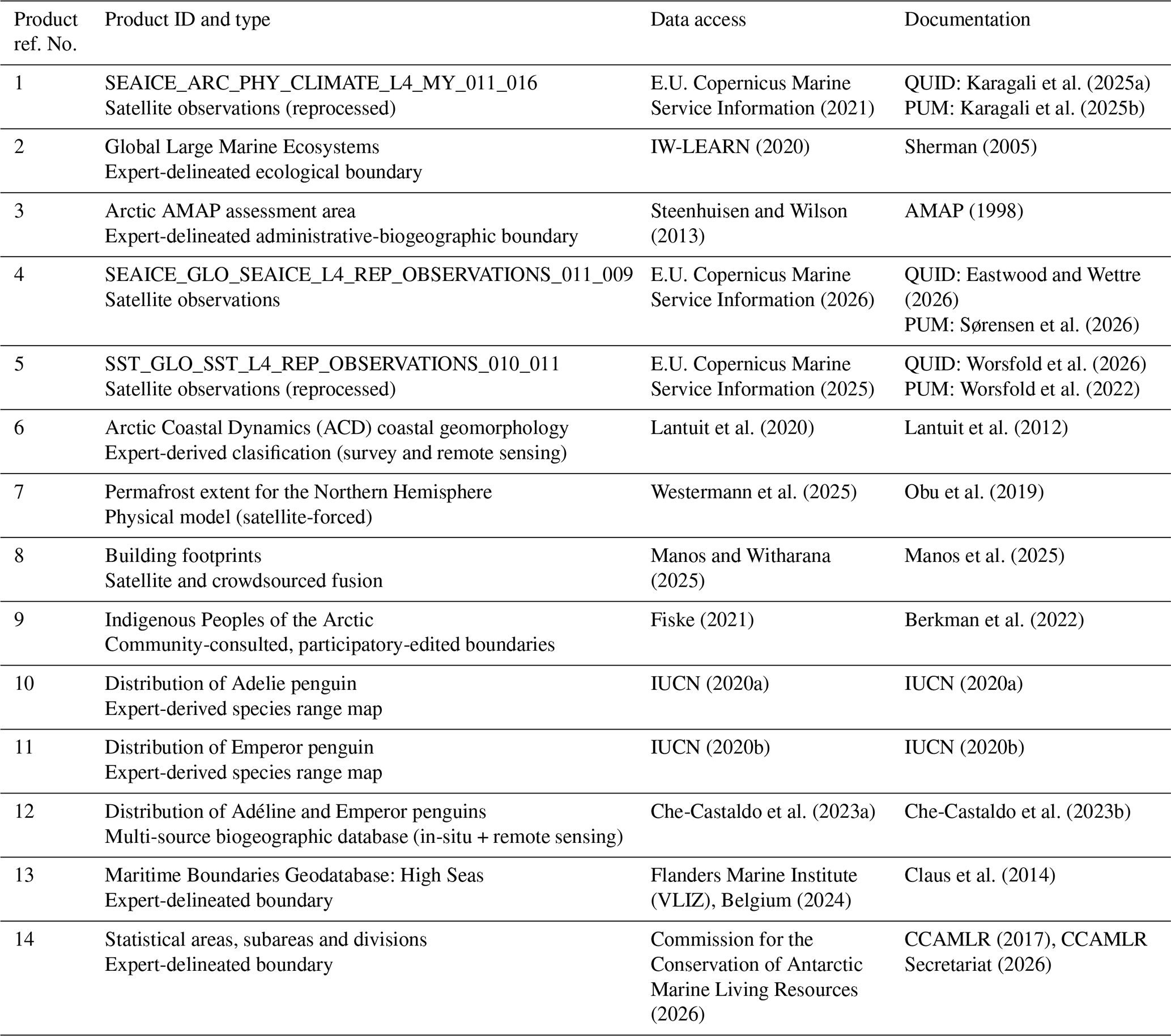
The approach offers several benefits. First, ocean narratives translate complex ocean science into societally relevant insights, as it provides a transparent framework for connecting environmental and socioeconomic information (see Table 1). Second, the approach helps to raise awareness on regions, sectors, and communities, that may be particularly exposed or resilient to ocean change. Third, ocean narratives can support policy development, as they link ocean conditions to tangible societal outcomes. And fourth, they enable communication of ocean knowledge and change through compelling, evidence-based stories, that resonate with diverse audiences. In other words, ocean narratives can serve as a bridge between observation and action, helping synthesize large, and often disconnected, datasets into coherent knowledge that can inform sustainable ocean governance, and into informed decision-making. By improving the accessibility and relevance of scientific information, ocean narratives can contribute to making data and science more actionable.
The narrative presented here focusses on the polar ocean areas, i.e. the Arctic and Antarctic ocean. This approach highlights critical questions: How are Arctic and Southern Ocean conditions changing in different regions relevant for regional to international ocean governance? How are these physical changes translating into consequences for ecosystems, biodiversity, and societies, including coastal communities in polar regions? How can observations and indicators support the understanding, conservation, and governance of rapidly changing polar ocean environments, including Areas Beyond National Jurisdictions (ABNJs) and shared global commons? By connecting physical ocean change with ecological responses and societal dimensions, ocean narratives aim to provide an integrated understanding of how polar ocean transformations unfold to help policymakers, practitioners, and scientists to move towards a more comprehensive view of the links between ocean change, ecosystem resilience and governance challenges. All data used for the narrative are documented in Product Table 1, together with information on data access and related references.
3.1 Sea ice extent and surface warming in the Arctic
Sea ice plays a major role in the Arctic Ocean due to its large cooling influence from its high reflectivity (IPCC, 2019). Sea ice supports all four ecosystem service categories (Steiner et al., 2021): supporting services, through habitat and nurseries for species such as Arctic cod and Antarctic krill; provisioning services, through harvesting and medicinal and genetic resources; cultural services, through Indigenous and local knowledge, identity, tourism, and research; and regulating services, through light regulation, biogenic aerosol production, halogen oxidation, and greenhouse gas exchange. Sea ice is not only ecologically, but socially and culturally foundational for Indigenous and Local Peoples. Millions of people live in close contact with the cryosphere in the Arctic, and sea ice underpins traditional subsistence practices, while also carrying deep cultural, spiritual, and identity-related significance (IPCC, 2019)(Steiner et al., 2021).
Arctic sea ice has dramatically retreated and thinned in recent decades, both of which are expected to continue under climate change (IPCC, 2021). These ongoing changes in the polar regions have strong impacts on sea-ice ecosystems and associated ecosystem services (Steiner et al., 2021). Decreasing sea ice reduces the surface albedo, resulting in more surface solar absorption, which amplifies surface warming and drives additional ice melt, known as the sea-ice albedo feedback (e.g., Zhang et al., 2025). Loss of Arctic sea ice is reducing habitat for key species and directly affecting the livelihoods of Indigenous communities and cultures (IPCC, 2019), while permafrost thaw, sea-level rise, and reduced sea-ice protection have already damaged or destroyed numerous cultural heritage sites across Arctic regions (IPCC, 2023). These changes are increasingly threatening Arctic livelihoods, culture, identity, health, and food security, with risks amplified for those most reliant on the environment for subsistence (IPCC, 2023). Traditional knowledge from I nupiaq and Yupik hunters in northern Alaska further documents how changing sea-ice patterns are altering the behaviour and accessibility of marine mammals, that remain a key subsistence food source, directly affecting hunting practices developed over generations (Huntington et al., 2016).
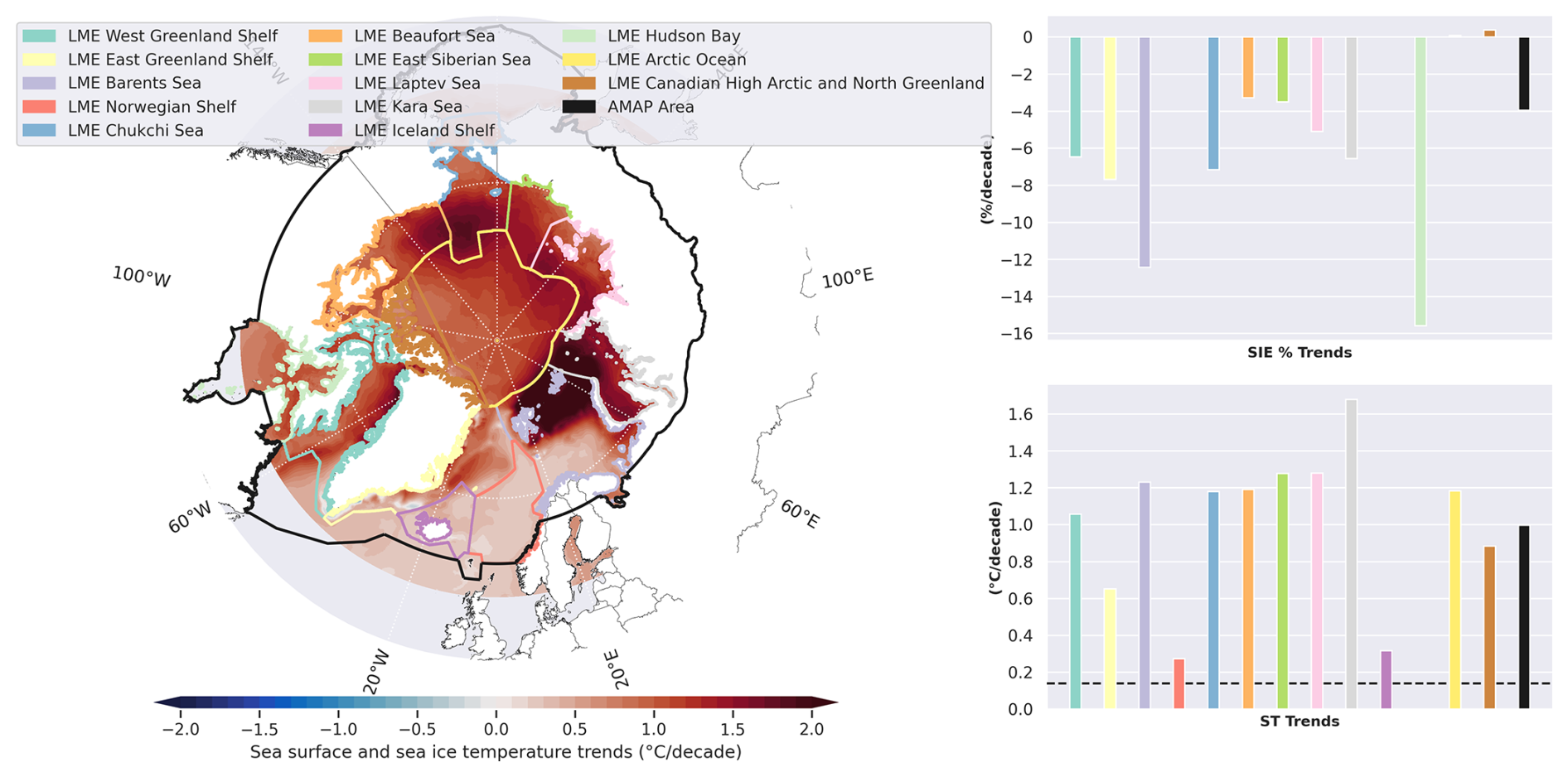
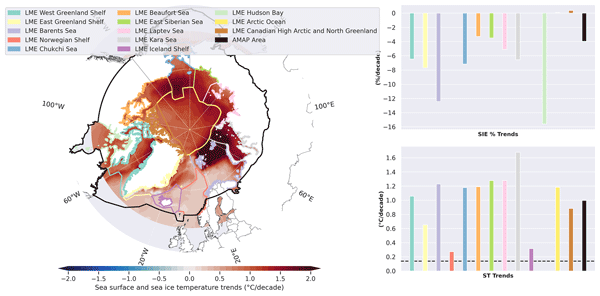
Figure 1Physical state of the Arctic. (a) Map of the trend in combined sea and ice surface temperature anomalies for the Arctic Ocean over 1982–2024 (blue-red shading, based on product ref. no. 1), showing clearly how most of the region has heated up over more than four decades. The boundaries of the Large Marine Ecosystems (LMEs) in the Arctic are displayed on top (colored lines, based on product ref. no. 2), to allow an estimation and intercomparison of the differential warming in each zone. The work area of the Arctic Monitoring and Assessment Programme (AMAP) is also shown, enclosed by a solid black line (based on product ref. no. 3). (b) Trend per decade of the percentage of sea ice extent loss compared to the climatology (1993–2010) in each Polar LME and the AMAP area from 1982 to 2024 (based on product ref. no. 4). (c) Sea surface and sea ice surface temperature anomalies trends in Polar LMEs and the AMAP area over period 1982–2024, expressed as the average increase in temperature observed in each region per decade (based on product ref. no. 1). As reference, the value of the corresponding sea surface temperature anomalies trend at global scale (computed using product ref. no. 5) is indicated by the black dashed line. LMEs are ecologically rather than politically defined ocean regions. They are relatively large regions of coastal water (200 000 km2 or greater) thus defined by ecological criteria, such as bathymetry or productivity (Sherman, 2014).
Large Marine Ecosystems (LMEs) are ecologically rather than politically defined ocean regions. They are relatively large regions of coastal water (200 000 km2 or greater) thus defined by ecological criteria, such as bathymetry or productivity (Sherman, 2014). LMEs cut across national boundaries and provide a scientific basis for transboundary, ecosystem-based management that links ocean knowledge directly to action on, for example, fisheries, pollution, habitat restoration, and biodiversity conservation (Sherman, 2014). Arctic LMEs were identified as an Arctic marine strategic plan following its decision to adopt ecosystem-based management, and were endorsed by the Arctic Council Ministers in 2006 (PAME, 2013). The map of Arctic LMEs was revised in 2013 to better respect ecological features and integrate all zones which are included in the Arctic Council work. In total, 18 LMEs have been identified in the Arctic (PAME, 2013). We address here 13 out of the 18 LMEs as defined by the Arctic Council, as the remaining 5 are currently only partly or not covered by the regional product for surface temperature (Fig. 1). Except for Iceland Shelf and Norwegian shelf, where seasonal sea ice is generally absent, polar LMEs with seasonal sea-ice cover have experienced sea-ice decline over the period 1982–2024, reaching in some areas up to −16 % per decade relative to the climatology 1993–2010 (Fig. 1b). LMEs most affected by sea ice loss include the Hudson Bay (−16 % per decade), Barent Sea (−12 % per decade), East Greenland Shelf (−8 % per decade), Chukchi Sea and the Kara Sea (−7 % per decade) (Fig. 1b). Sea ice loss of −4 % per decade is reported for the AMAP area over the period 1982–2024.
The sea-ice albedo feedback is central to the Arctic amplification, where near-surface air temperature change over the Arctic are enhanced relative to lower latitude (Previdi et al., 2021), and well established in ocean sea surface and sea ice surface temperature (SST, Fig. 1). SST provides crucial insight into the mechanisms underlying extreme weather and climate events in the Arctic, as well as broader oceanic and atmospheric teleconnections linking the Arctic to lower latitudes (Carvalho and Wang, 2020). Arctic Ocean SST is strongly influenced by sea ice and related melt water, brine rejection, continental runoff, and upward heat fluxes from the deeper warm ocean (Stroh et al., 2015). Warmer SSTs directly shape marine ecosystems, influencing the timing and development of primary production cycles, the availability of habitat, and the occurrence of harmful algal blooms, with cascading effects on fisheries, food security, and the communities that depend on them (IPCC, 2019). Rising Arctic SST, together with associated sea-ice loss and habitat change, is contributing to significant northward shifts in the distribution of commercially and culturally important fish species, with direct consequences for fisheries management and the Indigenous and local communities who rely on these resources (Mueter et al., 2021). Sea surface and sea ice surface temperature is increasing in all Arctic LMEs included in this study (LME Hudson Bay excluded due to data product limitations, see Fig. 1), and has increased on average in the AMAP region at a rate of 1 °C per decade over the period 1982–2024, which accumulates to 4.2 °C on average since 1982 (Fig. 1). These values are consistent with the study of Englyst et al. (2026). LMEs most affected by strong increase in SST include the Kara Sea (1.68 °C per decade), East Siberian Sea and Laptev Sea (1.28 °C per decade), Barent Sea (1.23 °C per decade), Beaufort Sea (1.19 °C per decade), Chukchi Sea and Arctic Ocean (1.18 °C per decade) (Fig. 1b).
3.2 Arctic ocean change and human exposure
Sea ice loss also has consequences beyond the open ocean itself, extending to compound impacts on Arctic coasts through its role in coastal erosion. Rapid coastal erosion in the Arctic consistently coincides with substantial sea-ice retreat over the past four decades (Fig. 2). As sea ice retreats, it expands the fetch over which wind can generate waves and prolongs the open-water season, increasing the mechanical exposure of Arctic coastlines to wave action (Nielsen et al., 2022). This process compounds with permafrost thaw, which causes soil decohesion and slumping as the frozen ground that structurally binds coastal sediment disappears, and this compound effect drives coastal retreat rates, that have already increased by a factor of two or more across the Arctic in recent decades (Nielsen et al., 2022). Recent research shows that these hazards interact more severely in combination than previously understood. Particularly, accounting for the compound effects of permafrost thaw subsidence, sea-level rise, and erosion together projects 6 to 8 times more land loss along Alaska's Arctic Coastal Plain by 2100 than erosion alone would suggest, potentially damaging 40 %–65 % of infrastructure in present-day coastal villages (Creel et al., 2024). Across the wider Arctic, 60 % of detected coastal infrastructure already sits in low-lying areas vulnerable to this compounding erosion and sea-level rise, underscoring the scale of the challenge facing coastal communities (Tanguy et al., 2024).
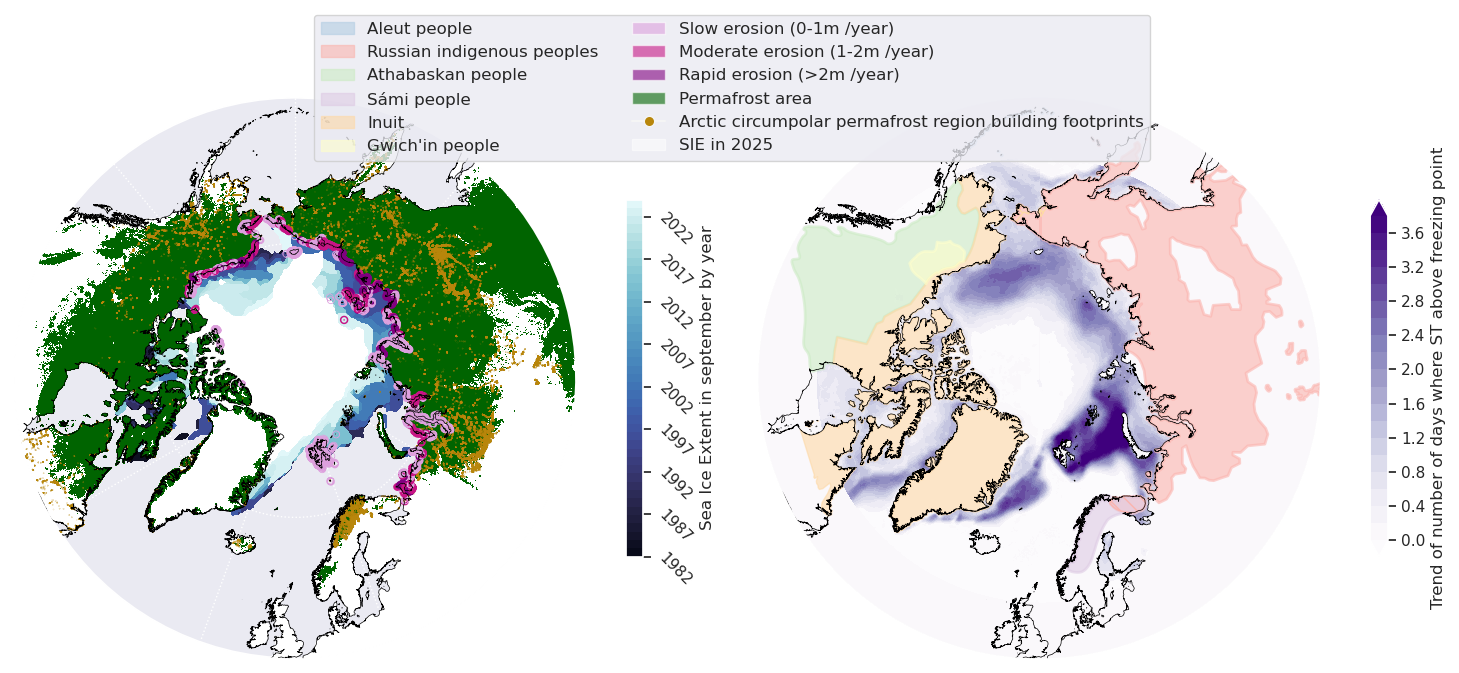
Figure 2Arctic ocean change and human exposure. (a) Map of sea ice retreat and erosion in the Arctic and surrounding regions. The gradual reduction of the sea ice extent in the Arctic Ocean over the last decades is shown through the variation observed in the month of September from 1982 to 2025 (blue-white shaded area, based on product ref. no. 4). The prolonged presence of open waters along the bordering coastline is usually accompanied by an increase in local erosion rates (Lantuit et al., 2012) (pink-purple dots, based on product ref. no. 6). Inland, the sustained warming of the circumpolar region is inducing also a thawing of the permafrost (green area shows its total extent in 2023, based on product ref. no. 7), which, besides its effect on ecosystems, can cause severe damage to buildings erected on frozen ground due to foundation movement (Hjort et al., 2022): the zones that could be potentially affected by this are indicated on the map through their building footprints (brown dots, based on product ref. no. 8). The second map (b) indicates the trend of the number of days per year where the surface temperature is above the freezing point (−1.8 °C), computed from 1982 to 2024 (purple-shaded area; white area indicates that the temperatures are always below or above the freezing point; based on product ref. no. 1); it also shows the regions where the different Indigenous and Local Peoples of the Arctic live (coloured areas, based on product ref. no. 9).
For many Arctic Indigenous and Local Peoples, sea ice is far more than a physical component of the environment, as it provides access to hunting grounds, supports food security, enables travel, and underpins cultural identity and knowledge systems (IPCC, 2019). The combined effects of declining sea ice, rising temperatures, increasing numbers of above-freezing days, and thawing permafrost are reducing the predictability and safety of travel, altering wildlife distributions and harvesting opportunities, and increasing risks to coastal settlements and traditional livelihoods (Grimmer et al., 2025; Hovelsrud et al., 2011; Huntington et al., 2022).
The annual number of days when Arctic surface waters exceed the seawater freezing point threshold (−1.8 °C) provides an integrated measure of changes in the seasonal sea-ice regime, as small shifts around this threshold can influence the timing and duration of sea-ice formation and persistence, with consequences for ocean–atmosphere exchanges, marine ecosystems, and human activities (Stroeve and Notz, 2018; Perovich et al., 2020; IPCC, 2019). All ocean areas adjacent to the Arctic coast show increasing trends in the annual number of days when conditions are above the seawater freezing point threshold (−1.8 °C), reflecting longer periods of warmer surface waters and reduced seasonal ice presence (Fig. 2). Trends range from approximately half a day per year to more than 3 d per year over the past four decades, with the strongest increases observed in the Barents Sea, Kara Sea, and Greenland Sea (Fig. 2). Over four decades, these trends result in an additional ∼ 20 to more than 120 d locally, with above-freezing conditions, compared with the beginning of the record in 1982, indicating a tremendous lengthening of the period during which Arctic waters remain exposed to warmer, ice-unfavourable conditions.
The impacts of Arctic change manifest differently across Indigenous and Local Peoples communities. For example, for Inuit Peoples across Canada, Alaska, and Greenland, declining and increasingly unpredictable sea ice is disrupting access to marine mammal hunting grounds and traditional travel routes, with direct consequences for food security, safety, and cultural practices (Ford et al., 2019; IPCC, 2019; Laidler and Ikummaq, 2008). Another example includes Yup'ik and I nupiat communities in Alaska that face similar challenges, as thinner and less predictable sea ice increasingly affects access to marine subsistence resources, and alters established patterns of travel and harvesting (Huntington et al., 2016; Meeker and Kettle, 2017).
As these environmental transitions evolve, Indigenous and Local communities face increasing challenges in maintaining traditional practices and livelihoods, highlighting the importance of integrating Indigenous and Local Peoples' knowledge systems with sustained environmental observations to inform adaptation and strengthen Arctic governance (Beaulieu et al., 2023; Bishop et al., 2026; Eerkes-Medrano and Huntington, 2021; Malik and Ford, 2025; Monakhova et al., 2026). Indigenous and Local Peoples knowledge is inseparable from culture: observing is stewardship, livelihood, and science all at once (Carroll, 2024; Carroll et al., 2020; Ladd et al., 2025).
3.3 Southern Ocean ecosystems, sea ice, and governance
Multilateral governance regimes, like the Antarctic Treaty System, play a central role in addressing complex, transboundary environmental problems, and their success depends heavily on effective exchange of knowledge between scientists and policymakers (Gardiner et al., 2025). The Antarctic treaty was signed in 1959, and entering into force in 1961, it set aside the region south of 60° S for peace, science, and international cooperation (The Antarctic Treaty, 1959). The Antarctic environmental conservation and protection is assured by the 1980 Convention on the Conservation of Antarctic Marine Living Resources (CCAMLR, entered into force in 1982; CCAMLR, 1980), and the 1991 Protocol on Environmental Protection to the Antarctic Treaty (the Madrid Protocol, entered into force in 1998). The Environmental Protocol of the Antarctic Treaty requires that the protection of the Antarctic environment and its ecosystems be a fundamental consideration in the planning and conduct of all activities in the Antarctic Treaty area, and, for example, bans mining and mineral exploitation except for scientific research (Antarctic Treaty Environmental Protocol, 1991). CCAMLR governs an area of around 10 % of the world's ocean surface, and mandates conservation, but allows rational use, where fishing is permitted but under a strict, precautionary, ecosystem-based approach (Nocito and Brooks, 2023). Decision-making within CCAMLR, whose membership comprises 26 states and the European Union, operates by consensus. Decisions are codified as Conservation Measures, which are legally binding on all CCAMLR Member States. This science-based, precautionary approach directly influenced the design of the 2023 Agreement on the Conservation and Sustainable Use of Marine Biological Diversity of Areas Beyond National Jurisdiction (BBNJ Agreement) governing biodiversity in the high seas (Nocito and Brooks, 2023).
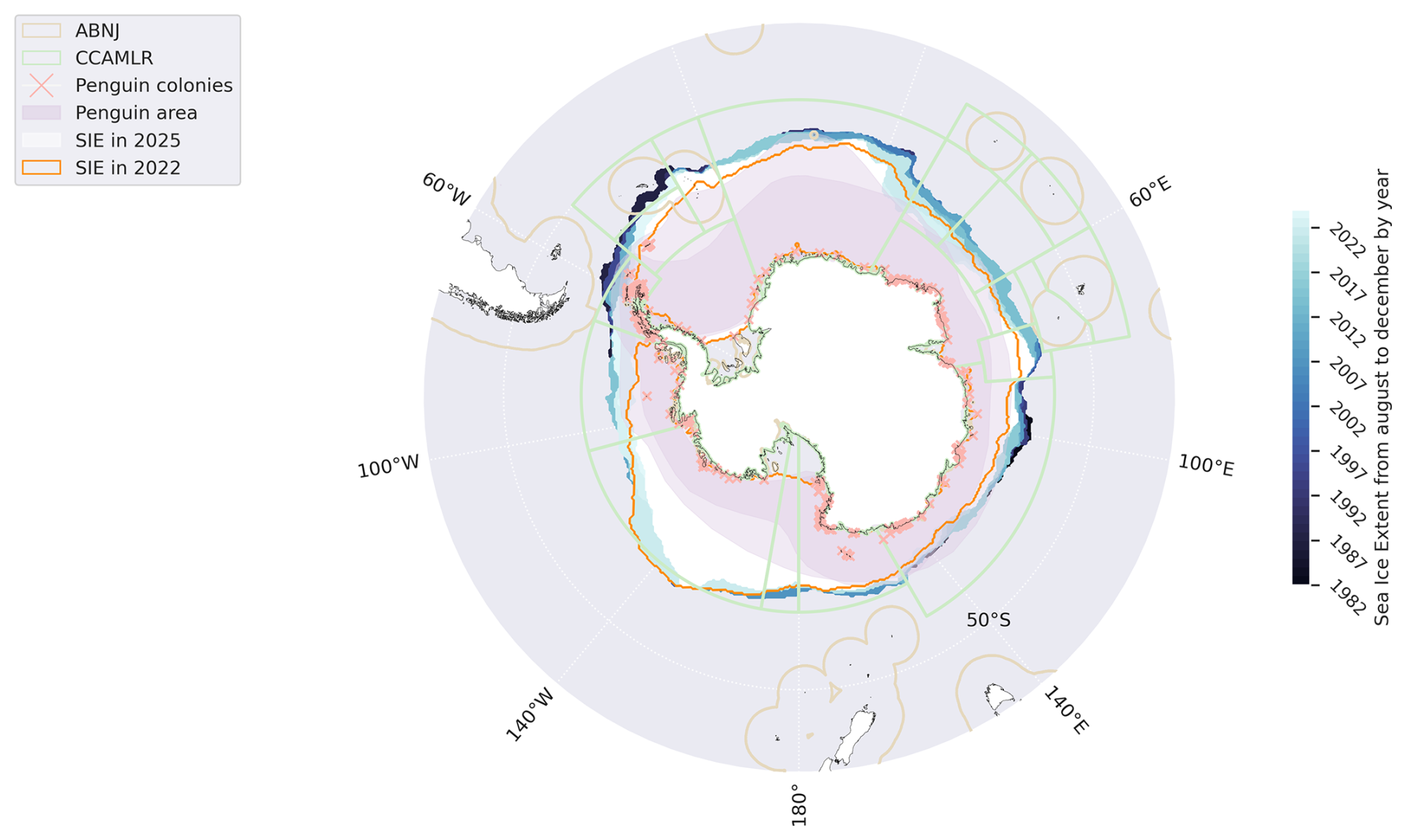
Figure 3Map of Antarctica and the Southern Ocean combining data on Antarctic animal species, sea ice and governance. Around the continent, the habitat range (purple area, based on product ref. nos. 10 and 11) and known colonies from 1982 to 2022 (red crosses, based on product ref. no. 12) of Adelie and Emperor penguins (Pygoscelis adeliae, Aptenodytes forsteri) are shown, two bird species whose conservation status is monitored by the IUCN Red List. The observed extent variations of the circumpolar sea ice on which they live are also displayed as annual averages from August to December between 1982 and 2025 (blue-white shading, based on product ref. no. 4), with the particular value for year 2022 highlighted (orange contour line over the shaded area). In relation to conservation agreements over the Antarctic seas, the Areas Beyond National Jurisdiction (ABNJ) defined under the 1982 United Nations Convention on the Law of the Sea (United Nations, 1982b, 2023) are delimited on the map by brown lines (based on product ref. no. 13), and the areas and subareas defined by the Commission for the Conservation of Antarctic Marine Living Resources (CCAMLR, 2017) are delineated in green (based on product ref. no. 14).
Today, the Southern Ocean is also a region of overlapping governance, where the Antarctic Treaty System and the newly established BBNJ framework may both have relevance for the conservation of marine biodiversity in areas beyond national jurisdiction (see Fig. 3). Since about 2016, negotiations on further Southern Ocean MPA proposals (e.g., East Antarctica, Weddell Sea, Antarctic Peninsula) have repeatedly failed to reach the consensus CCAMLR requires, leaving Southern Ocean MPA expansion effectively stalled for close to a decade (Nocito and Brooks, 2023). Against this backdrop, the 2023 adoption and 2026 entry into force of the BBNJ Agreement offers new momentum that CCAMLR can draw on to advance Southern Ocean protection (Haward, 2021; Nocito and Brooks, 2023). The Southern Ocean occupies an ambiguous position in both major global environmental conventions: it is formally excluded from Convention on Biological Diversity (CBD) assessments of progress toward its Strategic Plan for Biodiversity (Chown et al., 2017), and has no dedicated provisions within the UNFCCC process, leaving CCAMLR and the Antarctic Treaty System as the primary vehicles through which Southern Ocean conservation and climate-related action are pursued in practice (Chown et al., 2017; Constable, 2022; Lowther et al., 2022).
However, the Southern Ocean makes the case, more clearly than perhaps anywhere else, that climate and biodiversity action are two sides of the same problem. This interdependence becomes particularly evident where climate change directly alters the habitat that conservation policies seek to protect. Sea-ice-dependent species, such as the Emperor and Adélie penguin (Fig. 3), require both: (i) MPAs, advanced through the Antarctic Treaty System, and the emerging BBNJ framework, to reduce direct anthropogenic pressures, and (ii) the sea ice itself maintained, which requires deep emissions reductions under the Paris Agreement to limit long-term climate-driven sea-ice loss. These tracks are not alternatives but a single, intertwined agenda, and the Southern Ocean is where this relationship is particularly visible. For example, Emperor penguins, which breed exclusively on stable, shore-attached sea ice known as “fast ice”, are especially vulnerable: record-low Antarctic sea ice in 2022 coincided with the first-ever recorded large-scale breeding failure, with four of five monitored colonies experiencing total breeding failure after early ice break-up, and modelling suggests over 90 % of emperor penguin colonies could become quasi-extinct by 2100 if current sea-ice loss rates persist (Fretwell et al., 2023; Fretwell and Trathan, 2021; Jenouvrier et al., 2021). The August-to-December window is especially relevant because it spans the most vulnerable phase of the breeding cycle of emperor penguins (Fig. 3): chicks hatch in July–August and only become waterproofed and ready to fledge by mid-December to early January. Since chicks cannot survive in open water before fledging, sea-ice persistence during this period is a critical determinant of breeding success. Changes in sea ice do not solely affect emperor penguins, but also other species such as Adélie penguins, whose access to the ocean and to prey is determined by the sea ice around their colonies (Quilestino-Olario, 2026). Although satellite-derived regional sea-ice extent does not directly measure fast-ice stability, it provides an important indicator of the surrounding sea-ice conditions that influence fast-ice persistence and colony viability (Aoki, 2017; Fretwell, 2024).
The spatial overlap between areas of sea ice retreat over the past 4 decades coincide with major pinguin colonies areas, particularly around the Antarctic Peninsula (Fig. 3), which illustrates how physical changes in the cryosphere are already translating into biological responses, providing one of the clearest examples of climate-driven ecosystem change anywhere on Earth. Emperor penguins provide one of the clearest biological examples of the consequences of sea-ice decline, but they are not an isolated case. Antarctic sea ice structures the entire Southern Ocean ecosystem, regulating primary production, krill recruitment, predator distributions, and the seasonal availability of habitat. Changes in sea-ice extent and duration therefore propagate across multiple trophic levels, from phytoplankton and Antarctic krill to fish, seals, whales, and seabirds, reshaping ecosystem functioning at the scale of the Southern Ocean. When climate alters the habitat itself, conservation and climate policy become inseparable. This dependence fundamentally changes the conservation challenge. Marine Protected Areas can reduce anthropogenic pressures from fishing, disturbance, and habitat degradation, but they cannot preserve sea-ice habitat itself. Conversely, climate mitigation alone cannot address local ecological pressures. Conserving Southern Ocean biodiversity therefore requires climate and biodiversity policies to operate together, making the Southern Ocean one of the clearest demonstrations that climate mitigation and biodiversity conservation cannot be pursued independently.
The three themes of the polar ocean narrative presented here illustrate that polar ocean change is not expressed through isolated environmental trends, but through interconnected transformations affecting physical systems, ecosystems and societies. In the Arctic, declining sea ice and rising ocean and sea ice temperatures reveal a rapidly changing marine environment with consequences for ecosystem dynamics and ocean governance. These physical changes propagate beyond the open ocean, interacting with permafrost thaw and coastal processes to increase risks for infrastructure, ecosystems, and communities whose livelihoods and cultures depend on sea ice. In the Southern Ocean, the spatial relationship between sea-ice retreat and penguin colonies highlights a central conservation challenge: protecting biodiversity requires addressing both local pressures and the climate drivers reshaping the habitat itself. Together, these examples demonstrate why polar ocean observations must be translated into integrated knowledge to support effective adaptation, conservation and governance. The main insights from these narratives are captured in the following key messages:
Except for Iceland Shelf and Norwegian shelf, where seasonal sea ice is generally absent, polar LMEs with seasonal sea-ice cover have experienced sea-ice decline over the period 1982–2024, with the strongest losses observed in the Hudson Bay, Barent Sea, East Greenland Shelf, Chukchi Sea and the Kara Sea. Large Marine Ecosystems (LMEs) are ecologically defined ocean regions that provide a scientific framework for ecosystem-based management across national boundaries. By integrating oceanographic and ecological processes, they support coordinated management of fisheries, biodiversity, habitat conservation and other shared marine resources. Tracking sea-ice change at the LME scale therefore provides information directly relevant for transboundary ocean governance and the sustainable management of Arctic marine ecosystems.
Across the AMAP region, combined sea surface and sea-ice surface temperature has increased at an average rate of 1 °C per decade over 1982–2024, equivalent to approximately 4.2 °C of warming over the observational period, with the strongest warming rates (above 1 °C per decade) observed in the LMEs Kara Sea, East Siberian Sea and Laptev Sea, Barent Sea, Beaufort Sea, Chukchi Sea and Arctic Ocean. Sea surface temperature is a fundamental indicator of Arctic amplification and provides an integrated measure of changes in the coupled ocean–sea ice–atmosphere system. Also, increasing ocean temperatures are transforming Arctic marine ecosystems, driving shifts in species distributions and ecosystem productivity, with implications for fisheries, food security and Indigenous and Local Peoples livelihoods.
Rapid coastal erosion in the Arctic consistently coincides with substantial sea-ice retreat over the past four decades. Sea-ice loss increases the exposure of Arctic coastlines to wave action by extending the open-water season and enlarging the fetch over which waves can develop. Combined with thawing permafrost that weakens coastal sediments, these interacting processes have accelerated coastal retreat across many Arctic regions, with important consequences for infrastructure and coastal communities.
All ocean areas adjacent to the Arctic coast show increasing numbers of days above the seawater freezing point threshold (−1.8 °C), with trends ranging from approximately 0.5 to more than 3 additional days per year over the past four decades. These trends correspond to approximately 20 to more than 120 additional days with above-freezing conditions since 1982, indicating longer periods of warmer surface waters and reduced seasonal ice presence, particularly in the Barents Sea, Kara Sea and Greenland Sea. As sea ice becomes less predictable and persistent, Arctic ecosystems, marine species distributions, and communities that rely on sea ice for travel, harvesting and cultural practices are increasingly affected. Understanding these interconnected changes requires sustained observations and the integration of Indigenous and Local Peoples' knowledge to support adaptation and informed Arctic governance.
The spatial overlap between long-term sea-ice retreat and major penguin colonies illustrates a fundamental conservation challenge: the habitat that supports Southern Ocean biodiversity is itself changing. Protecting biodiversity therefore requires both reducing local pressures through conservation and addressing the climate drivers of sea-ice loss through global mitigation.
All codes are available upon request.
All data used are available, and their sources are listed in the product table.
KvS: conceptualization, designing, methodology, writing (original draft), investigation, supervision, and formal analysis. FG: writing (original draft), conceptualization, mehtodology and formal analysis. All authors: writing (review and editing).
At least one of the (co-)authors serves as topic editor for the report to which this paper belongs. The peer-review process was guided by an independent editor, and the authors also have no other competing interests to declare.
The Copernicus Marine Service offering is regularly updated to ensure it remains at the forefront of user requirements. In this process, some products may undergo replacement or renaming, leading to the removal of certain product IDs from the catalogue. If readers have any questions or require assistance regarding these modifications, please feel free to reach out to the Copernicus Marine Service user support team for further guidance. They will be able to provide the necessary information to address concerns and find suitable alternatives.
Publisher's note: Copernicus Publications remains neutral with regard to jurisdictional claims made in the text, published maps, institutional affiliations, or any other geographical representation in this paper. The authors bear the ultimate responsibility for providing appropriate place names. Views expressed in the text are those of the authors and do not necessarily reflect the views of the publisher.
This research was carried out as part of the Copernicus Marine Service implemented by MOi under a contributing agreement with the European Commission, and “Ocean observations and indicators for climate and assessments” (ObsSea4Clim) is funded by the European Union Horizon Europe Funding Programme for Research and Innovation under grant no. 101136548.
This paper was edited by Marilaure Grégoire.
Abram, N. J., Purich, A., England, M. H., McCormack, F. S., Strugnell, J. M., Bergstrom, D. M., Vance, T. R., Stål, T., Wienecke, B., Heil, P., Doddridge, E. W., Sallée, J.-B., Williams, T. J., Reading, A. M., Mackintosh, A., Reese, R., Winkelmann, R., Klose, A. K., Boyd, P. W., Chown, S. L., and Robinson, S. A.: Emerging evidence of abrupt changes in the Antarctic environment, Nature, 644, 621–633, https://doi.org/10.1038/s41586-025-09349-5, 2025.
AMAP: AMAP Assessment Report: Arctic Pollution Issues, Chapter 2 – Definitions, ISBN 82-7655-061-4, 1998.
Antarctic Treaty Environmental Protocol: Protocol on Environmental Protection to the Antarctic Treaty, https://www.ats.aq/e/protocol.html (last access: 21 September 2026), 1991.
Aoki, S.: Breakup of land-fast sea ice in Lützow-Holm Bay, East Antarctica, and its teleconnection to tropical Pacific sea surface temperatures, Geophys. Res. Lett., 44, 3219–3227, https://doi.org/10.1002/2017GL072835, 2017.
Argüello, G. and Rafaly, V.: Science diplomacy and Asian states: Transforming the governance landscape in the Arctic, Polar Rec., 59, e41, https://doi.org/10.1017/S0032247423000281, 2023.
Arouf, A., Chepfer, H., Kay, J. E., L'Ecuyer, T. S., and Lac, J.: Surface Cloud Warming Increases as Late Fall Arctic Sea Ice Cover Decreases, Geophys. Res. Lett., 51, e2023GL105805, https://doi.org/10.1029/2023GL105805, 2024.
Årthun, M., Brakstad, A., Dörr, J., Johnson, H. L., Mans, C., Semper, S., and Våge, K.: Atlantification drives recent strengthening of the Arctic overturning circulation, Sci. Adv., 11, eadu1794, https://doi.org/10.1126/sciadv.adu1794, 2025.
Baudry, J., Didier, D., Dumont, D., Jourdain-Bonneau, C., Noah, T., Hamilton, A., and Bertrand, E.: Arctic sea-ice decline amplifies extreme wave exposure for coastalInuit communities, Nature Portfolio, https://doi.org/10.21203/rs.3.rs-9011874/v1, in review, 2026.
Beaulieu, L., Arreak, A., Holwell, R., Dicker, S., Qamanirq, O., Moorman, L., Wilson, K., Segal, R., Crichton, S., and Bell, T.: Indigenous self-determination in cryospheric science: The Inuit-led Sikumik Qaujimajjuti (“tools to know how the ice is”) program in Inuit Nunangat, Canada, Front. Earth Sci., 11, 1076774, https://doi.org/10.3389/feart.2023.1076774, 2023.
Berkman, P. A.: Science diplomacy and the 5th International Polar Year (IPY-5): planetary considerations across centuries, Camb. Prisms Coast. Futures, 3, e6, https://doi.org/10.1017/cft.2025.2, 2025.
Berkman, P. A., Young, O. R., Vylegzhanin, A. N., Balton, D. A., and Øvretveit, O. R.: Introduction: Building Common Interests with Informed Decisionmaking for Sustainability, in: Building Common Interests in the Arctic Ocean with Global Inclusion, edited by: Berkman, P. A., Vylegzhanin, A. N., Young, O. R., Balton, D. A., and Øvretveit, O. R., Springer International Publishing, Cham, 3–54, https://doi.org/10.1007/978-3-030-89312-5_1, 2022.
Bishop, B., Andersen, B., Oliver, E. C. J., Aporta, C., and Anthony, K.: Co-developing a conceptual model rooted in Inuit Knowledge of the landfast sea ice season near Makkovik, Nunatsiavut, Arctic Science, 12, 1–23, https://doi.org/10.1139/as-2025-0047, 2026.
Bronen, R.: Climate-induced community relocations: using integrated social-ecological assessments to foster adaptation and resilience, Ecol. Soc., 20, 36, https://doi.org/10.5751/ES-07801-200336, 2015.
Bronen, R. and Chapin, F. S.: Adaptive governance and institutional strategies for climate-induced community relocations in Alaska, P. Natl. Acad. Sci. USA, 110, 9320–9325, https://doi.org/10.1073/pnas.1210508110, 2013.
Carroll, S. R.: Indigenous peoples breathing data back, Youtube, https://www.youtube.com/watch?v=jPS_3mZXWXw (last access: 10 September 2026), 2024.
Carroll, S. R., Garba, I., Figueroa-Rodríguez, O. L., Holbrook, J., Lovett, R., Materechera, S., Parsons, M., Raseroka, K., Rodriguez-Lonebear, D., Rowe, R., Sara, R., Walker, J. D., Anderson, J., and Hudson, M.: The CARE Principles for Indigenous Data Governance, Data Science Journal, 19, 43, https://doi.org/10.5334/dsj-2020-043, 2020.
Carvalho, K. S. and Wang, S.: Sea surface temperature variability in the Arctic Ocean and its marginal seas in a changing climate: Patterns and mechanisms, Global Planet. Change, 193, 103265, https://doi.org/10.1016/j.gloplacha.2020.103265, 2020.
CCAMLR: The Convention for the Conservation of Antarctic Marine Living Resources (CAMLR Convention), https://www.ccamlr.org/en/organisation/camlr-convention-text (last access: 10 September 2026), 1980.
CCAMLR: Map of the CAMLR Convention Area, https://www.ccamlr.org/ru/node/72742 (last access: 10 September 2026), 2017.
Commission for the Conservation of Antarctic Marine Living Resources: CCAMLR Geospatial Operations, GitHub [code], https://github.com/ccamlr/geospatial_operations, last access: 15 July 2026.
CCAMLR Secretariat: Geographical data layer: CCAMLR Statistical Areas, Subareas and Divisions (ASD) (0.6.3), https://spatial.ccamlr.org/ (last access: 10 September 2026), 2026.
Chavez-Molina, V., Nocito, E. S., Carr, E., Cavanagh, R. D., Sylvester, Z., Becker, S. L., Dorman, D. D., Wallace, B., White, C., and Brooks, C. M.: Managing for climate resilient fisheries: Applications to the Southern Ocean, Ocean Coast. Manage., 239, 106580, https://doi.org/10.1016/j.ocecoaman.2023.106580, 2023.
Che-Castaldo, C., Humphries, G., Lynch, H., and Van de Putte, A.: Antarctic Penguin Biogeography Project: Database of abundance and distribution for the Adélie, chinstrap, gentoo, emperor, macaroni, and king penguin south of 60 S. Version 2.3. SCAR – AntOBIS [data set], https://doi.org/10.48361/ZFTXKR, 2023a.
Che-Castaldo, C., Humphries, G., and Lynch, H.: Antarctic Penguin Biogeography Project: Database of abundance and distribution for the Adelie, chinstrap, gentoo, emperor, macaroni and king penguin south of 60 S, Biodiversity Data Journal, 11, e101476, https://doi.org/10.3897/BDJ.11.e101476, 2023b.
Cheng, L., Von Schuckmann, K., Abraham, J. P., Trenberth, K. E., Mann, M. E., Zanna, L., England, M. H., Zika, J. D., Fasullo, J. T., Yu, Y., Pan, Y., Zhu, J., Newsom, E. R., Bronselaer, B., and Lin, X.: Past and future ocean warming, Nat. Rev. Earth Environ., 3, 776–794, https://doi.org/10.1038/s43017-022-00345-1, 2022.
Chown, S. L., Brooks, C. M., Terauds, A., Le Bohec, C., Van Klaveren-Impagliazzo, C., Whittington, J. D., Butchart, S. H. M., Coetzee, B. W. T., Collen, B., Convey, P., Gaston, K. J., Gilbert, N., Gill, M., Höft, R., Johnston, S., Kennicutt, M. C., Kriesell, H. J., Le Maho, Y., Lynch, H. J., Palomares, M., Puig-Marcó, R., Stoett, P., and McGeoch, M. A.: Antarctica and the strategic plan for biodiversity, PLoS Biol., 15, e2001656, https://doi.org/10.1371/journal.pbio.2001656, 2017.
Claus, S., De Hauwere, N., Vanhoorne, B., Deckers, P., Souza Dias, F., Hernandez, F., and Mees, J.: Marine Regions: Towards a Global Standard for Georeferenced Marine Names and Boundaries, Mar. Geod., 37, 99–125, https://doi.org/10.1080/01490419.2014.902881, 2014.
Constable, A. J.: Imperatives for integrated science and policy in managing greenhouse gas risks to the Southern Polar Region, Glob. Change Biol., 28, 4489–4492, https://doi.org/10.1111/gcb.16219, 2022.
Constable, A. J.: Ecosystem Resilience, Fisheries and Conservation in the Southern Ocean, in: Antarctica and the Earth System, Routledge, London, 186–229, https://doi.org/10.4324/9781003406471-9, 2025.
Crate, S. A. and Nuttall, M. (Eds.): Anthropology and climate change: from transformations to worldmaking, 3rd edn., Routledge, New York, NY, ISBN 9781032150932, 2024.
Creel, R., Guimond, J., Jones, B. M., Nielsen, D. M., Bristol, E., Tweedie, C. E., and Overduin, P. P.: Permafrost thaw subsidence, sea-level rise, and erosion are transforming Alaska's Arctic coastal zone, P. Natl. Acad. Sci. USA, 121, e2409411121, https://doi.org/10.1073/pnas.2409411121, 2024.
Deb, J. C. and Bailey, S. A.: Arctic marine ecosystems face increasing climate stress, Environ. Rev., 31, 403–451, https://doi.org/10.1139/er-2022-0101, 2023.
Eastwood, S. and Wettre, C.: EU Copernicus Marine Service Quality Information Document for SEAICE_GLO_SEAICE_L4_NRT_OBSERVATIONS_011_001 SEAICE_GLO_SEAICE_L4_REP_OBSERVATIONS_011_009, Mercator Ocean International, https://documentation.marine.copernicus.eu/QUID/CMEMS-SEAICE-QUID-011-001-009.pdf (last access: 10 Spetember 2026), 2026.
Eerkes-Medrano, L. and Huntington, H. P.: Untold Stories: Indigenous Knowledge Beyond the Changing Arctic Cryosphere, Front. Clim., 3, 675805, https://doi.org/10.3389/fclim.2021.675805, 2021.
Englyst, P., Karagali, I., Olsen, I. L., Gacitúa, G., Hayward, A., Dasgupta, N., Scheller, J. H., and Høyer, J. L.: Global satellite-based sea and sea-ice surface temperatures since 1982, Sci. Data, 13, 1052, https://doi.org/10.1038/s41597-026-07363-4, 2026.
E.U. Copernicus Marine Service Information (CMEMS): Arctic Ocean – Sea and Ice Surface Temperature REPROCESSED, Marine Data Store (MDS) [data set], https://doi.org/10.48670/moi-00123, 2021.
E.U. Copernicus Marine Service Information (CMEMS): Global Ocean OSTIA Sea Surface Temperature and Sea Ice Reprocessed, Marine Data Store (MDS) [data set], https://doi.org/10.48670/moi-00168, 2025.
E.U. Copernicus Marine Service Information (CMEMS): Global Ocean Sea Ice Concentration Time Series REPROCESSED (EUMETSAT OSI-SAF), Marine Data Store (MDS) [data set], https://doi.org/10.48670/moi-00136, 2026.
Fiske, G.: Indigenous Peoples of the Arctic boundary polygons, 2021, Arctic Data Center [data set], https://doi.org/10.18739/A2Z31NQ2H, 2021.
Flanders Marine Institute (VLIZ), Belgium: Maritime Boundaries Geodatabase: High Seas, version 2, VLIZ [data set], https://doi.org/10.14284/696, 2024.
Ford, J. D., Clark, D., and Naylor, A.: Food insecurity in Nunavut: Are we going from bad to worse?, Canadian Medical Associations Journal, 191, E550–E551, https://doi.org/10.1503/cmaj.190497, 2019.
Fretwell, P. T.: A 6 year assessment of low sea-ice impacts on emperor penguins, Antarct. Sci., 36, 3–5, https://doi.org/10.1017/S0954102024000130, 2024.
Fretwell, P. T. and Trathan, P. N.: Discovery of new colonies by Sentinel2 reveals good and bad news for emperor penguins, Remote Sens. Ecol. Conserv., 7, 139–153, https://doi.org/10.1002/rse2.176, 2021.
Fretwell, P. T., Boutet, A., and Ratcliffe, N.: Record low 2022 Antarctic sea ice led to catastrophic breeding failure of emperor penguins, Commun. Earth Environ., 4, 273, https://doi.org/10.1038/s43247-023-00927-x, 2023.
Frölicher, T. L., Sarmiento, J. L., Paynter, D. J., Dunne, J. P., Krasting, J. P., and Winton, M.: Dominance of the Southern Ocean in Anthropogenic Carbon and Heat Uptake in CMIP5 Models, J. Climate, 28, 862–886, https://doi.org/10.1175/JCLI-D-14-00117.1, 2015.
Gaffey, C. B., Bax, N., Krauzig, N., and Tougeron, K.: A call to strengthen international collaboration to assess climate change effects in polar regions, PLOS Clim., 3, e0000495, https://doi.org/10.1371/journal.pclm.0000495, 2024.
Gardiner, N. B., Liggett, D., Gilbert, N., and Cvitanovic, C.: Practitioners' perspectives on the enablers and barriers to successful Antarctic science‐policy knowledge exchange, Env. Pol. Gov., 35, 362–381, https://doi.org/10.1002/eet.2143, 2025.
Goessling, H. F., Rackow, T., and Jung, T.: Recent global temperature surge intensified by record-low planetary albedo, Science, 387, 68–73, https://doi.org/10.1126/science.adq7280, 2025.
Griffiths, H. J., Cummings, V. J., Van De Putte, A., Whittle, R. J., and Waller, C. L.: Antarctic benthic ecological change, Nat. Rev. Earth Environ., 5, 645–664, https://doi.org/10.1038/s43017-024-00583-5, 2024.
Grimmer, M., Baggenstos, D., Schmitt, J., Krauss, F., Shackleton, S., Severinghaus, J. P., and Fischer, H.: AMOC Modulates Ocean Heat Content During Deglaciations, Geophys. Res. Lett., 52, e2024GL114415, https://doi.org/10.1029/2024GL114415, 2025.
Gruber, N., Gloor, M., Mikaloff Fletcher, S. E., Doney, S. C., Dutkiewicz, S., Follows, M. J., Gerber, M., Jacobson, A. R., Joos, F., Lindsay, K., Menemenlis, D., Mouchet, A., Müller, S. A., Sarmiento, J. L., and Takahashi, T.: Oceanic sources, sinks, and transport of atmospheric CO2, Global Biogeochem. Cy., 23, 2008GB003349, https://doi.org/10.1029/2008GB003349, 2009.
Haward, M.: Biodiversity in Areas Beyond National Jurisdiction (BBNJ): the Commission for the Conservation of Antarctic Marine Living Resources (CCAMLR) and the United Nations BBNJ agreement, The Polar Journal, 11, 303–316, https://doi.org/10.1080/2154896X.2021.1984658, 2021.
He, Y., Shu, Q., Wang, Q., Song, Z., Zhang, M., Wang, S., Zhang, L., Bi, H., Pan, R., and Qiao, F.: Arctic Amplification of marine heatwaves under global warming, Nat. Commun., 15, 8265, https://doi.org/10.1038/s41467-024-52760-1, 2024.
Hjort, J., Streletskiy, D., Doré, G., Wu, Q., Bjella, K., and Luoto, M.: Impacts of permafrost degradation on infrastructure, Nat. Rev. Earth Environ., 3, 24–38, https://doi.org/10.1038/s43017-021-00247-8, 2022.
Hobbs, W., Spence, P., Meyer, A., Schroeter, S., Fraser, A. D., Reid, P., Tian, T. R., Wang, Z., Liniger, G., Doddridge, E. W., and Boyd, P. W.: Observational Evidence for a Regime Shift in Summer Antarctic Sea Ice, J. Climate, 37, 2263–2275, https://doi.org/10.1175/JCLI-D-23-0479.1, 2024.
Hovelsrud, G. K., Poppel, B., Van Oort, B., and Reist, J. D.: Arctic Societies, Cultures, and Peoples in a Changing Cryosphere, AMBIO, 40, 100–110, https://doi.org/10.1007/s13280-011-0219-4, 2011.
Huntington, H. P., Quakenbush, L. T., and Nelson, M.: Effects of changing sea ice on marine mammals and subsistence hunters in northern Alaska from traditional knowledge interviews, Biol. Lett., 12, 20160198, https://doi.org/10.1098/rsbl.2016.0198, 2016.
Huntington, H. P., Zagorsky, A., Kaltenborn, B. P., Shin, H. C., Dawson, J., Lukin, M., Dahl, P. E., Guo, P., and Thomas, D. N.: Societal implications of a changing Arctic Ocean, Ambio, 51, 298–306, https://doi.org/10.1007/s13280-021-01601-2, 2022.
IPCC: The Ocean and Cryosphere in a Changing Climate: Special Report of the Intergovernmental Panel on Climate Change, 1st edn., Cambridge University Press, https://doi.org/10.1017/9781009157964, 2019.
IPCC: Climate Change 2021 – The Physical Science Basis: Working Group I Contribution to the Sixth Assessment Report of the Intergovernmental Panel on Climate Change, 1st edn., Cambridge University Press, https://doi.org/10.1017/9781009157896, 2021.
IPCC: Climate Change 2022 – Impacts, Adaptation and Vulnerability: Working Group II Contribution to the Sixth Assessment Report of the Intergovernmental Panel on Climate Change, 1st edn., Cambridge University Press, https://doi.org/10.1017/9781009325844, 2023.
IUCN: Pygoscelis adeliae (Adelie Penguin): BirdLife International: The IUCN Red List of Threatened Species 2020: e.T22697758A157660553, IUCN [data set], https://doi.org/10.2305/IUCN.UK.2020-3.RLTS.T22697758A157660553.en, 2020a.
IUCN: Aptenodytes forsteri (Emperor Penguin). The IUCN Red List of Threatened Species 2020: e.T22697752A157658053, The International Union for Conservation of Nature (IUCN) Red List of Threatened Species [data set], https://doi.org/10.2305/IUCN.UK.2020-3.RLTS.T22697752A157658053.en, 2020b.
IW-LEARN: Global Large Marine Ecosystems, International Waters Learning Exchange and Resource Network (IW-LEARN), GeoNode [data set], https://archive.iwlearn.net/lme.edc.uri.edu/lme.edc.uri.edu/lme.edc.uri.edu/index.php/digital-data.html (last access: 10 September 2026), 2020.
Jayaram, D.: Geopolitics, Environmental Change and Antarctic Governance: A Region in Need of a Transformative Approach to Science Diplomacy, in: Assessing the Antarctic Environment from a Climate Change Perspective, edited by: Khare, N., Springer International Publishing, Cham, 1–17, https://doi.org/10.1007/978-3-030-87078-2_1, 2022.
Jenouvrier, S., Che-Castaldo, J., Wolf, S., Holland, M., Labrousse, S., LaRue, M., Wienecke, B., Fretwell, P., Barbraud, C., Greenwald, N., Stroeve, J., and Trathan, P. N.: The call of the emperor penguin: Legal responses to species threatened by climate change, Glob. Change Biol., 27, 5008–5029, https://doi.org/10.1111/gcb.15806, 2021.
Karagali, I., Kolbe, W., Gacitúa, G., Englyst, P., and Høyer, J.: EU Copernicus Marine Service Quality Information Document for Arctic Sea & Sea-Ice Surface Temperature SEAICE_ARC_PHY_CLIMATE_L4_MY_011_016 SEAICE_ARC_PHY_CLIMATE_L3S_MY_011_021, https://documentation.marine.copernicus.eu/QUID/CMEMS-SEAICE-QUID-011-016-021.pdf (last access: 10 September 2026), 2025a.
Karagali, I., Englyst, P., Kolbe, W., and Høyer, J.: EU Copernicus Marine Service Product User Manual for Arctic Ocean Sea and Sea-Ice Surface Temperature Products SEAICE_ARC_PHY_CLIMATE_L4_MY_011_016 SEAICE_ARC_PHY_CLIMATE_L3S_MY_011_021, Mercator Ocean International, https://documentation.marine.copernicus.eu/PUM/CMEMS-SEAICE-PUM-011-016-021.pdf (last access: 10 September 2026), 2025b.
Khatiwala, S., Tanhua, T., Mikaloff Fletcher, S., Gerber, M., Doney, S. C., Graven, H. D., Gruber, N., McKinley, G. A., Murata, A., Ríos, A. F., and Sabine, C. L.: Global ocean storage of anthropogenic carbon, Biogeosciences, 10, 2169–2191, https://doi.org/10.5194/bg-10-2169-2013, 2013.
Kusahara, K. and Tatebe, H.: Causes of the Abrupt and Sustained 2016–2023 Antarctic Sea-Ice Decline: A Sea Ice–Ocean Model Perspective, Geophys. Res. Lett., 52, e2025GL115256, https://doi.org/10.1029/2025GL115256, 2025.
Ladd, H.-M., Padula, V. M., Bishop, A., and Robson, B.: NOAA Arctic Report Card 2025: Indigenous Sentinels Network, NOAA technical report OAR ARC; 25-13 (Arctic Report Card), NOAA, https://doi.org/10.25923/QRM7-BV68, 2025.
Laidler, G. J. and Ikummaq, T.: Human geographies of sea ice: freeze/thaw processes around Igloolik, Nunavut, Canada, Polar Rec., 44, 127–153, https://doi.org/10.1017/S0032247407007152, 2008.
Lambert, E., Le Bars, D., van der Linden, E., Jüling, A., and Drijfhout, S.: Quantifying the feedback between Antarctic meltwater release and subsurface Southern Ocean warming, Earth Syst. Dynam., 16, 1303–1323, https://doi.org/10.5194/esd-16-1303-2025, 2025.
Lantuit, H., Overduin, P. P., Couture, N., Wetterich, S., Aré, F., Atkinson, D., Brown, J., Cherkashov, G., Drozdov, D., Forbes, D. L., Graves-Gaylord, A., Grigoriev, M., Hubberten, H.-W., Jordan, J., Jorgenson, T., Ødegård, R. S., Ogorodov, S., Pollard, W. H., Rachold, V., Sedenko, S., Solomon, S., Steenhuisen, F., Streletskaya, I., and Vasiliev, A.: The Arctic Coastal Dynamics Database: A New Classification Scheme and Statistics on Arctic Permafrost Coastlines, Estuar. Coast., 35, 383–400, https://doi.org/10.1007/s12237-010-9362-6, 2012.
Lantuit, H., Overduin, P. P., Couture, N., Wetterich, S., Are, F., Atkinson, D., Brown, J., Cherkashov, G. A., Drozdov, D. S., Forbes, D. L., Graves-Gaylord, A., Grigoriev, M. N., Hubberten, H.-W., Jordan, J., Jorgenson, M. T., Ødegård, R. S., Ogorodov, S., Pollard, W. H., Rachold, V., Sedenko, S., Solomon, S., Steenhuisen, F., Streletskaya, I., and Vasiliev, A.: The ACD Classification of Arctic Coasts, PANGAEA [data set], https://doi.org/10.1594/PANGAEA.919573, 2020.
Li, X., Guo, H., Cheng, G., Song, X., Ran, Y., Feng, M., Che, T., Li, X., Wang, L., Duan, A., Shangguan, D., Chen, D., Jin, R., Deng, J., Su, J., and Cao, B.: Polar regions are critical in achieving global sustainable development goals, Nat. Commun., 16, 3879, https://doi.org/10.1038/s41467-025-59178-3, 2025.
Lowther, A., Von Quillfeldt, C., Assmy, P., De Steur, L., Descamps, S., Divine, D., Elvevold, S., Forwick, M., Fransson, A., Fraser, A., Gerland, S., Granskog, M., Hallanger, I., Hattermann, T., Itkin, M., Hop, H., Husum, K., Kovacs, K., Lydersen, C., Matsuoka, K., Miettinen, A., Moholdt, G., Moreau, S., Myhre, P. I., Orme, L., Pavlova, O., and Tandberg, A. H.: A review of the scientific knowledge of the seascape off Dronning Maud Land, Antarctica, Polar Biol., 45, 1313–1349, https://doi.org/10.1007/s00300-022-03059-8, 2022.
Luo, Y. and Alverson, K.: A Global Call to Action: The Decade of Action for Cryospheric Sciences and the First World Day for Glaciers, Adv. Atmos. Sci., 42, 2559–2565, https://doi.org/10.1007/s00376-025-5389-2, 2025.
Malik, I. H. and Ford, J. D.: Barriers and limits to adaptation in the Arctic, Curr. Opin. Env. Sust., 73, 101519, https://doi.org/10.1016/j.cosust.2025.101519, 2025.
Manos, E. and Witharana, C.: Arctic circumpolar permafrost region building footprints from < 1 meter resolution Maxar satellite imagery and OpenStreetMap Version 2 (2018–2023), Arctic Data Center [data set], https://doi.org/10.18739/A28K74Z87, 2025.
Manos, E., Witharana, C., and Liljedahl, A. K.: Permafrost thaw-related infrastructure damage costs in Alaska are projected to double under medium and high emission scenarios, Commun. Earth Environ., 6, 221, https://doi.org/10.1038/s43247-025-02191-7, 2025.
Meeker, D. and Kettle, N.: A synthesis of climate adaptation planning needs in Alaska Native Communities., Alaska Center for Climate Assessment and Policy, Fairbanks, AK, https://uaf-accap.org/wp-content/uploads/2019/08/Synthesis-CAP-Alaska-Native-Communities_2017.pdf (last access: 10 September 2026), 2017.
Mercator Ocean international: Mercator Ocean Sea Ice Bulletin, https://www.mercator-ocean.eu/bulletin/sea-ice-bulletin-highlights-2025/ (last access: 10 September 2026), 2026.
Monakhova, M., York, A., Peterson, M., McCracken Pringle, J. A., BurnSilver, S., and Degai, T.: Co-production of Arctic sea ice knowledge: A systematic review, Ambio, 55, 1198–1217, https://doi.org/10.1007/s13280-025-02303-9, 2026.
Mueter, F. J., Planque, B., Hunt, G. L., Alabia, I. D., Hirawake, T., Eisner, L., Dalpadado, P., Chierici, M., Drinkwater, K. F., Harada, N., Arneberg, P., and Saitoh, S.-I.: Possible future scenarios in the gateways to the Arctic for Subarctic and Arctic marine systems: II. prey resources, food webs, fish, and fisheries, ICES J. Mar. Sci., 78, 3017–3045, https://doi.org/10.1093/icesjms/fsab122, 2021.
Naik, N., Bot, K., Whiteman, G., Fleming, L. E., Morrissey, K., Bellerby, R. G. J., Dupont, S., Yumashev, D., Hancock, S., Rogers, B. M., Ebi, K. L., and Rocklöv, J.: A framework for assessing global health impacts of polar change: An urgent call for interdisciplinary research, Ambio, 55, 529–545, https://doi.org/10.1007/s13280-025-02255-0, 2026.
Nanni, U., DeRepentigny, P., Lundén, A., Popovaitė, V., Shen, Y., Basaran, I. K., Duarte Neubern, N., Mascorda-Cabre, L., Bennett, A., Vold Hansen, T., Holmes, F. A., Kavvatha, E., Meyer, A., Prakash, A., and Wołoszyn, A.: Redefining Arctic boundaries in a changing climate: interdisciplinary perspectives on governance strategies, Polar Geography, 47, 127–155, https://doi.org/10.1080/1088937X.2024.2359926, 2024.
Nielsen, D. M., Pieper, P., Barkhordarian, A., Overduin, P., Ilyina, T., Brovkin, V., Baehr, J., and Dobrynin, M.: Increase in Arctic coastal erosion and its sensitivity to warming in the twenty-first century, Nat. Clim. Chang., 12, 263–270, https://doi.org/10.1038/s41558-022-01281-0, 2022.
Nocito, E. S. and Brooks, C. M.: The influence of Antarctic governance on marine protected areas in the Biodiversity Beyond National Jurisdiction Agreement negotiations, npj Ocean Sustain., 2, 13, https://doi.org/10.1038/s44183-023-00019-5, 2023.
Obu, J., Westermann, S., Bartsch, A., Berdnikov, N., Christiansen, H. H., Dashtseren, A., Delaloye, R., Elberling, B., Etzelmüller, B., Kholodov, A., Khomutov, A., Kääb, A., Leibman, M. O., Lewkowicz, A. G., Panda, S. K., Romanovsky, V., Way, R. G., Westergaard-Nielsen, A., Wu, T., Yamkhin, J., and Zou, D.: Northern Hemisphere permafrost map based on TTOP modelling for 2000–2016 at 1 km2 scale, Earth-Sci. Rev., 193, 299–316, https://doi.org/10.1016/j.earscirev.2019.04.023, 2019.
PAME: Large Marine Ecosystems (LMEs) of the Arctic area. Revision of the Arctic LME map, https://pame.is/ourwork/ecosystem-approach-to-management-ea/large-marine-ecosystems/ (last access: 10 September 2026), 2013.
PAME: The increase in Arctic shipping 2013–2025, https://arctic-council.org/news/increase-in-arctic-shipping/ (last access: 10 September 2026), 2026.
Perovich, D., Meier, W., Tschudi, M., Hendricks, S., Petty, A. A., Divine, D., Farrell, S., Gerland, S., Haas, C., Kaleschke, L., Pavlova, O., Ricker, R., Tian-Kunze, X., Wood, K., and Webster, M.: Arctic Report Card 2020: Sea Ice, Arctic Report Card, https://doi.org/10.25923/N170-9H57, 2020.
Polyakov, I. V., Pnyushkov, A. V., Charette, M., Cho, K.-H., Jung, J., Kipp, L., Muilwijk, M., Whitmore, L., Yang, E. J., and Yoo, J.: Atlantification advances into the Amerasian Basin of the Arctic Ocean, Sci. Adv., 11, eadq7580, https://doi.org/10.1126/sciadv.adq7580, 2025.
Previdi, M., Smith, K. L., and Polvani, L. M.: Arctic amplification of climate change: a review of underlying mechanisms, Environ. Res. Lett., 16, 093003, https://doi.org/10.1088/1748-9326/ac1c29, 2021.
Purich, A. and Doddridge, E. W.: Record low Antarctic sea ice coverage indicates a new sea ice state, Commun. Earth Environ., 4, 314, https://doi.org/10.1038/s43247-023-00961-9, 2023.
Quilestino-Olario, R.: From fossils to conservation: an overview of Antarctic and sub-Antarctic penguins, Polarforschung, 94, 17–41, https://doi.org/10.5194/polf-94-17-2026, 2026.
Rignot, E., Mouginot, J., Scheuchl, B., Van Den Broeke, M., Van Wessem, M. J., and Morlighem, M.: Four decades of Antarctic Ice Sheet mass balance from 1979–2017, P. Natl. Acad. Sci. USA, 116, 1095–1103, https://doi.org/10.1073/pnas.1812883116, 2019.
Rignot, E., Scheuchl, B., Barre, J. B., Brancato, V., Charrier, L., Chen, H., Ciraci, E., Dinh, A., Herreid, S., Jeong, S., Li, X., Mitchell, T., Mohajerani, Y., Shamsian, S., Tolpekin, V., Velicogna, I., and Wollersheim, M.: Thirty years of glacier grounding line retreat in Antarctica, P. Natl. Acad. Sci. USA, 123, e2524380123, https://doi.org/10.1073/pnas.2524380123, 2026.
Riihelä, A., Bright, R. M., and Anttila, K.: Recent strengthening of snow and ice albedo feedback driven by Antarctic sea-ice loss, Nat. Geosci., 14, 832–836, https://doi.org/10.1038/s41561-021-00841-x, 2021.
Sherman, K.: The Large Marine Ecosystem Approach for Assessment and Management of Ocean Coastal Waters, in: Large Marine Ecosystems, vol. 13, Elsevier, 3–16, https://doi.org/10.1016/S1570-0461(05)80025-4, 2005.
Sherman, K.: Toward ecosystem-based management (EBM) of the world×s large marine ecosystems during climate change, Environmental Development, 11, 43–66, https://doi.org/10.1016/j.envdev.2014.04.006, 2014.
Silvano, A., Narayanan, A., Catany, R., Olmedo, E., González-Gambau, V., Turiel, A., Sabia, R., Mazloff, M. R., Spira, T., Haumann, F. A., and Naveira Garabato, A. C.: Rising surface salinity and declining sea ice: A new Southern Ocean state revealed by satellites, P. Natl. Acad. Sci. USA, 122, e2500440122, https://doi.org/10.1073/pnas.2500440122, 2025.
Slater, T., Shepherd, A., McMillan, M., Leeson, A., Gilbert, L., Muir, A., Munneke, P. K., Noël, B., Fettweis, X., Van Den Broeke, M., and Briggs, K.: Increased variability in Greenland Ice Sheet runoff from satellite observations, Nat. Commun., 12, 6069, https://doi.org/10.1038/s41467-021-26229-4, 2021.
SO-CHIC, Sallée, J. B., Abrahamsen, E. P., Allaigre, C., Auger, M., Ayres, H., Badhe, R., Boutin, J., Brearley, J. A., De Lavergne, C., Ten Doeschate, A. M. M., Droste, E. S., Du Plessis, M. D., Ferreira, D., Giddy, I. S., Gülk, B., Gruber, N., Hague, M., Hoppema, M., Josey, S. A., Kanzow, T., Kimmritz, M., Lindeman, M. R., Llanillo, P. J., Lucas, N. S., Madec, G., Marshall, D. P., Meijers, A. J. S., Meredith, M. P., Mohrmann, M., Monteiro, P. M. S., Mosneron Dupin, C., Naeck, K., Narayanan, A., Naveira Garabato, A. C., Nicholson, S.-A., Novellino, A., Ödalen, M., Østerhus, S., Park, W., Patmore, R. D., Piedagnel, E., Roquet, F., Rosenthal, H. S., Roy, T., Saurabh, R., Silvy, Y., Spira, T., Steiger, N., Styles, A. F., Swart, S., Vogt, L., Ward, B., and Zhou, S.: Southern ocean carbon and heat impact on climate, Phil. Trans. R. Soc. A., 381, 20220056, https://doi.org/10.1098/rsta.2022.0056, 2023.
Sørensen, A. M., Lavergne, T., and Eastwood, S.: EU Copernicus Marine Service Product User Manual for Reprocessed Sea Ice Concentration from EUMETSAT OSI SAF SEAICE_GLO_SEAICE_L4_REP_OBSERVATIONS_011_009, Mercator Ocean International, https://documentation.marine.copernicus.eu/PUM/CMEMS-SEAICE-PUM-011-009.pdf (last access: 10 September 2026), 2026.
Spira, T., Du Plessis, M., Haumann, F. A., Giddy, I., Narayanan, A., Silvano, A., and Swart, S.: Wind-triggered Antarctic sea-ice decline preconditioned by thinning Winter Water, Nat. Clim. Chang., 16, 583–590, https://doi.org/10.1038/s41558-026-02601-4, 2026.
Steenhuisen, F. and Wilson, S.: AMAP Area (GIS) – boundary, line and polygon shapefiles, Arctic Monitoring and Assessment Programme (AMAP) [data set], https://www.amap.no/work-area/document/868 (last access: 10 September 2026), 2013.
Steiner, N. S., Bowman, J., Campbell, K., Chierici, M., Eronen-Rasimus, E., Falardeau, M., Flores, H., Fransson, A., Herr, H., Insley, S. J., Kauko, H. M., Lannuzel, D., Loseto, L., Lynnes, A., Majewski, A., Meiners, K. M., Miller, L. A., Michel, L. N., Moreau, S., Nacke, M., Nomura, D., Tedesco, L., Van Franeker, J. A., Van Leeuwe, M. A., and Wongpan, P.: Climate change impacts on sea-ice ecosystems and associated ecosystem services, Elem. Sci. Anth., 9, 00007, https://doi.org/10.1525/elementa.2021.00007, 2021.
Stern, H. L.: Regime Shift in Arctic Ocean Sea‐Ice Extent, Geophys. Res. Lett., 52, e2024GL114546, https://doi.org/10.1029/2024GL114546, 2025.
Stokke, O. S.: Introductory essay: Polar regions and multi-level governance, The Polar Journal, 11, 249–268, https://doi.org/10.1080/2154896X.2021.2007460, 2021.
Stroeve, J. and Notz, D.: Changing state of Arctic sea ice across all seasons, Environ. Res. Lett., 13, 103001, https://doi.org/10.1088/1748-9326/aade56, 2018.
Stroh, J. N., Panteleev, G., Kirillov, S., Makhotin, M., and Shakhova, N.: Sea-surface temperature and salinity product comparison against external in situ data in the Arctic Ocean, J. Geophys. Res.-Oceans, 120, 7223–7236, https://doi.org/10.1002/2015JC011005, 2015.
Szkarłat, M., Łuszczuk, M., and Rakowski, P.: Enhancing Science Diplomacy for a Better Arctic Governance, in: GlobalArctic, edited by: Rekvig, G. and Finger, M., Springer Nature Singapore, Singapore, 417–436, https://doi.org/10.1007/978-981-96-4868-9_16, 2025.
Tanguy, R., Bartsch, A., Nitze, I., Irrgang, A., Petzold, P., Widhalm, B., Von Baeckmann, C., Boike, J., Martin, J., Efimova, A., Vieira, G., Whalen, D., Heim, B., Wieczorek, M., and Grosse, G.: Pan-Arctic Assessment of Coastal Settlements and Infrastructure Vulnerable to Coastal Erosion, Sea-Level Rise, and Permafrost Thaw, Earths Future, 12, e2024EF005013, https://doi.org/10.1029/2024EF005013, 2024.
The Antarctic Treaty: The Antarctic Treaty, https://www.ats.aq/e/antarctictreaty.html (last access: 10 September 2026), 1959.
United Nations: United Nations Convention on the Law of the Sea, Montego Bay, https://www.un.org/depts/los/convention_agreements/convention_overview_convention.htm#:~:text=The%20United%20Nations%20Convention%20on,the%20oceans%20and%20their%20resources, (last access: 21 September 2026), 1982a.
United Nations: United Nations Convention on the Law of the Sea, https://www.un.org/depts/los/convention_agreements/texts/unclos/unclos_e.pdf (last access: 10 September 2026), 1982b.
United Nations: Agreement under the United Nations Convention on the Law of the Sea on the Conservation and Sustainable Use of Marine Biological Diversity of Areas beyond National Jurisdiction, https://www.un.org/bbnjagreement/sites/default/files/2024-08/Text%20of%20the%20Agreement%20in%20English.pdf (last access: 10 September 2026), 2023.
von Schuckmann, K., Gues, F., Moreira, L., Liné, A., and de Pascual Collar, Á.: Global ocean change in the era of the triple planetary crisis, in: 9th edition of the Copernicus Ocean State Report (OSR9), edited by: von Schuckmann, K., Moreira, L., de Pascual Collar, Á., Grégoire, M., Brasseur, P., Garric, G., Karstensen, J., Lionello, P., Marcos, M., Poulain, P.-M., and Staneva, J., Copernicus Publications, State Planet, 6-osr9, 2, https://doi.org/10.5194/sp-6-osr9-2-2025, 2025a.
von Schuckmann, K., Gues, F., Moreira, L., Liné, A., and de Pascual Collar, Á.: Ocean change in the northeastern Atlantic and adjacent seas: a multi-dimensional challenge for the environment, society, and economy, in: 9th edition of the Copernicus Ocean State Report (OSR9), edited by: von Schuckmann, K., Moreira, L., de Pascual Collar, Á., Grégoire, M., Brasseur, P., Garric, G., Karstensen, J., Lionello, P., Marcos, M., Poulain, P.-M., and Staneva, J., Copernicus Publications, State Planet, 6-osr9, 3, https://doi.org/10.5194/sp-6-osr9-3-2025, 2025b.
Von Schuckmann, K., Godoy-Faundez, A., Garçon, V., Muller-Karger, F. E., Evans, K., Appeltans, W., Bax, N., Benedetti Cecchi, L., Bernard, A., Bernard, K., Byrnes, J., Canonico, G., Chapuis, L., Clark, M. R., Darnaude, A. M., Davies, C., Englyst, P., Fransson, A., Hallam, S., Heslop, E., Holland, E., Hood, M., Kern, S., Liné, A., Lara-Lopez, A., Loose, N., Martín Míguez, B., McMahon, C. R., Nordlund, L. M., Post, J., Speich, S., Sutton, A., Tanhua, T., Telszewski, M., Poursanidis, D., and Yu, W.: Global ocean indicators: Marking pathways at the science-policy nexus, Mar. Policy, 184, 106922, https://doi.org/10.1016/j.marpol.2025.106922, 2026.
Wang, Q., Shu, Q., and Wang, F.: Recent emergence of Arctic atlantification dominated by climate warming, Sci. Adv., 10, eadq5235, https://doi.org/10.1126/sciadv.adq5235, 2024.
Westermann, S., Barboux, C., Bartsch, A., Delaloye, R., Grosse, G., Heim, B., Hugelius, G., Irrgang, A., Kääb, A. M., Matthes, H., Miesner, F., Nitze, I., Pellet, C., Seifert, F. M., Strozzi, T., Wegmüller, U., Wieczorek, M., and Wiesmann, A.: ESA Permafrost Climate Change Initiative (Permafrost_cci): Permafrost extent for the Northern Hemisphere, v5.0, CEDA archive [data set], https://doi.org/10.5285/D235665772EC4B558E9A89AC85595E71, 2025.
WMO: WMO State of the Climate in 2025, WMO, https://wmo.int/publication-series/state-of-global-climate/state-of-global-climate-2025 (last access: 10 September 2026), 2026.
Wood-Donnelly, C.: Evaluating normative capacity through Arctic environmental governance, Climatic Change, 176, 127, https://doi.org/10.1007/s10584-023-03603-3, 2023.
Worsfold, M., Good, S., Martin, M., McLaren, A., Roberts-Jones, J., and Fiedler, E.: EU Copernicus Marine Service Product User Manual for Global Ocean OSTIA Sea Surface Temperature Reprocessing SST-GLO-SST-L4-REP-OBSERVATIONS-010-011, issue 1.4, Mercator Ocean International, https://documentation.marine.copernicus.eu/PUM/CMEMS-SST-PUM-010-011.pdf (last access: 14 July 2026), 2022.
Worsfold, M., Good, S., McLaren, A., Fiedler, E., Roberts-Jones, J., and Martin, M.: EU Copernicus Marine Service Quality Information Document for Global Ocean OSTIA Sea Surface Temperature Reprocessing SST-GLO-SST-L4-REP-OBSERVATIONS-010-011, issue 3.0, Mercator Ocean International, https://documentation.marine.copernicus.eu/QUID/CMEMS-SST-QUID-010-011.pdf (last access: 14 July 2026), 2026.
Wu, Q., Ma, Y., Hu, A., Rosenbloom, N., Zhang, L., Liu, H., Liu, S., Yang, L., and Yang, C.: Pacific sub-decadal sea surface temperature variations contributed to recent Antarctic Sea ice decline trend, Nat. Commun., 16, 3386, https://doi.org/10.1038/s41467-025-58788-1, 2025.
Young, O. R.: Governing the Arctic Ocean, Mar. Policy, 72, 271–277, https://doi.org/10.1016/j.marpol.2016.04.038, 2016.
Zhang, H., Storto, A., Bai, X., and Yang, C.: Quantifying the interplay of sea ice meltwater and ice–albedo feedbacks in the Arctic ice-ocean system, The Cryosphere, 19, 6807–6826, https://doi.org/10.5194/tc-19-6807-2025, 2025.
Zhang, L., Delworth, T. L., Yang, X., Zeng, F., Lu, F., Morioka, Y., and Bushuk, M.: The relative role of the subsurface Southern Ocean in driving negative Antarctic Sea ice extent anomalies in 2016–2021, Commun. Earth Environ., 3, 302, https://doi.org/10.1038/s43247-022-00624-1, 2022.
Zhou, S., Meijers, A. J. S., Meredith, M. P., Abrahamsen, E. P., Holland, P. R., Silvano, A., Sallée, J.-B., and Østerhus, S.: Slowdown of Antarctic Bottom Water export driven by climatic wind and sea-ice changes, Nat. Clim. Chang., 13, 701–709, https://doi.org/10.1038/s41558-023-01695-4, 2023.
Zhou, W., Leung, L. R., Xie, S.-P., and Lu, J.: An analytic theory for the degree of Arctic Amplification, Nat. Commun., 15, 5060, https://doi.org/10.1038/s41467-024-48469-w, 2024.