the Creative Commons Attribution 4.0 License.
the Creative Commons Attribution 4.0 License.
 | 30 Sep 2026 | OSR10 | Chapter 4.5
Mediterranean Sea warming and marine heatwaves in 2024
Blanca Fernández-Álvarez

Bàrbara Barceló-Llull
Ananda Pascual
This study offers an assessment of Mediterranean Sea surface temperature (SST) trends (1982–2024) and marine heatwaves (MHWs) for the period 2002 to 2024, with a special focus on the last year, using three MHW detection approaches: a fixed baseline (1982–2011), a 20-year moving baseline, and detrended SST data. Our trend analysis reveals a significant warming signal across the basin, with an average rate of 0.032 ± 0.001 °C yr−1 and mean anomalies of 1.23 °C in 2024 relative to the 1982–2024 period. When evaluating MHW characteristics, 2024 stands out as the most extreme year of the past two decades in terms of total MHW days, regardless of the detection method. The Eastern Mediterranean (EMed) experienced record MHWs in 2024 across all three detection approaches. It recorded the highest number of MHW days and the longest mean event durations over the study period and also showed the highest mean intensities under the fixed baseline. In the Western Mediterranean (WMed), 2024 featured an exceptional number of MHW days; however, both the duration and intensity of events remained below those of 2003, 2022, and 2023, particularly when using the moving baseline and detrended methods, which reduce the influence of long-term warming. These results underscore the importance of MHWs in 2024 in the Mediterranean Sea, particularly in the EMed. In addition, this study highlights how methodological choices in MHW detection significantly shape the characterisation of extreme marine heat events in a warming climate.
- Article
(2373 KB) - Full-text XML
- BibTeX
- EndNote


Marine heatwaves (MHWs) are periods of extreme sea warming that can persist from several days to months. These events can have serious ecological and socioeconomic consequences, disrupting marine ecosystems by altering species distributions, modifying individuals' behaviour and physiology and, in extreme cases, triggering mass mortality events (Garrabou et al., 2022; Smith et al., 2023; Wernberg et al., 2025). MHWs can also adversely impact economic activities, such as fisheries, aquaculture, and tourism (Smith et al., 2021, 2025b). A range of physical processes contribute to the development and persistence of MHWs, and their relative importance often depends on the event's spatial and temporal scale and its location (Holbrook et al., 2019). For longer lasting or more widespread MHWs, atmospheric forcing tends to play a more dominant role than oceanic processes (Bian et al., 2024).
The Mediterranean Sea is a region that is particularly vulnerable to the effects of climate change, with regional warming trends in this basin estimated to be up to four times higher than the global ocean average (Juza et al., 2022). In the Mediterranean Sea, MHWs can sometimes be triggered regionally by atmospheric forcing (Bonino et al., 2025; Paredes-Fortuny et al., 2025), and modified by local ocean dynamics that modulate the spatial distribution and intensity of each event (see Darmaraki et al., 2024, for a more in-depth review on events and drivers). Different drivers of MHWs also trigger the propagation in the water column; shallower MHWs are influenced by air-sea fluxes, while their penetration to deeper layers is influenced by ocean processes (Pirro et al., 2024).
Table 1List of products used for the analysis of the SST trend and the MHW detection.

Previous studies have reported an increase in MHW frequency, intensity and duration over time in the global ocean (Oliver et al., 2018) and in the Mediterranean Sea (Darmaraki et al., 2024), with the possibility of leading to a permanent state of MHW or “saturation” in the near future (Oliver et al., 2021). However, most of these results were obtained by applying the most widespread identification method proposed by Hobday et al. (2016). This widely adopted method defines MHWs as extreme events during which the temperature exceeds the 90th percentile of the distribution of temperature of a daily climatology. The climatology is constructed over a fixed period (or baseline); consequently, the threshold against which temperatures are compared remains constant throughout all years of analysis. Under a long-term ocean warming scenario, the static nature of the fixed baseline may lead to an apparent increase in the intensity and duration of recent events, as it compares present-day temperatures to a baseline constructed from a cooler period (e.g. 1982–2011). This has led to growing interest in exploring alternative definitions and frameworks for studying MHWs in a warming climate (Amaya et al., 2023; Capotondi et al., 2024; Beyraghdar Kashkooli et al., 2025, for instance). Two key proposals are to adapt the baseline used for MHW detection to more recent climate and to remove the long-term trend (Rosselló et al., 2023; Smith et al., 2025a; Farchadi et al., 2025; Fernández-Álvarez et al., 2025). In the Mediterranean, three different baselines (fixed, moving, and detrended) have been used to study MHWs in the Balearic Sea from 2002 to 2023 (Fernández-Álvarez et al., 2025). In this study, we aim to analyse Mediterranean Sea surface temperature (SST) trends from 1982 to 2024 and marine heatwaves (MHWs) in 2002–2024, using three detection approaches: a fixed baseline (1982–2011), a 20-year moving baseline, and detrended SST data. By comparing these approaches to detect MHWs, we explore how the choice of baseline influences the results and contextualise how extreme the 2024 events were relative to those of the past two decades.
We use the Copernicus Marine Service SST product (Table 1, ref. no. 1), a L4 analysis that optimally interpolates observations from multiple satellite sensors. This gap-free, daily night-time SST dataset is provided on a 0.05° × 0.05° regular grid over the Mediterranean Sea from 25 August 1981 to one month before the present. For this study, we extract data from 1 January 1982 to 31 December 2024, accounting for 43 complete years of SST data.
A MHW is an extreme event during which SST exceeds a locally defined threshold (90th percentile of a reference climatology) for at least five consecutive days (Hobday et al., 2016). The climatology is constructed in this study using three methods as in Fernández-Álvarez et al. (2025). First, a fixed baseline (1982–2011); as a result, the threshold remains constant throughout the analysis period (Hobday et al., 2016). This is the standard in MHW analysis, and, as previously noted, this detection framework is sensitive to long-term warming (Rosselló et al., 2023). Therefore, in order to differentiate MHWs from the long-term warming of the ocean we compare this methodology with two alternative approaches: the moving (or shifting) baseline method (Rosselló et al., 2023), where the climatology is updated annually (i.e. to detect events in year Y, we use the preceding 20 years to compute the 90th percentile threshold); and the detrended method (Martínez et al., 2023), where we first subtract at each grid point the long-term linear trend from the original SST time series, and then compute and apply a fixed baseline (1982–2011) threshold on the detrended data. In all cases, the remaining steps of the detection algorithm follow Hobday et al. (2016). The MHWs are calculated from 2002 to 2024, which is the common period for all the baselines. Due to the nature of the moving baseline approach, the first year for which MHWs can be consistently computed is 2002, once the initial 20-year reference window is available.
For the SST trend estimation, we first remove the mean seasonal cycle, estimated by fitting a harmonic function at each grid point and then compute the long-term SST trend using the Theil–Sen slope estimator (Fernández-Álvarez et al., 2025). Previous studies have shown that a linear fit is a good approximation of the trend in the Mediterranean Sea (Pisano et al., 2020; Simon et al., 2023). Statistical significance (p < 0.05) is assessed via a modified Mann–Kendall test that accounts for autocorrelation (Yue and Wang, 2004).
For each detected MHW event, we compute duration and mean intensity (average SST anomaly referred to the climatology). We also count the total number of days under MHW per year, named from here onwards MHW days. All metrics are calculated at each grid point, and then spatially averaged using area-weighted means (to account for latitude-dependent cell areas).
Ocean warming across the Mediterranean Sea is spatially heterogeneous (Fig. 1a): the eastern subbasins (EMed) warm more rapidly, with trends higher than 0.035 ± 0.001 °C yr−1, whereas the western subbasins (WMed) present lower trends. The lowest SST trend in the Mediterranean is 0.002 ± 0.001 °C yr−1, while the highest is 0.055 ± 0.002 °C yr−1. The Mediterranean Sea has a statistically significant warming trend of 0.032 ± 0.001 °C yr−1 when analysing spatially averaged SST data from 1982 through 2024 (Fig. 1c). The spatial distribution of the SST trend obtained for the period 1982–2024 coincides with that of previous studies based on previous versions of the same SST product, as the work by Pisano et al. (2020), where they estimated a mean warming trend of 0.041 ± 0.006 °C yr−1 from 1982 to 2018, and Denaxa et al. (2025), in which the same trend is reported, 0.041 °C yr−1, but for the period 1982–2023. Pastor et al. (2020), using a different product, found a warming trend of 0.035 °C yr−1 from 1982 to 2019.
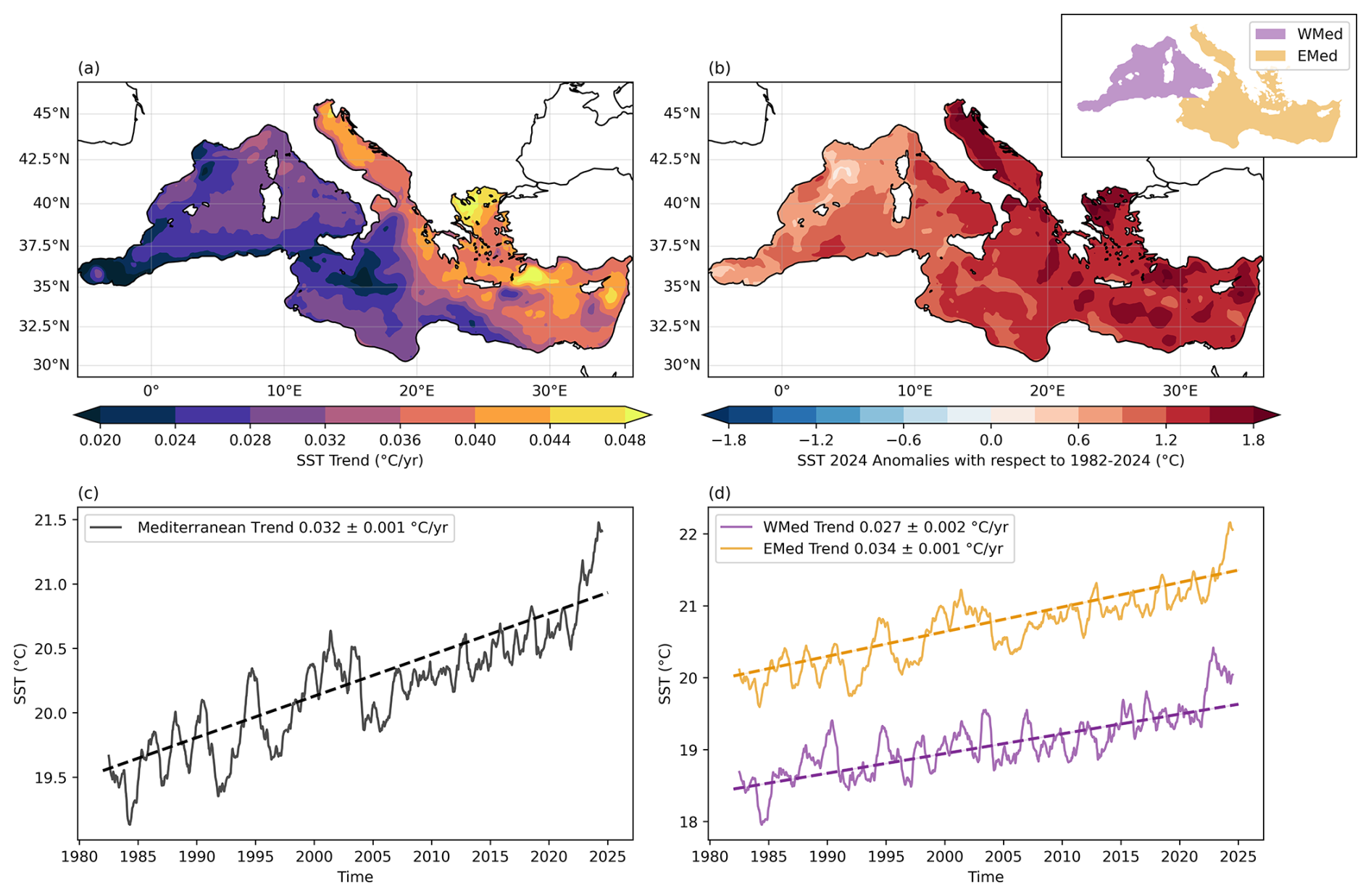
Figure 1(a) Map of the statistically significant SST trends in the Mediterranean Sea computed from 1982 to 2024 (p < 0.05) from reprocessed satellite observations (Table 1, prod. ref. 1). (b) Map of the SST anomalies in 2024 computed with respect to the mean values over the period 1982–2024. The inset shows the WMed and EMed regions defined for the analysis. (c) Time series of the spatially averaged SST in the Mediterranean and its trend from 1982 to 2024. (d) Time series of the spatially averaged SST in the WMed (solid purple line) and EMed (solid orange line), and their trends (dashed lines) from 1982 to 2024. The time series (c, d) have been smoothed using a 365 d moving average for clearer visual representation. All trends are statistically significant (p < 0.05).
The 2024 SST anomalies computed with respect to the mean values over the period 1982–2024 reach a spatial average of 1.23 °C (Fig. 1b), with maximum anomalies in the EMed exceeding 1.92 °C. When considering data only on the summer season (June–July–August), 2024 exhibits a mean anomaly of 1.63 °C, with maximums of 2.84 °C (not shown).
Regarding the time series of the averaged SST data for the whole basin, the smoothed temperatures from 2022 onwards fall above the trend line (Fig. 1c). When averaging the SST data in each sub-basin, the highest temperature is detected in 2022–2023 in the WMed and in 2024 in the EMed (Fig. 1d). The long-term warming trends differ between the two sub-basins: the WMed has a warming trend of 0.027 ± 0.002 °C yr−1, while the EMed has a higher trend of 0.034 ± 0.001 °C yr−1 (Fig. 1d). The SST trends obtained for the period 1982 to 2024 in both sub-basins are slightly lower than the trends of 0.032 ± 0.002 °C yr−1 (WMed) and 0.044 ± 0.002 °C yr−1 (EMed) reported from 1982 to 2020 by Juza et al. (2022), and the trends of 0.036 ± 0.006 °C yr−1 (WMed) and 0.048 ± 0.006 °C yr−1 (EMed) by Pisano et al. (2020), noting that these studies apply comparable but not identical definitions of the Western and Eastern Mediterranean sub-basins.
The difference between the SST trends computed here and those reported previously by other authors is likely introduced by an update of the SST product applied in June 2024; the version of the SST product that we use in this study is based on the ESA CCI SST v.3.0 (Pisano et al., 2024b). Methodological differences can also impact SST trends. Juza et al. (2022) derived their trends by fitting an ordinary least squares (OLS) regression on annual mean SST values, using Chelton (1983)'s effective-degrees-of-freedom approach to account for autocorrelation. In this study, we estimate SST trends at each grid point with the Theil–Sen slope estimator, which is more robust against outliers (Pisano et al., 2020). In addition, we first remove seasonality via harmonic decomposition rather than the X−11 procedure used by Pisano et al. (2020). We have conducted a sensitivity analysis of SST trends in the Balearic Sea (western Mediterranean), which reveals that the method used can slightly modify the SST trends, but a difference of the order of 0.010 °C yr−1 is only explained by the different versions of the SST product used. Similar sensitivities have been observed in satellite altimetry products, where updated versions yield different eddy kinetic energy trend estimates (Barceló-Llull et al., 2025). Using the NOAA OI SST V2.1, Ibrahim et al. (2021) found that the EMed (excluding the Adriatic) had a warming trend of 0.033 ± 0.004 °C yr−1 from 1982 to 2020, similar to the value reported in this work for the EMed from 1982–2024 (0.034 ± 0.001 °C yr−1). The authors also used Mann-Kendall test and SST with removed seasonality.
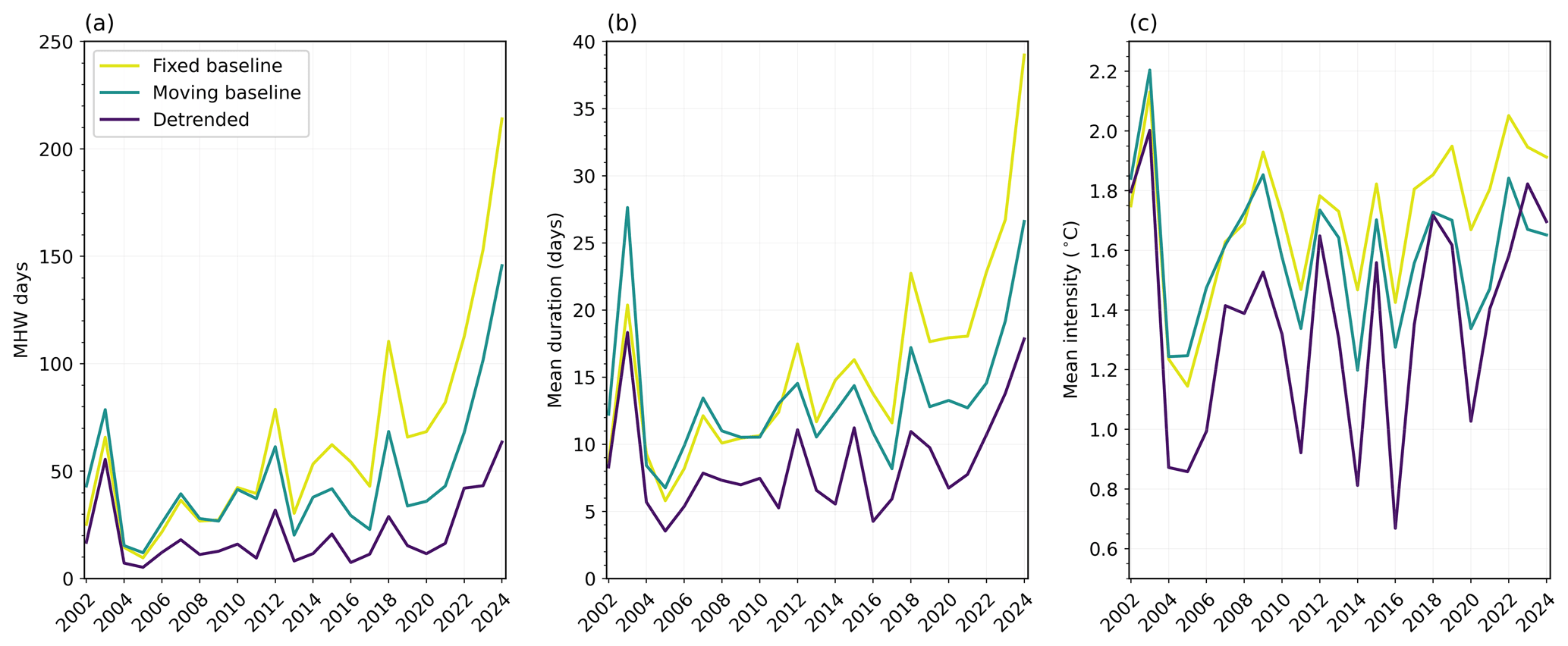
Figure 2Spatially averaged metrics of the MHWs detected in the Mediterranean Sea from 2002 to 2024 using three detection methods: fixed baseline, moving baseline and detrended data. (a) Annual total number of days under MHWs. (b) Annual mean duration of the MHW events. (c) Annual average of the mean intensity of MHW events.
When assessing MHWs across the entire Mediterranean, the detection method applied introduces differences in all metrics and in their interannual variability (Fig. 2). Using the fixed baseline, the Mediterranean has a temporal average of 62 MHW days per year over the common period 2002–2024, whereas applying the moving baseline yields an average of 46 d under MHW conditions. With the detrended method, the average is further reduced to 21 d under MHWs (Fig. 2a). The temporally averaged intensity and duration are also higher when using the fixed baseline, 1.71 °C and 15.6 d, than with the moving baseline, 1.60 °C and 13.5 d, and with the detrended data, 1.36 °C and 8.8 d (Fig. 2b, c).
When comparing across all the years, with the fixed baseline, most years that exceed the mean MHW days are clustered in the past decade, revealing how a fixed baseline amplifies the appearance of recent MHWs. Moreover, since the year 2011, towards the end of the reference period, MHW days show an increasing tendency, especially intensifying in the last few years (Fig. 2a). This tendency can also be observed to a lesser extent with the moving baseline and is reduced but still present with the detrended method, suggesting this increase might be due to a mechanism other than just the increase in mean warming (Fig. 2a). For the mean duration and mean intensity of MHWs, we observe a similar pattern to the MHWs days (Fig. 2b, c).
In 2024, the Mediterranean Sea experienced record high MHWs, recording more MHW days than any other year in the past two decades, regardless of the baseline definition applied (fixed, moving or detrended). Using the fixed baseline, the Mediterranean in 2024 reached 214 MHW days, surpassing the previous record of 153 d in 2023 (Fig. 2a). With a moving baseline, 2024 had MHWs over a total of 145 d, and with the detrended data over 63 d (Fig. 2a).
When considering the mean MHW duration, 2024 also set a record under the fixed baseline, with an average duration of 39.0 d. With the moving and detrended baselines, 2024 had mean durations of 26.6 and 17.8 d, respectively, only surpassed by the longest events occurred in 2003 (Fig. 2b). In terms of mean intensity, the MHWs of 2024 were above the basin average, but less intense than previous major events, such as those in 2003, 2019, 2022, or 2023 (Fig. 2c).
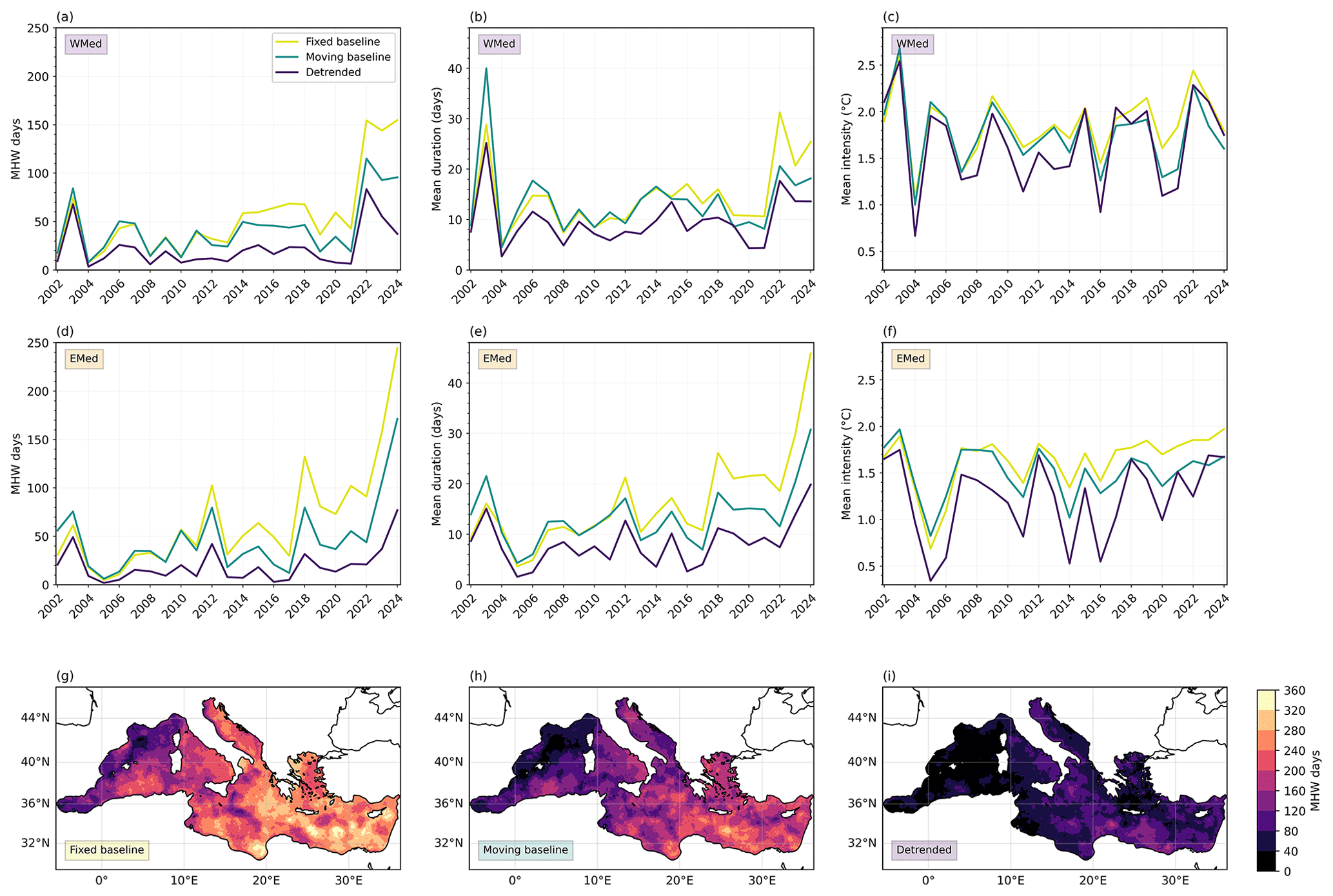
Figure 3(a–f) Spatially averaged metrics of the MHWs detected in the WMed (a–c) and EMed (d–e) from 2002 to 2024 using three detection methods: fixed baseline, moving baseline and detrended data. (a, d) Annual total number of days under MHWs. (b, e) Annual mean duration of the MHW events. (c, f) Annual average of the mean intensity of MHW events. (g–i) Maps of the total number of days with MHWs (MHW days) in 2024 detected using a fixed baseline (g), moving baseline (h) and detrended data (i).
When averaged over 2002–2024, the fixed-baseline method yields higher mean MHW days and longer mean durations in the EMed than in the WMed, 66 d versus 56 d on average, and 16.2 d versus 13.6 d of mean event duration, respectively. By contrast, when using detrended data, WMed records both more MHW days and longer durations than EMed, 22 MHW days and a mean duration of 9.6 d for the WMed, while 20 d of MHWs and a mean duration of 8.2 d for the EMed. Under the moving baseline, similarly to the fixed baseline, EMed has the most MHW days (47 versus 43 d), while WMed exhibits the longer mean duration out of the two subbasins (13.6 versus 13.5 d) (Fig. 3a–b, d–e).
In both the WMed and EMed, most years with above-average MHW days occur in the latter half of the record; however, this behaviour is more pronounced in the EMed. Which reflects, at least in part, the region's stronger long-term warming trend rather than purely interannual variability. Long-term warming of the sea has been pointed out as the main driver for MHW at global scales (Frölicher et al., 2018; Marcos et al., 2025), and in the Mediterranean Sea studies by Simon et al. (2023), Martínez et al. (2023), Pastor and Khodayar (2023), and Denaxa et al. (2025) confirm this. In particular, Denaxa et al. (2025) show that, across most of the Mediterranean (both EMed and WMed), trends in MHW duration and MHW days are mainly driven by the long-term trend. MHW mean intensity, however, exhibits a different behaviour: it is generally dominated by interannual variability, except in the easternmost part of the EMed and in the western part of the WMed (Denaxa et al., 2025).
Across all three detection methods, mean MHW intensities in the WMed exceed those in the EMed (Fig. 3c, f), in agreement with Hamdeno and Alvera-Azcaráte (2023) and Simon et al. (2023). The only exceptions occur in 2007, 2012, and 2024, when EMed anomalies briefly surpassed those of the WMed.
In the WMed, 2024 featured an exceptional number of MHW days (a total of 155, 96 and 37 d, for fixed, moving and detrended, respectively). Considering only the fixed baseline, 2024 was the year with the most MHW days since 2002; however, using the moving baseline, its total was surpassed only by 2022, and with detrended data by 2003, 2022, and 2023 (Fig. 3a). Mean event duration in 2024 remained below those of 2003 and 2022 across all methods (Fig. 3b), and mean intensities were similarly lower (Fig. 3c). Consequently, MHWs in 2003 remain the most intense events of the last two decades in the WMed (Juza et al., 2024; McAdam et al., 2024; Pirro et al., 2024) and surrounding areas (Castrillo-Acuña et al., 2024).
By contrast, EMed in 2024 recorded its highest number of MHW days in the study period, with 244 d (fixed), 170 d (moving), and 77 d (detrended) (Fig. 3d), with areas that locally reached up to 350 d of MHWs with the fixed baseline (Fig. 3g). It also achieved the longest mean durations across all detection methods (Fig. 3e) and the highest mean intensity under the fixed baseline (Fig. 3f). The spatial distribution of areas with higher and lower numbers of MHW days obtained with the moving baseline method (Fig. 3h) is consistent with that derived using the fixed baseline (Fig. 3g), although the overall magnitude is reduced by approximately 40 d. In contrast, when using the detrended approach, MHWs are largely restricted to the EMed, particularly its southern part (Fig. 3i).
The MHWs detected in the EMed during 2024 were first reported by Androulidakis et al. (2024), who identified 2024 as a record-breaking year in the Aegean, Ionian and Cretan Seas, all part of the eastern Mediterranean, using a fixed monthly baseline constructed with data from 1982–2024. Their results indicate a small number of MHW events compared with other years, which relates the drift towards the “saturation” previously mentioned. As large portions of the year fall under MHW conditions, the number of distinct events decreases, while their duration and cumulative intensity increase. The authors attribute these long-lasting MHWs primarily to an increase in heat flux from the atmosphere to the ocean, combined with weakened restoration mechanisms. In particular, coastal upwelling in the eastern Aegean Sea and the inflow of cooler Black Sea water, which typically act to restore lower temperatures, were not sufficient to reestablish the climatological conditions.
Consistent with this interpretation, Napolitano et al. (2025) related the 2024 Mediterranean MHWs to reduced latent and sensible heat fluxes from the ocean to the atmosphere during the early part of the year, which led to a shallower mixed layer, concentrating more heat near the surface. The reduction in both the sensitive and the latent heat fluxes is associated with decreased winds (Napolitano et al., 2025). In addition, 2024 experienced intense atmospheric heatwaves (AHWs) over Eastern Europe driven by a series of sustained high-pressure systems (atmospheric blocking) (Tolika et al., 2025). AHWs in the EMed have been shown to co-occur with MHWs (Aboelkhair et al., 2023). At the basin scale, Paredes-Fortuny et al. (2025) describe how concurrent AHW–MHW events interact. During these concurrent events, AHWs intensify MHWs by inhibiting the latent heat flux from the sea to the air, effectively trapping heat in the upper ocean. Moreover, the wind and the cloud cover decrease, allowing more shortwave radiation to reach the surface of the ocean, further enhancing upper-ocean stratification.
These mechanisms are consistent with the findings of Bonino et al. (2025), who detected that MHWs in the Mediterranean are often triggered by the persistence of atmospheric anticyclonic systems that travel from subtropical latitudes. Although the authors do not explicitly analyse AHWs, the atmospheric configurations they describe are similar to those associated with AHW development by Paredes-Fortuny et al. (2025), with both studies reporting reduced latent heat fluxes and enhanced shortwave radiation.
The difference between the three MHW detection methods used in this study lies in the choice of the baseline used to compute the statistics that define a MHW. This issue has been widely discussed in recent literature (e.g. Amaya et al., 2023; Rosselló et al., 2023; Smith et al., 2025a; Fernández-Álvarez et al., 2025), which reflects the absence of a single, universally optimal approach. Several methodological choices, including the baseline definition, the percentile used to set the threshold, the minimum event duration, or the minimum spatial extent, can substantially influence the detected magnitude of MHWs metrics (Hayward et al., 2025).
The fixed baseline MHWs are strongly influenced by the long-term warming signal, which is particularly pronounced in the Mediterranean, as shown here. For this reason, the fixed baseline turns out to be of limited usefulness for interpreting present-day MHWs in the Mediterranean. The other two approaches attempt to mitigate this effect. The moving baseline method updates the reference climatology over time, enabling the identification of MHWs relative to contemporaneous background conditions. This approach has also been proposed for ecological studies to better reflect the thermal conditions to which a species or ecosystem is exposed and may progressively adapt (Amaya et al., 2023), rather than referencing a fixed historical climate. While conceptually appealing, the practical application of a threshold for each case is challenging, as it requires detailed, species- or ecosystem-specific information on thermal tolerances, acclimation rates, and exposure, which is rarely available at basin scales. Therefore, the use of a moving baseline represents a compromise that can partially account for acclimatisation while remaining applicable at larger spatial scales. In addition, this method is sensitive to the choice of baseline length: if the window is too long, some effects of long-term warming remain; if it is too short, the resulting statistics may be less robust. Here we employ a 20-year baseline following Rosselló et al. (2023), who did a comparison between both 20- and 30-year moving baselines in the Mediterranean and found that the longer baseline yields a slightly higher number of detected MHW days.
The detrended approach removes the long-term warming. This method relies on assumptions about the shape of the long-term trend, assumed linear in our case, which may not always adequately represent the actual evolution of warming. Moreover, the long-term warming signal is not necessarily uniform throughout the year, which complicates the interpretation of linearly detrended SST. Changes may also occur in the seasonal cycle itself, and not only in the mean temperature. Denaxa et al. (2025) found that while some parts of the Mediterranean exhibit no significant change in the seasonal variability (defined as the amplitude of the annual temperature cycle) the northern WMed shows increased variability, whereas the southern WMed and the eastern EMed have reduced their variability over the last four decades. Such changes imply that detrending may not fully isolate the climate-change signal, as modifications in seasonal amplitude can still influence whether temperatures exceed MHW thresholds. This has implications for attributing detected MHW trends either to long-term mean warming or to interannual variability; in particular, the authors showed that the spatial distribution of trends in seasonal amplitude is closely related to patterns in mean MHW intensity.
The aim of detrending is usually to isolate the climate-change signal from natural variability. However, removing only the linear or quadratic trend may result in part of the climate-change signal being retained (for example, through changes in seasonal variability), or in the removal of low-frequency natural variability. In addition, the detrended approach is inherently sensitive to the estimated long-term trend. Because this trend is inferred from the available time series, its magnitude and structure may evolve as additional years are included, potentially leading to differences in MHW detection for the same event when the record is extended. In practice, we note that this sensitivity is stronger to the SST product version than to the specific length of the analysed period.
We analysed the SST trends in the Mediterranean Sea from 1982 to 2024 and assessed MHW characteristics in 2024 relative to events of the last two decades (2002–2024). To detect MHWs we used three detection methods: a fixed baseline (1982–2011), a 20-year moving baseline and detrended SST data. The SST trend analysis reveals a statistically significant warming signal across the Mediterranean Sea, averaging 0.032 ± 0.001 °C yr−1, and a 2024 annual mean SST anomaly of 1.23 °C with respect to the mean temperature from 1982–2024. When assessing MHWs in the Mediterranean, in average 2024 recorded more MHW days than any other year of the past two decades, regardless of whether a fixed, moving, or detrended baseline was used. In the WMed, although 2024 featured an exceptional number of MHW days, neither the total days nor the mean duration or intensities surpassed those of 2003, 2022 and 2023, especially with the moving baseline and the detrended data, methods that reduce the influence of long-term warming on MHW detection. By contrast, the EMed in 2024 presented the maximum records for both MHW days and mean duration across all methods, and also the highest mean intensities in the case of the fixed baseline.
In practice, two complementary strategies can guide MHW detection. For large-scale assessment, long-term monitoring, or comparative studies, an ensemble perspective that combines results across multiple definitions can provide robust metrics and illustrate sensitivity to threshold choice. While the fixed baseline method is generally not highly informative on its own, it can provide complementary information when included in an ensemble perspective. On the other hand, for targeted analyses focused on specific locations or species (e.g. ecosystems with temperature-sensitive species), adopting a particular, context-specific approach (e.g. defining the thresholds according to the thermal tolerance of said species) ensures that MHW detection aligns with the processes and impacts most relevant to the study (Smith et al., 2025a; Farchadi et al., 2025). Regardless of the chosen strategy, it is critical to explicitly state the baseline used, as this decision affects comparability and interpretation across studies.
The data used to conduct this study is listed in Table 1 and is publicly available at the Copernicus Marine Service (CMEMS) website via https://doi.org/10.48670/moi-00173 (EU Copernicus Marine Service Product, 2024). The processing and analysis scripts used in this study are publicly available at https://doi.org/10.5281/zenodo.19567880 (Fernández-Álvarez, 2026).
All of the authors conceptualized the study. BFÁ performed the data analysis and wrote the first draft. All of the authors contributed to discussion of the results and the preparation of the final draft.
The contact author has declared that none of the authors has any competing interests.
The Copernicus Marine Service offering is regularly updated to ensure it remains at the forefront of user requirements. In this process, some products may undergo replacement or renaming, leading to the removal of certain product IDs from the catalogue. If readers have any questions or require assistance regarding these modifications, please feel free to reach out to the Copernicus Marine Service user support team for further guidance. They will be able to provide the necessary information to address concerns and find suitable alternatives.
Publisher's note: Copernicus Publications remains neutral with regard to jurisdictional claims made in the text, published maps, institutional affiliations, or any other geographical representation in this paper. The authors bear the ultimate responsibility for providing appropriate place names. Views expressed in the text are those of the authors and do not necessarily reflect the views of the publisher.
We would like to thank the two anonymous reviewers for their constructive feedback, which helped improve and shape this work. The present research was carried out within the framework of the activities of the Spanish Government through the “María de Maeztu Centre of Excellence” accreditation to IMEDEA (CSIC-UIB) (grant no. CEX2021-001198). This publication contributes to grant RED2024-154139-E, ALIANZA OBSERVA: Strategic Network for Earth Observation by Satellite, funded by MICIU/AEI/10.13039/501100011033/.
ObsSea4Clim “Ocean observations and indicators for climate and assessments” is funded by the European Union, Horizon Europe Funding Programme for Research and Innovation under grant agreement number: 101136548. ObsSea4Clim contribution no. 50. B.F.-Á. received support through an FPU grant from the Spanish Ministry of Science, Innovation and Universities (grant no. FPU23/01280). B.B.-L. is funded by the Balearic Government Vicenç Mut programme (grant no. PD/008/2022). A.P. acknowledges the FaSt-SWOT project (reference PID2021-122417NB-I00/MCIN/AEI/10.13039/501100011033/FUE).
This paper was edited by Pierre Brasseur and reviewed by two anonymous referees.
Aboelkhair, H., Mohamed, B., Morsy, M., and Nagy, H.: Co-Occurrence of Atmospheric and Oceanic Heatwaves in the Eastern Mediterranean over the Last Four Decades, Remote Sens., 15, 1841, https://doi.org/10.3390/rs15071841, 2023.
Amaya, D. J., Jacox, M. G., Fewings, M. R., Saba, V. S., Stuecker, M. F., Rykaczewski, R. R., Ross, A. C., Stock, C. A., Capotondi, A., Petrik, C. M., Bograd, S. J., Alexander, M. A., Cheng, W., Hermann, A. J., Kearney, K. A., and Powell, B. S.: Marine heatwaves need clear definitions so coastal communities can adapt, Nature, 616, 29–32, https://doi.org/10.1038/d41586-023-00924-2, 2023.
Androulidakis, Y., Kolovoyiannis, V., Makris, C., and Krestenitis, Y.: Evidence of 2024 Summer as the Warmest During the Last Four Decades in the Aegean, Ionian, and Cretan Seas, Journal of Marine Science and Engineering, 12, 2020, https://doi.org/10.3390/jmse12112020, 2024.
Barceló-Llull, B., Rosselló, P., Combes, V., Sánchez-Román, A., Pujol, M. I., and Pascual, A.: Kuroshio Extension and Gulf Stream dominate the Eddy Kinetic Energy intensification observed in the global ocean, Sci. Rep., 15, 21754, https://doi.org/10.1038/s41598-025-06149-9, 2025.
Beyraghdar Kashkooli, O., Mohit Isfahani, P., and Modarres, R.: Revisiting marine heatwaves baselines in warming oceans under nonstationary condition, Sci. Total Environ., 958, 178194, https://doi.org/10.1016/j.scitotenv.2024.178194, 2025.
Bian, C., Jing, Z., Wang, H., and Wu, L.: Scale-Dependent Drivers of Marine Heatwaves Globally, Geophys. Res. Lett., 51, e2023GL107306, https://doi.org/10.1029/2023GL107306, 2024.
Bonino, G., McAdam, R., Athanasiadis, P., Cavicchia, L., Rodrigues, R. R., Scoccimarro, E., Tibaldi, S., and Masina, S.: Mediterranean summer marine heatwaves triggered by weaker winds under subtropical ridges, Nat. Geosci., 18, 848–853, https://doi.org/10.1038/s41561-025-01762-9, 2025.
Capotondi, A., Rodrigues, R. R., Sen Gupta, A., Benthuysen, J. A., Deser, C., Frölicher, T. L., Lovenduski, N. S., Amaya, D. J., Le Grix, N., Xu, T., Hermes, J., Holbrook, N. J., Martinez-Villalobos, C., Masina, S., Roxy, M. K., Schaeffer, A., Schlegel, R. W., Smith, K. E., and Wang, C.: A global overview of marine heatwaves in a changing climate, Commun. Earth Environ., 5, 701, https://doi.org/10.1038/s43247-024-01806-9, 2024.
Castrillo-Acuña, L., Alonso-Valle, A., and de Pascual-Collar, Á.: Characterization of marine heat waves in the Iberia–Biscay–Ireland (IBI) region in 2022, in: 8th edition of the Copernicus Ocean State Report (OSR8), edited by: von Schuckmann, K., Moreira, L., Grégoire, M., Marcos, M., Staneva, J., Brasseur, P., Garric, G., Lionello, P., Karstensen, J., and Neukermans, G., Copernicus Publications, State Planet, 4-osr8, 17, https://doi.org/10.5194/sp-4-osr8-17-2024, 2024.
Chelton, D. B.: Effects of sampling errors in statistical estimation, Deep-Sea Res. Pt. A, 30, 1083–1103, https://doi.org/10.1016/0198-0149(83)90062-6, 1983.
Darmaraki, S., Denaxa, D., Theodorou, I., Livanou, E., Rigatou, D., Raitsos E., D., Stavrakidis-Zachou, O., Dimarchopoulou, D., Bonino, G., McAdam, R., Organelli, E., Pitsouni, A., and Parasyris, A.: Marine Heatwaves in the Mediterranean Sea: A Literature Review, Mediterr. Mar. Sci., 25, 586–620, https://doi.org/10.12681/mms.38392, 2024.
Denaxa, D., Korres, G., Darmaraki, S., and Hatzaki, M.: Insights into sea surface temperature variability and the impact of long-term warming on marine heatwaves in the Mediterranean Sea, in: 9th edition of the Copernicus Ocean State Report (OSR9), edited by: von Schuckmann, K., Moreira, L., de Pascual Collar, Á., Grégoire, M., Brasseur, P., Garric, G., Karstensen, J., Lionello, P., Marcos, M., Poulain, P.-M., and Staneva, J., Copernicus Publications, State Planet, 6-osr9, 10, https://doi.org/10.5194/sp-6-osr9-10-2025, 2025.
EU Copernicus Marine Service Product: Mediterranean Sea – High Resolution L4 Sea Surface Temperature Reprocessed, Mercator Ocean International [data set], https://doi.org/10.48670/moi-00173, 2024.
Farchadi, N., McDonnell, L. H., Ryan, S., Lewison, R. L., and Braun, C. D.: Marine heatwaves are in the eye of the beholder, Nat. Clim. Chang., 15, 236–239, https://doi.org/10.1038/s41558-025-02257-6, 2025.
Fernández-Álvarez, B.: Code for “Mediterranean Sea Warming and Marine Heatwaves in 2024” (v1.0), Zenodo [code], https://doi.org/10.5281/zenodo.19567880, 2026.
Fernández-Álvarez, B., Barceló-Llull, B., and Pascual, A.: Tracking marine heatwaves in the Balearic Sea: temperature trends and the role of detection methods, Ocean Sci., 21, 1987–1999, https://doi.org/10.5194/os-21-1987-2025, 2025.
Frölicher, T. L., Fischer, E. M., and Gruber, N.: Marine heatwaves under global warming, Nature, 560, 360–364, https://doi.org/10.1038/s41586-018-0383-9, 2018.
Garrabou, J., Gómez-Gras, D., Medrano, A., Cerrano, C., Ponti, M., Schlegel, R., Bensoussan, N., Turicchia, E., Sini, M., Gerovasileiou, V., Teixido, N., Mirasole, A., Tamburello, L., Cebrian, E., Rilov, G., Ledoux, J., Souissi, J. B., Khamassi, F., Ghanem, R., Benabdi, M., Grimes, S., Ocaña, O., Bazairi, H., Hereu, B., Linares, C., Kersting, D. K., La Rovira, G., Ortega, J., Casals, D., Pagès-Escolà, M., Margarit, N., Capdevila, P., Verdura, J., Ramos, A., Izquierdo, A., Barbera, C., Rubio-Portillo, E., Anton, I., López-Sendino, P., Díaz, D., Vázquez-Luis, M., Duarte, C., Marbà, N., Aspillaga, E., Espinosa, F., Grech, D., Guala, I., Azzurro, E., Farina, S., Cristina Gambi, M., Chimienti, G., Montefalcone, M., Azzola, A., Mantas, T. P., Fraschetti, S., Ceccherelli, G., Kipson, S., Bakran-Petricioli, T., Petricioli, D., Jimenez, C., Katsanevakis, S., Kizilkaya, I. T., Kizilkaya, Z., Sartoretto, S., Elodie, R., Ruitton, S., Comeau, S., Gattuso, J., and Harmelin, J.: Marine heatwaves drive recurrent mass mortalities in the Mediterranean Sea, Glob. Change Biol., 28, 5708–5725, https://doi.org/10.1111/gcb.16301, 2022.
Hamdeno, M. and Alvera-Azcaráte, A.: Marine heatwaves characteristics in the Mediterranean Sea: Case study the 2019 heatwave events, Front. Mar. Sci., 10, 1093760, https://doi.org/10.3389/fmars.2023.1093760, 2023.
Hayward, A., Dasgupta, N., McAdam, R., Payne, M. R., Raj, R. P., Bonino, G., Chatterjee, S., Combes, V., Denaxa, D., De Rovere, F., Englyst, P., Haapaniemi, V., Hargous, P., Høyer, J., Joseph, K. A., Lopes, B., Oliveira, A., Paixão, J., Silva, F., Surendran, S., Zegna-Rata, A., and Olsen, S.: Marine Heat waves – Multiple Analysis / Definitions (MHW-MAD): A Multi-Definition Global Marine Heatwave Dataset from Satellite Sea Surface Temperature data, Earth Syst. Sci. Data Discuss. [preprint], https://doi.org/10.5194/essd-2025-590, in review, 2025.
Hobday, A. J., Alexander, L. V., Perkins, S. E., Smale, D. A., Straub, S. C., Oliver, E. C. J., Benthuysen, J. A., Burrows, M. T., Donat, M. G., Feng, M., Holbrook, N. J., Moore, P. J., Scannell, H. A., Sen Gupta, A., and Wernberg, T.: A hierarchical approach to defining marine heatwaves, Prog. Oceanogr., 141, 227–238, https://doi.org/10.1016/j.pocean.2015.12.014, 2016.
Holbrook, N. J., Scannell, H. A., Sen Gupta, A., Benthuysen, J. A., Feng, M., Oliver, E. C. J., Alexander, L. V., Burrows, M. T., Donat, M. G., Hobday, A. J., Moore, P. J., Perkins-Kirkpatrick, S. E., Smale, D. A., Straub, S. C., and Wernberg, T.: A global assessment of marine heatwaves and their drivers, Nat. Commun., 10, 2624, https://doi.org/10.1038/s41467-019-10206-z, 2019.
Ibrahim, O., Mohamed, B., and Nagy, H.: Spatial Variability and Trends of Marine Heat Waves in the Eastern Mediterranean Sea over 39 Years, Journal of Marine Science and Engineering, 9, 643, https://doi.org/10.3390/jmse9060643, 2021.
Juza, M., Fernández-Mora, À., and Tintoré, J.: Sub-Regional Marine Heat Waves in the Mediterranean Sea From Observations: Long-Term Surface Changes, Sub-Surface and Coastal Responses, Front. Mar. Sci., 9, https://doi.org/10.3389/fmars.2022.785771, 2022.
Juza, M., de Alfonso, M., and Fernández-Mora, Á.: Coastal ocean response during the unprecedented marine heatwaves in the western Mediterranean in 2022, in: 8th edition of the Copernicus Ocean State Report (OSR8), edited by: von Schuckmann, K., Moreira, L., Grégoire, M., Marcos, M., Staneva, J., Brasseur, P., Garric, G., Lionello, P., Karstensen, J., and Neukermans, G., Copernicus Publications, State Planet, 4-osr8, 14, https://doi.org/10.5194/sp-4-osr8-14-2024, 2024.
Marcos, M., Amores, A., Agulles, M., Robson, J., and Feng, X.: Global warming drives a threefold increase in persistence and 1 °C rise in intensity of marine heatwaves, P. Natl. Acad. Sci. USA, 122, e2413505122, https://doi.org/10.1073/pnas.2413505122, 2025.
Martínez, J., Leonelli, F. E., García-Ladona, E., Garrabou, J., Kersting, D. K., Bensoussan, N., and Pisano, A.: Evolution of marine heatwaves in warming seas: the Mediterranean Sea case study, Front. Mar. Sci., 10, 1193164, https://doi.org/10.3389/fmars.2023.1193164, 2023.
McAdam, R., Bonino, G., Clementi, E., and Masina, S.: Forecasting the Mediterranean Sea marine heatwave of summer 2022, in: 8th edition of the Copernicus Ocean State Report (OSR8), edited by: von Schuckmann, K., Moreira, L., Grégoire, M., Marcos, M., Staneva, J., Brasseur, P., Garric, G., Lionello, P., Karstensen, J., and Neukermans, G., Copernicus Publications, State Planet, 4-osr8, 13, https://doi.org/10.5194/sp-4-osr8-13-2024, 2024.
Napolitano, E., Carillo, A., Iacono, R., Struglia, M. V., dell'Aquila, A., Palma, M., Marullo, S., De Sabata, E., Bordone, A., and Borzelli, G. E.: Unprecedented Mediterranean Sea warming in 2024: analysis of the driving mechanisms, Front. Mar. Sci., 12, https://doi.org/10.3389/fmars.2025.1668204, 2025.
Oliver, E. C. J., Donat, M. G., Burrows, M. T., Moore, P. J., Smale, D. A., Alexander, L. V., Benthuysen, J. A., Feng, M., Sen Gupta, A., Hobday, A. J., Holbrook, N. J., Perkins-Kirkpatrick, S. E., Scannell, H. A., Straub, S. C., and Wernberg, T.: Longer and more frequent marine heatwaves over the past century, Nat. Commun., 9, 1324, https://doi.org/10.1038/s41467-018-03732-9, 2018.
Oliver, E. C. J., Benthuysen, J. A., Darmaraki, S., Donat, M. G., Hobday, A. J., Holbrook, N. J., Schlegel, R. W., and Sen Gupta, A.: Marine Heatwaves, Annu. Rev. Mar. Sci., 13, 313–342, https://doi.org/10.1146/annurev-marine-032720-095144, 2021.
Pastor, F. and Khodayar, S.: Marine heat waves: Characterizing a major climate impact in the Mediterranean, Sci. Total Environ., 861, 160621, https://doi.org/10.1016/j.scitotenv.2022.160621, 2023.
Pastor, F., Valiente, J. A., and Khodayar, S.: A Warming Mediterranean: 38 Years of Increasing Sea Surface Temperature, Remote Sens., 12, 2687, https://doi.org/10.3390/rs12172687, 2020.
Paredes-Fortuny, L., Pastor, F., and Khodayar, S.: Concurrent atmospheric heatwaves intensify marine heatwaves through air-sea heat flux change in the Mediterranean Sea, Commun. Earth Environ., 6, 638, https://doi.org/10.1038/s43247-025-02633-2, 2025.
Pirro, A., Martellucci, R., Gallo, A., Kubin, E., Mauri, E., Juza, M., Notarstefano, G., Pacciaroni, M., Bussani, A., and Menna, M.: Subsurface warming derived from Argo floats during the 2022 Mediterranean marine heat wave, in: 8th edition of the Copernicus Ocean State Report (OSR8), edited by: von Schuckmann, K., Moreira, L., Grégoire, M., Marcos, M., Staneva, J., Brasseur, P., Garric, G., Lionello, P., Karstensen, J., and Neukermans, G., Copernicus Publications, State Planet, 4-osr8, 18, https://doi.org/10.5194/sp-4-osr8-18-2024, 2024.
Pisano, A., Marullo, S., Artale, V., Falcini, F., Yang, C., Leonelli, F. E., Santoleri, R., and Buongiorno Nardelli, B.: New Evidence of Mediterranean Climate Change and Variability from Sea Surface Temperature Observations, Remote Sens., 12, 132, https://doi.org/10.3390/rs12010132, 2020.
Pisano, A., Fanelli, C., Massi, A., Tronconi, C., Cesarini, C., La Padula, F., Buongiorno Nardelli, B., and Ciani, D.: EU Copernicus Marine Service Product User Manual for the Mediterranean Sea – High Resolution L4 Sea Surface Temperature Reprocessed, SST_MED_SST_L4_REP_OBSERVATIONS_010_021, Issue 4.0, Mercator Ocean International, https://documentation.marine.copernicus.eu/PUM/CMEMS-SST-PUM-010-021-022-041-042.pdf (last access: 10 July 2025), 2024a.
Pisano, A., Fanelli, C., Massi, A., Tronconi, C., Cesarini, C., La Padula, F., Buongiorno Nardelli, B., and Ciani, D.: EU Copernicus Marine Service Quality Information Document for the Mediterranean Sea – High Resolution L4 Sea Surface Temperature Reprocessed, SST_MED_SST_L4_REP_OBSERVATIONS_010_021, Issue 4.0, Mercator Ocean International, https://documentation.marine.copernicus.eu/QUID/CMEMS-SST-QUID-010-021-022-041-042.pdf (last access: 10 July 2025), 2024b.
Rosselló, P., Pascual, A., and Combes, V.: Assessing marine heat waves in the Mediterranean Sea: a comparison of fixed and moving baseline methods, Front. Mar. Sci., 10, 1168368, https://doi.org/10.3389/fmars.2023.1168368, 2023.
Simon, A., Pires, C., Frölicher, T. L., and Russo, A.: Long-term warming and interannual variability contributions' to marine heatwaves in the Mediterranean, Weather and Climate Extremes, 42, 100619, https://doi.org/10.1016/j.wace.2023.100619, 2023.
Smith, K. E., Burrows, M. T., Hobday, A. J., Sen Gupta, A., Moore, P. J., Thomsen, M., Wernberg, T., and Smale, D. A.: Socioeconomic impacts of marine heatwaves: Global issues and opportunities, Science, 374, eabj3593, https://doi.org/10.1126/science.abj3593, 2021.
Smith, K. E., Burrows, M. T., Hobday, A. J., King, N. G., Moore, P. J., Sen Gupta, A., Thomsen, M. S., Wernberg, T., and Smale, D. A.: Biological Impacts of Marine Heatwaves, Annu. Rev. Mar. Sci., 15, 119–145, https://doi.org/10.1146/annurev-marine-032122-121437, 2023.
Smith, K. E., Sen Gupta, A., Amaya, D., Benthuysen, J. A., Burrows, M. T., Capotondi, A., Filbee-Dexter, K., Frölicher, T. L., Hobday, A. J., Holbrook, N. J., Malan, N., Moore, P. J., Oliver, E. C. J., Richaud, B., Salcedo-Castro, J., Smale, D. A., Thomsen, M., and Wernberg, T.: Baseline matters: Challenges and implications of different marine heatwave baselines, Prog. Oceanogr., 231, 103404, https://doi.org/10.1016/j.pocean.2024.103404, 2025a.
Smith, K. E., Sen Gupta, A., Burrows, M. T., Filbee-Dexter, K., Hobday, A. J., Holbrook, N. J., Malan, N., Moore, P. J., Oliver, E. C. J., Thomsen, M. S., Wernberg, T., Zhao, Z., and Smale, D. A.: Ocean extremes as a stress test for marine ecosystems and society, Nat. Clim. Chang., 15, 231–235, https://doi.org/10.1038/s41558-025-02269-2, 2025b.
Tolika, K., Manios, E. M., Zachos, A. P., Velikou, K., and Anagnostopoulou, C.: Can we predict the extreme? Assessing the skill of seasonal forecasts in capturing the 2024 European heatwave, Environ. Res. Lett., 20, 124050, https://doi.org/10.1088/1748-9326/ae21f7, 2025.
Wernberg, T., Thomsen, M. S., Burrows, M. T., Filbee-Dexter, K., Hobday, A. J., Holbrook, N. J., Montie, S., Moore, P. J., Oliver, E. C. J., Sen Gupta, A., Smale, D. A., and Smith, K.: Marine heatwaves as hot spots of climate change and impacts on biodiversity and ecosystem services, Nat. Rev. Biodivers., 1, 461–479, https://doi.org/10.1038/s44358-025-00058-5, 2025.
Yue, S. and Wang, C.: The Mann-Kendall Test Modified by Effective Sample Size to Detect Trend in Serially Correlated Hydrological Series, Water Resour. Manage., 18, 201–218, https://doi.org/10.1023/B:WARM.0000043140.61082.60, 2004.